Bench ist eine KI-gestützte Plattform, die Engineering-Workflows automatisiert. Sie integriert sich in Ihren bestehenden CAD-, CAE- und PLM-Toolstack und ermöglicht es Ingenieuren, komplexe Design-Workflows zu generieren und auszuführen, parallele Simulationen durchzuführen und Revisionen zu automatisieren, was letztendlich die Produktentwicklung und die Markteinführungszeit beschleunigt.

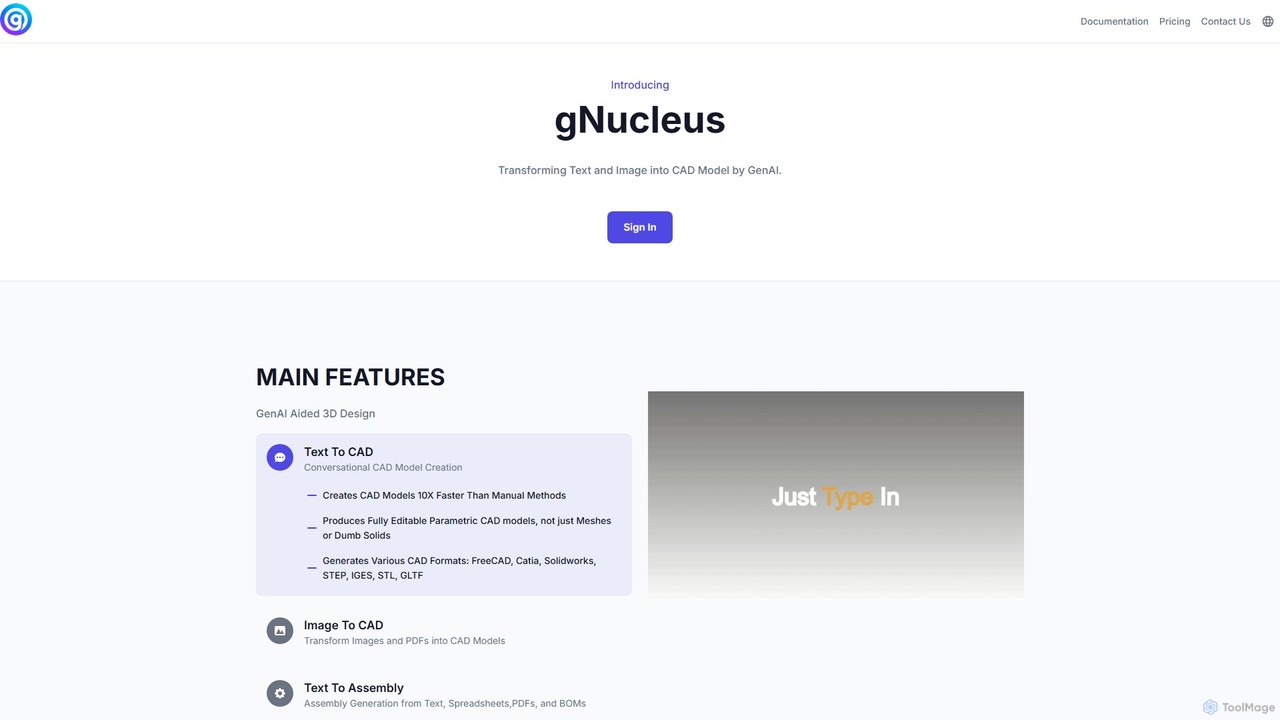
gNucleus ist eine generative KI-Plattform, die Text, Bilder und Daten in vollständig bearbeitbare, parametrische 3D-CAD-Modelle umwandelt. Entwickelt für Ingenieure und Designer, beschleunigt es den Designprozess um das bis zu 10-fache, unterstützt verschiedene CAD-Formate und eine nahtlose Integration in bestehende Arbeitsabläufe.
Produktübersicht
Bench Produktübersicht
Bench ist eine KI-gestützte Plattform, die Engineering-Workflows automatisiert. Sie integriert sich in Ihren bestehenden CAD-, CAE- und PLM-Toolstack und ermöglicht es Ingenieuren, komplexe Design-Workflows zu generieren und auszuführen, parallele Simulationen durchzuführen und Revisionen zu automatisieren, was letztendlich die Produktentwicklung und die Markteinführungszeit beschleunigt.

gNucleus Produktübersicht
gNucleus ist eine generative KI-Plattform, die Text, Bilder und Daten in vollständig bearbeitbare, parametrische 3D-CAD-Modelle umwandelt. Entwickelt für Ingenieure und Designer, beschleunigt es den Designprozess um das bis zu 10-fache, unterstützt verschiedene CAD-Formate und eine nahtlose Integration in bestehende Arbeitsabläufe.
Detailed feature comparison
| Feature | Bench | gNucleus |
|---|---|---|
| Hauptkategorie | 3D | 3D-Modellierung |
| Hinzugefügt | 2025-08-10 | 2025-08-03 |
| Preismodell | Kostenpflichtig | Freemium |
| Offizielle Website | getbench.ai | gnucleus.ai |
| Produkttyp | Website | Website |
| Performance data | ||
| Nutzerbewertung | Nicht verifiziert | Nicht verifiziert |
| Kommentare | 0 | 0 |
| Monatliche Besuche | 3.7K | 1K |
| Monatliches Wachstum | 21.3% | 1265.8% |
| Favoriten | 131 | 117 |
| Details | Details ansehen | Details ansehen |
Bench vs gNucleus monthly traffic
Compare Bench and gNucleus by monthly reach, traffic trend, visit depth, top regions, and acquisition sources.
How to interpret the traffic data
In the Bench vs gNucleus monthly traffic comparison, Bench currently shows 3.7K visits and gNucleus shows 1K; Bench has about 3.6 times the visible traffic of gNucleus, an absolute difference of about 2.7K visits. This reflects visible reach, not feature quality or paid users.
Both tools provide verified traffic details, so monthly trends, visit depth, regions, and acquisition sources can be compared on the same basis.
gNucleus is registered at the gnucleus.ai/zh subpage. Because the current data does not state whether other host pages are excluded, treat this as domain-level context rather than independent traffic for one product or project.
Bench monthly traffic:
Latest traffic
Monthly traffic trend
- 2025/9: 3.7K Monatliche Besuche
- 2026/1: 3.8K Monatliche Besuche
- 2026/2: 2.7K Monatliche Besuche
- 2026/3: 1.3K Monatliche Besuche
- 2026/4: 3K Monatliche Besuche
- 2026/5: 3.7K Monatliche Besuche
Top-Regionen
Top 5 countries/regions
| Country/region | Percentage | Traffic |
|---|---|---|
| 🇺🇸United States | 55.64% | 2.1K |
| 🇬🇧United Kingdom | 31.5% | 1.2K |
| 🇮🇳India | 12.86% | 475 |
Suchbegriffe
gNucleus monthly traffic:
Latest traffic
Monthly traffic trend
- 2026/2: 204 Monatliche Besuche
- 2026/3: 0 Monatliche Besuche
- 2026/4: 76 Monatliche Besuche
- 2026/5: 1K Monatliche Besuche
Top-Regionen
Top 5 countries/regions
| Country/region | Percentage | Traffic |
|---|---|---|
| 🇺🇸United States | 70.49% | 732 |
| 🇮🇳India | 29.51% | 306 |
Suchbegriffe
Usage comparison
Compare the core capabilities of Bench and gNucleus
Bench Core features
gNucleus Core features
Use cases
Bench Use cases
gNucleus Use cases
Bench vs gNucleus:In-depth comparison and selection guidance
First decide whether the products solve the same kind of need
This in-depth Bench vs gNucleus comparison uses only the product records, taxonomy, audience, traffic, and community signals available on this page. Bench is primarily listed under “3D”, while gNucleus is primarily listed under “3D-Modellierung”, so the first decision is whether your actual task matches their recorded scope.
The structured fields currently show these decision-relevant differences: Primary category (Bench: 3D; gNucleus: 3D-Modellierung); Pricing (Bench: Paid; gNucleus: Freemium); Monthly visits (Bench: 3.7K; gNucleus: 1K); Monthly growth (Bench: 21.3%; gNucleus: 1265.8%); Favorites (Bench: 131; gNucleus: 117). These facts are more useful for selection than brand visibility alone.
What market visibility and monthly traffic mean
In the Bench vs gNucleus monthly traffic comparison, Bench currently shows 3.7K visits and gNucleus shows 1K; Bench has about 3.6 times the visible traffic of gNucleus, an absolute difference of about 2.7K visits. This reflects visible reach, not feature quality or paid users.
Both tools provide verified traffic details, so monthly trends, visit depth, regions, and acquisition sources can be compared on the same basis.
gNucleus is registered at the gnucleus.ai/zh subpage. Because the current data does not state whether other host pages are excluded, treat this as domain-level context rather than independent traffic for one product or project.
If public market visibility is an important first-pass criterion, investigate Bench first. The final choice should still follow taxonomy, use case, and a real trial because higher traffic does not prove broader capabilities or better workflow fit.
Product positioning, use cases, and roles
Bench and gNucleus currently overlap in shared categories: Automatisierung; shared tags: Automatisierung, CAD und Ingenieurwesen. This can place both on the same shortlist, but it does not prove equal implementation, depth, or cost.
Bench's unique categories/tags are 3D, Ingenieurwesen, KI-Ingenieurwesen, CAE, Designoptimierung, Hardwareentwicklung, Onshape und PLM; gNucleus's are 3D-Modellierung, API, CAD, FreeCAD, Generative KI, Bild zu 3D, Industriedesign und Parametrische Modellierung. These unique fields are the strongest differentiators: validate the product whose recorded scope matches the task instead of following traffic alone.
What ratings, comments, and favorites can tell you
Bench has no verified rating, 0 comments, 131 favorites, and 124 likes;gNucleus has no verified rating, 0 comments, 117 favorites, and 121 likes。
Neither product has enough rating or comment samples for a credible reputation ranking.
Selection guidance by actual need
When to evaluate Bench first
Put Bench on the priority trial list when the task aligns with “3D” and especially 3D, Ingenieurwesen, KI-Ingenieurwesen, CAE, Designoptimierung und Hardwareentwicklung. This follows recorded positioning and does not imply unlisted capabilities are absent.
Bench also currently records: pricing is paid, product type is website, 3.7K verified monthly visits, no verified user rating. Verify any hard requirement around price, platform, or reach before trial, and do not let sparse review data substitute for testing.
When to evaluate gNucleus first
Put gNucleus on the priority trial list when the task aligns with “3D-Modellierung” and especially 3D-Modellierung, API, CAD, FreeCAD, Generative KI und Bild zu 3D. This follows recorded positioning and does not imply unlisted capabilities are absent.
gNucleus also currently records: pricing is freemium, product type is website, 1K monthly visits shown for the registered host (subpage scope unknown), no verified user rating. Verify any hard requirement around price, platform, or reach before trial, and do not let sparse review data substitute for testing.
How to validate the recommendation before deciding
The available data describes positioning, public visibility, and community signals, but it cannot prove output quality, speed, integration effort, privacy, or long-term cost in your workflow. Before deciding, run the same representative tasks in Bench and gNucleus, then record completion time, accuracy, manual corrections, and the real paid threshold. A like-for-like trial turns this comparison into a defensible adoption decision.