airportpianos
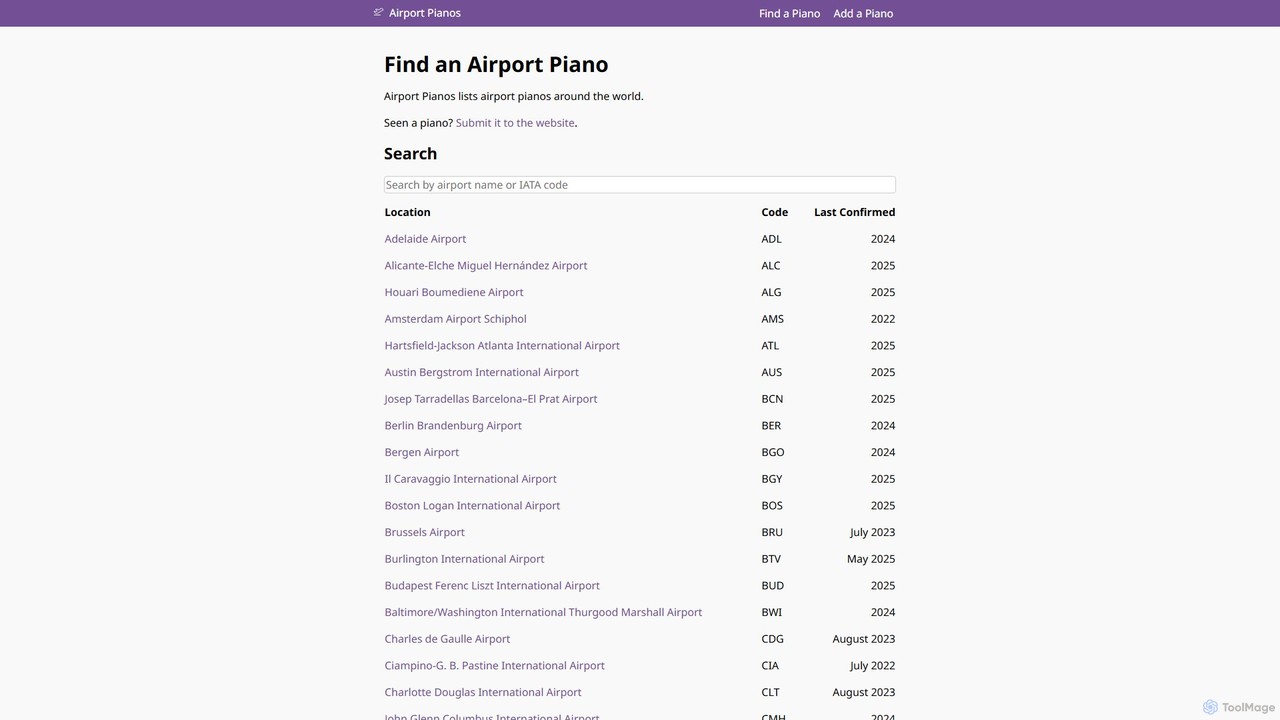
airportpianos is a free, community-driven online directory that helps travelers and musicians find public pianos in airports worldwide. …
airportpianos is a free, community-driven online directory that helps travelers and musicians find public pianos in airports worldwide. Search for pianos by airport, view their last confirmed locations, and contribute by submitting new sightings. It's a simple, valuable resource for making airport layovers more enjoyable.
About Public Databases
Public Databases are openly accessible collections of structured or unstructured data, often maintained by governments, research institutions, or non-profits. These vast repositories provide foundational raw data crucial for AI model training, research, and application development. Unlike proprietary datasets, public databases democratize access to information, enabling transparent analysis, validating hypotheses, and fostering innovation across various domains. They are essential for building robust AI systems and conducting large-scale data-driven studies.
Core Features
- Open Accessibility: Data is freely available via web interfaces, APIs, or bulk downloads, ensuring broad access.
- Diverse Data Types: Includes numerical, textual, geospatial, image, and scientific data, catering to varied research needs.
- Standardized Formats: Often provided in common formats like CSV, JSON, XML, or SQL dumps for easy integration.
- Regular Updates: Many databases are actively maintained and frequently updated with new information, ensuring data freshness.
- Comprehensive Metadata: Detailed documentation on data sources, fields, and collection methodologies enhances usability.
Applicable Scenarios
Public databases are invaluable for various data-driven initiatives. Researchers utilize them for scientific studies and validating hypotheses, while AI developers leverage them to train and benchmark machine learning models. Businesses can analyze public economic or demographic data for market research, identifying trends and informing strategic decisions. They also support data journalists in uncovering stories and policymakers in evidence-based decision-making.
How to Choose
When selecting a public database, consider its relevance to your project, ensuring the data aligns with your objectives. Evaluate data quality, accuracy, and the frequency of updates to guarantee reliability and freshness. Understand the licensing terms for usage rights and assess the ease of access through APIs or download formats for seamless integration into your workflows. Also, check for comprehensive metadata and community support.
Public DatabasesUse Cases
Training AI Models for Public Services
AI researchers and government agencies utilize public datasets, such as traffic patterns, public health records, or urban planning statistics, to train predictive models. These models can forecast disease outbreaks, optimize public transportation routes, or identify areas needing infrastructure improvements, leading to more efficient and responsive public services.
Market Trend Analysis for Startups
Startups and small businesses access public economic indicators, consumer behavior surveys, or demographic data to identify niche markets, validate business ideas, and inform product development strategies. By analyzing these free resources, they can gain competitive insights without significant upfront investment in proprietary data.
Academic Research & Hypothesis Testing
Academics, students, and independent researchers download large scientific datasets (e.g., genomic data, climate records, astronomical observations) from public databases. This allows them to conduct independent research, test complex hypotheses, and publish findings without the need to generate primary data, accelerating scientific discovery and knowledge sharing.
Data Journalism & Investigative Reporting
Journalists utilize public records, court documents, financial disclosures, and government datasets to uncover corruption, analyze policy impacts, and create data-driven news stories. Access to these transparent sources enables rigorous fact-checking and provides a solid foundation for investigative reporting, enhancing public accountability.
Developing Educational AI Tools
Educators and developers build AI-powered learning applications using public educational datasets, such as curriculum standards, test scores, or open-source textbooks. These tools can personalize learning experiences, provide adaptive assessments, or offer intelligent tutoring, making education more accessible and effective for diverse learners.
Environmental Monitoring & Impact Assessment
Environmental scientists and organizations integrate public geospatial data, pollution levels, climate models, and biodiversity records to assess environmental impacts, track changes over time, and inform conservation efforts. This data-driven approach helps in identifying environmental risks and developing sustainable solutions for ecological preservation.