Dribbble
Dribbble is the leading online community for creative professionals and designers worldwide. It serves as a portfolio platform, …
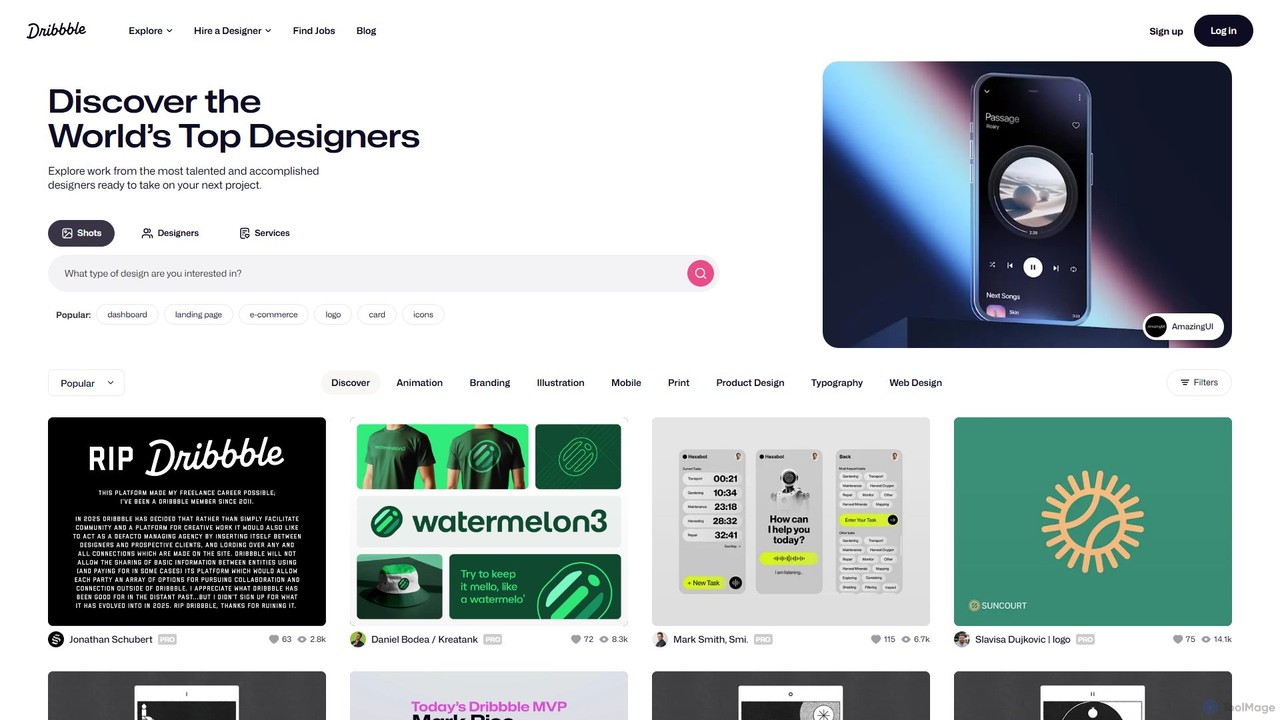
Dribbble is the leading online community for creative professionals and designers worldwide. It serves as a portfolio platform, a source of inspiration, and a marketplace where designers can showcase their work, connect with peers, and find job opportunities. From UI/UX and branding to illustration and animation, Dribbble is the go-to destination for discovering top design talent and creative work.
About Jobs
AI Jobs tools are a class of applications that use artificial intelligence to streamline the entire employment lifecycle, from job searching to recruitment. These tools leverage machine learning and natural language processing (NLP) to analyze resumes, match candidates with roles, and even prepare users for interviews. They provide data-driven insights for both job seekers and employers, making the hiring process more efficient and effective. By automating repetitive tasks and offering personalized guidance, these platforms help users navigate the competitive job market with greater precision.
Core Features
- AI Resume Analysis: Scans and scores resumes against specific job descriptions, suggesting keyword and formatting improvements to pass Applicant Tracking Systems (ATS).
- Intelligent Job Matching: Uses algorithms to connect candidates with relevant job openings based on their skills, experience, and career goals.
- Interview Preparation: Offers AI-powered mock interviews that provide feedback on answers, speech patterns, and overall performance.
- Career Path Guidance: Analyzes a user's profile to recommend potential career paths, identify skill gaps, and suggest relevant training.
- Automated Candidate Sourcing: Enables recruiters to automatically find and rank potential candidates from various online sources based on predefined criteria.
Use Cases
These tools are widely used by individual job seekers, from recent graduates to seasoned professionals looking to change careers. Corporate HR departments and recruitment agencies utilize them to accelerate talent acquisition. Career coaches and university career services also employ these platforms to provide students and clients with advanced job search support.
How to Choose
When selecting an AI Jobs tool, first identify your primary role: job seeker or recruiter. For job seekers, evaluate the depth of resume analysis and interview preparation features. For recruiters, consider the tool's sourcing capabilities and integration with existing Applicant Tracking Systems (ATS). Also, assess the platform's data privacy policies and the pricing model to ensure it aligns with your needs and budget.
JobsUse Cases
Optimize Resumes for Applicant Tracking Systems (ATS)
A marketing manager applying for multiple jobs online needs their resume to pass through automated screening filters. They upload their resume and a target job description into an AI tool. The platform analyzes the job description for crucial keywords, skills, and qualifications. It then provides specific suggestions, such as adding 'SEO strategy' or quantifying achievements like 'increased lead generation by 30%'. The tool also checks for ATS-friendly formatting, ensuring the document is easily parsable. This process increases the resume's match score, significantly boosting its chances of being reviewed by a human recruiter.
AI-Powered Mock Interview Preparation
A recent university graduate is preparing for their first major job interview. Using an AI interview coach, they start a simulated video session. The AI asks common behavioral questions like 'Tell me about a time you faced a challenge.' After the session, the tool generates a detailed report analyzing their performance. The feedback includes metrics on speech pace, use of filler words (e.g., 'um', 'like'), and an analysis of the answer's relevance and structure. This allows the graduate to practice and refine their responses, building confidence and improving their communication skills before the actual interview.
Automated Sourcing of Passive Candidates
A corporate recruiter needs to fill a niche role for a Senior Data Scientist. Instead of manually searching professional networks, they use an AI sourcing tool. The recruiter inputs key criteria: 'Python', 'TensorFlow', '5+ years experience', and 'fintech industry'. The AI scans millions of public profiles across platforms like LinkedIn, GitHub, and academic sites. It identifies and ranks the top 20 most suitable candidates, including those not actively looking for a job (passive candidates). The tool also provides contact information and suggests personalized outreach message templates, reducing sourcing time from days to a few hours.
Personalized Career Path Discovery
A mid-career professional in marketing feels stagnant and wants to explore new career options. They use an AI career guidance platform, inputting their work history, skills (e.g., project management, digital advertising), and interests. The AI analyzes this data against current labor market trends. It suggests several potential career paths, such as transitioning to a 'Product Marketing Manager' or a 'Growth Hacker'. For each path, it highlights the user's existing relevant skills, identifies skill gaps (e.g., 'SQL for data analysis'), and recommends specific online courses to bridge those gaps, providing a clear, actionable roadmap for a career change.
Crafting Personalized Cover Letters at Scale
A freelance graphic designer applies to dozens of projects each week. Writing a unique cover letter for each is time-consuming. They use an AI tool where they have pre-loaded their portfolio link, key skills, and a personal bio. For each new project, they paste the project description into the tool. The AI then generates a draft cover letter that highlights the most relevant skills and past experiences from their profile that match the project's needs. The designer can then make minor edits before sending, allowing them to apply to three times as many projects with high-quality, tailored proposals.
Intelligent Job Alert and Filtering
An active job seeker is tired of sifting through hundreds of irrelevant job postings daily. They set up an AI-powered job alert system. Instead of just using keywords like 'Software Engineer', they add nuanced preferences: 'remote-first company culture', 'Series B or C startup', 'focus on work-life balance', and 'uses Go programming language'. The AI not only filters new postings based on these criteria but also learns from the jobs the user clicks on or dismisses. Over time, the daily email alerts become highly curated, presenting only the top 5-10 most relevant opportunities, saving the user hours of manual searching and reducing job search fatigue.