Hackerman
Hackerman is a modern, AI-native, and highly customizable code editor designed for the AI age. Inspired by the …
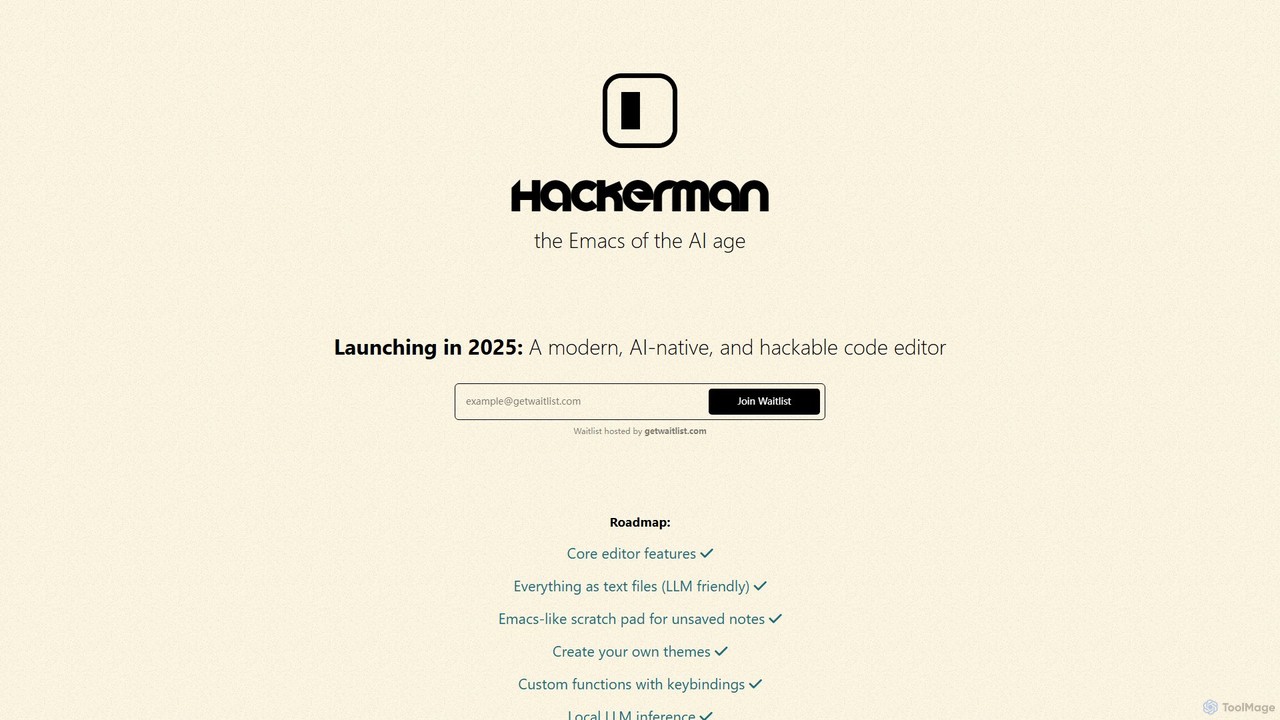
Hackerman is a modern, AI-native, and highly customizable code editor designed for the AI age. Inspired by the legendary Emacs, it offers deep integration with both local and remote LLMs, providing developers with unparalleled control and privacy. Features include mix-and-match LLM support, in-code shell access, and custom function creation, empowering developers to build a truly personalized and powerful coding environment. Launching in 2025.
About Ai Coding Assistant
AI Coding Assistants are AI-powered tools that leverage machine learning and natural language processing to streamline the software development process. They assist developers by automating repetitive tasks, providing intelligent code suggestions, and identifying potential errors in real-time. These assistants significantly boost productivity, reduce development time, and help improve overall code quality across various programming languages and environments.
Core Features
- Code Generation: Automatically generate code snippets, functions, or boilerplate code based on natural language prompts or context.
- Intelligent Auto-completion: Provide context-aware code suggestions and complete lines of code, accelerating typing and reducing syntax errors.
- Error Detection & Debugging: Identify potential bugs, security vulnerabilities, and suggest fixes or improvements in the code.
- Code Refactoring & Optimization: Analyze code for inefficiencies and suggest ways to refactor, optimize performance, or improve readability.
- Documentation Generation: Automatically create comments, docstrings, or even full documentation from existing code.
Applicable Scenarios
Software developers, data scientists, and web engineers utilize AI Coding Assistants to accelerate their daily coding tasks. They are particularly useful in rapid prototyping, maintaining large codebases, and learning new programming languages or frameworks. For instance, a front-end developer might use one to quickly generate CSS styles or JavaScript functions, while a data scientist could leverage it to write complex data analysis scripts more efficiently.
How to Choose
When selecting an AI Coding Assistant, consider its compatibility with your preferred Integrated Development Environment (IDE) and the programming languages you use most frequently. Evaluate the breadth and depth of its features, such as code generation accuracy, debugging capabilities, and refactoring suggestions. Also, assess its privacy policy regarding code data handling and compare pricing models to ensure it aligns with your budget and team size.

Ai Coding AssistantUse Cases
Automated Boilerplate Code Generation
A software engineer starting a new project can use an AI Coding Assistant to instantly generate common boilerplate code for frameworks like React or Spring Boot. By simply describing the desired component or service, the assistant provides a foundational structure, saving hours of manual setup and ensuring adherence to best practices from the outset.
Real-time Code Error Detection and Suggestion
During active development, a junior developer might struggle with syntax errors or logical bugs. An AI Coding Assistant continuously scans the code, highlighting issues in real-time and offering precise suggestions for correction. This immediate feedback loop accelerates learning, reduces debugging time, and prevents minor errors from escalating into larger problems.
Refactoring and Optimization of Existing Code
A team maintaining an older, complex codebase can leverage an AI Coding Assistant to identify areas for refactoring and performance optimization. The assistant can suggest cleaner code structures, more efficient algorithms, or modern API usages, helping to improve maintainability and reduce technical debt without extensive manual analysis.
Generating Comprehensive Unit Tests
Quality assurance is crucial, but writing unit tests can be time-consuming. A developer can use an AI Coding Assistant to automatically generate unit tests for functions or modules. The assistant analyzes the code's logic and potential edge cases, creating robust test suites that ensure code reliability and significantly improve test coverage with minimal effort.
Translating Natural Language Requirements to Code
Product managers or business analysts can use AI Coding Assistants to translate high-level natural language requirements directly into executable code snippets. For example, describing "a function to calculate the average of numbers in a list" could yield a working Python function, bridging the gap between business logic and technical implementation for rapid prototyping or proof-of-concept development.
Learning New APIs and Frameworks
When a developer needs to quickly get up to speed with a new library or framework, an AI Coding Assistant can provide context-aware examples and usage patterns. Instead of constantly consulting documentation, the assistant offers relevant code snippets for specific functions or classes as they type, accelerating the learning curve and enabling faster adoption of new technologies.