ToolMage
Sign in

Best 1 Prompt Sharing AI tools for Ai Community

Popular Prompt Sharing AI tools in Ai Community include Yugong, helping you work more efficiently.

Yugong
Free

Yugong

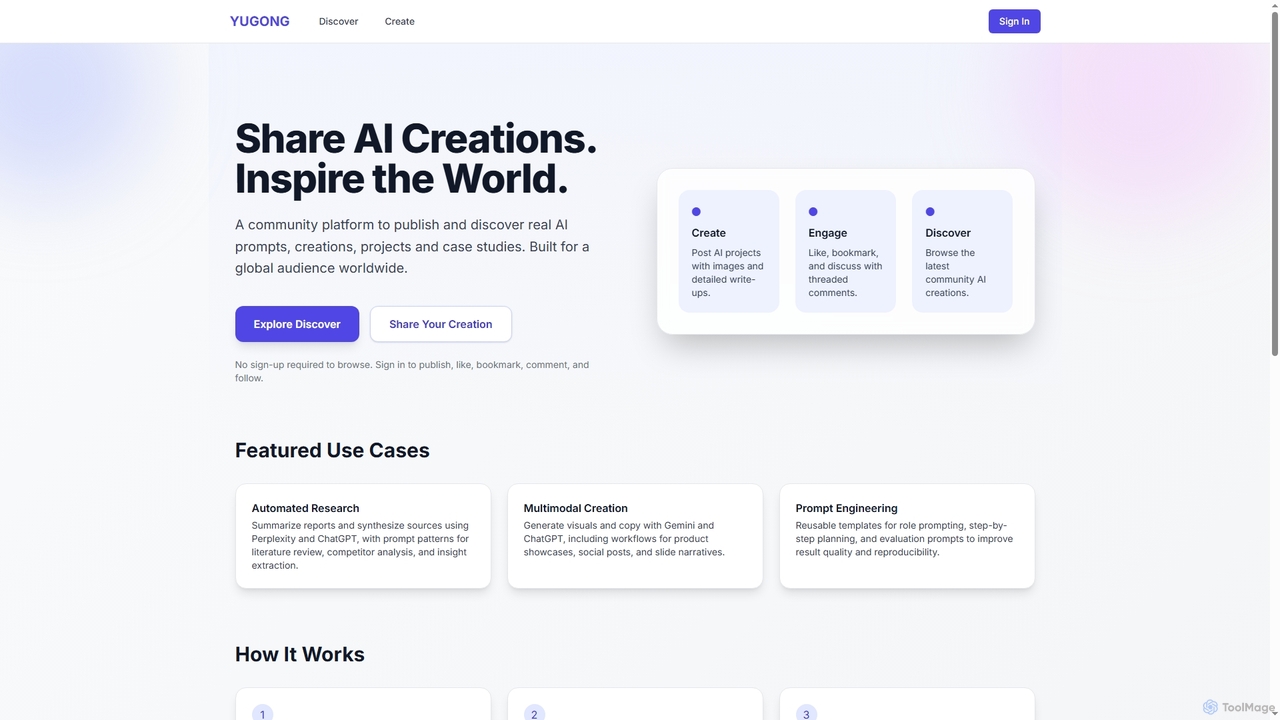
Yugong is a global community platform for discovering and sharing AI creations, prompts, projects, and case studies. It enables users to publish detailed AI workflows, engage with a worldwide audience, and explore innovative applications of AI tools like ChatGPT, Gemini, and Perplexity.

Prompt Sharing
Visits 5.9KFavorites 131Likes 136

About Prompt Sharing

Prompt Sharing platforms are specialized AI tools designed to facilitate the discovery, sharing, and refinement of effective prompts for various artificial intelligence models. These platforms serve as collaborative hubs where users can exchange meticulously crafted inputs, often accompanied by specific parameters, model details, and example outputs. By centralizing prompt knowledge, they significantly reduce the trial-and-error process for users, democratize prompt engineering expertise, and accelerate creative and analytical workflows across diverse AI applications.

Core Features

  • Prompt Discovery: Browse and search a vast library of prompts, categorized by AI model, application, or keywords, to find optimal inputs for specific tasks.
  • Prompt Submission & Management: Easily share your own successful prompts, including detailed metadata, parameters, and generated examples, and manage your contributions.
  • Community Interaction: Engage with other users through comments, ratings, and "forking" prompts, fostering a collaborative environment for prompt improvement.
  • Version Control & History: Track the evolution of prompts, allowing users to see iterations and improvements over time, enhancing learning and refinement.
  • Prompt Collections & Organization: Create and save personalized collections of favorite or frequently used prompts for quick access and efficient workflow management.

Applicable Scenarios

Prompt Sharing tools are invaluable for content creators seeking inspiration, AI artists exploring new styles, and developers optimizing model interactions. They enable users to quickly find proven prompts for generating high-quality images, compelling text, or efficient code, significantly streamlining creative and technical processes by leveraging collective intelligence.

How to Choose

When selecting a Prompt Sharing platform, prioritize community size and activity, as a larger user base often means more diverse and higher-quality prompts. Ensure the platform supports the specific AI models you frequently use. Evaluate the richness of prompt metadata and organization features, which are crucial for effective discovery. Finally, consider the overall user interface and experience for seamless browsing, submission, and interaction.

Prompt Sharing use cases

1

Discovering High-Quality AI Art Prompts

A digital artist frequently uses AI image generators but struggles to achieve specific artistic styles or complex compositions. By using a Prompt Sharing platform, they can browse a curated collection of prompts, filter by style (e.g., 'cyberpunk', 'watercolor'), artist influence, or specific elements. They discover a highly-rated prompt that perfectly matches their desired aesthetic, saving hours of experimentation and generating stunning visuals for their portfolio.

2

Optimizing AI Art Generation

Digital artists and graphic designers utilize prompt sharing platforms to find advanced text-to-image prompts. By exploring prompts that yield specific artistic styles, lighting, or compositions, they can generate unique and high-quality AI artwork more efficiently. This saves time on experimentation and allows for rapid iteration on visual concepts, enhancing creative output.

3

Discovering High-Quality Prompts for Content Creation

Content creators, marketers, and copywriters frequently need fresh ideas and optimized prompts to generate engaging text for blogs, social media, and ad campaigns. By using prompt sharing platforms, they can explore a vast library of community-vetted prompts tailored for specific tones, formats, or topics. This allows them to quickly find effective inputs, saving hours of experimentation and ensuring consistent, high-quality AI-generated content that resonates with their target audience.

4

Discovering Creative Prompts for Content Creation

Content creators, including bloggers and social media managers, frequently use prompt sharing platforms to find innovative ideas and effective prompts for generating engaging articles, headlines, and social media posts. By exploring prompts shared by others, they can quickly overcome writer's block, experiment with different tones or styles, and produce high-quality content more efficiently, saving hours of brainstorming.

5

Discovering Niche AI Art Styles

An AI artist explores prompt sharing platforms to find unique aesthetic styles, such as "vaporwave cityscapes" or "baroque cyberpunk portraits." They leverage community-contributed prompts and their associated outputs to inspire and refine their own artistic creations, saving time on experimentation.

6

Discovering High-Quality Image Generation Prompts

A graphic designer needs to create unique visual concepts for a new marketing campaign. Instead of experimenting from scratch, they use a prompt sharing platform to search for proven text-to-image prompts that generate specific artistic styles, lighting, or compositions. This allows them to quickly find effective prompts, iterate on ideas, and produce high-quality visuals much faster, saving hours of trial and error.

7

Collaborating on AI Model Development Prompts

AI developers and researchers often work in teams to fine-tune models or develop new applications. Prompt sharing platforms provide a centralized space for them to share, version, and iterate on prompts used for training, testing, or specific API calls. This collaborative environment ensures consistency across development efforts, allows for easy tracking of prompt performance, and accelerates the process of optimizing AI model behavior by leveraging collective intelligence and shared best practices.

8

Optimizing LLM Prompts for Content Marketing

A content marketer needs to generate engaging social media posts and blog outlines using a large language model (LLM). Instead of starting from scratch, they visit a Prompt Sharing platform to find prompts specifically designed for marketing copy. They adapt a highly effective prompt for generating catchy headlines, then share their refined version with their team, ensuring consistent brand voice and saving significant time in content creation workflows.

9

Optimizing Prompts for AI Art Generation

Digital artists and designers leverage prompt sharing communities to discover intricate and effective prompts for generating specific visual styles, themes, or complex compositions using AI image models. They can learn from experienced prompt engineers, adapt existing prompts, and share their own successful creations, accelerating their artistic workflow and pushing creative boundaries in AI art.

10

Optimizing Marketing Copy Generation

A marketing specialist needs to generate compelling ad copy for a new product launch. They search prompt sharing sites for high-performing prompts related to "persuasive call-to-action" or "product benefit highlighting," adapting successful community-tested templates to quickly produce effective marketing materials.

11

Optimizing AI Writing Prompts for Content Creation

A content marketer regularly uses AI to draft blog posts, social media updates, and email newsletters. To improve the quality and relevance of the AI-generated text, they browse prompt sharing platforms for prompts specifically designed for marketing copy. By adopting prompts that include tone, style, and keyword parameters, they can generate more engaging and on-brand content, reducing editing time and increasing output efficiency.

12

Improving LLM Outputs for Content Creation

Content writers and marketers leverage prompt sharing sites to access expertly crafted prompts for large language models. They can find prompts designed for generating blog posts, marketing copy, social media updates, or even complex research summaries. This ensures more coherent, relevant, and engaging AI-generated text, significantly boosting productivity and content quality.

13

Collaborating on Prompt Engineering Best Practices

A team of AI developers is building a new application that relies heavily on precise AI responses. They use a Prompt Sharing platform to create a private collection of prompts, allowing team members to submit, review, and comment on each other's prompt designs. This collaborative environment helps them collectively refine prompts, identify edge cases, and establish a standardized set of effective prompts for their application, improving development efficiency and output reliability.

14

Learning Advanced Prompt Engineering Techniques

A new AI enthusiast wants to master prompt engineering to get the best results from various AI models. They utilize prompt sharing platforms as a learning resource, studying how experienced users structure their prompts, incorporate negative prompts, and use specific parameters. By analyzing and experimenting with shared prompts, they quickly grasp advanced techniques and develop their own effective prompting strategies, accelerating their learning curve.

15

Accelerating Software Development with AI

Software developers and engineers use prompt sharing platforms to discover specialized prompts for AI code assistants. These prompts can range from generating specific functions or debugging code snippets to explaining complex algorithms. By using proven prompts, developers can accelerate their coding process, reduce errors, and learn best practices for interacting with AI development tools.

16

Collaborating on Coding Prompts for Development Tasks

Developers and programmers utilize prompt sharing platforms to find, share, and refine prompts for various coding tasks, such as generating code snippets, debugging assistance, or creating test cases. This fosters collaboration, allows teams to standardize prompt usage for specific projects, and significantly speeds up development cycles by leveraging community-tested and optimized coding prompts.

17

Learning Advanced Prompt Engineering Techniques

A novice AI user aims to master complex AI outputs. They delve into expert-shared prompts on these platforms, meticulously studying the intricate structures, specific keywords, and parameter settings that yield sophisticated results, thereby accelerating their journey to becoming a proficient prompt engineer.

18

Optimizing AI Art Generation Prompts

Digital artists and graphic designers leverage AI art generators to create unique visuals. Prompt sharing platforms allow them to discover complex and nuanced prompts that yield specific artistic styles, compositions, or effects. By exploring prompts shared by experienced users, artists can learn advanced prompt engineering techniques, avoid common pitfalls, and quickly generate high-quality images that align with their creative vision, significantly expanding their artistic capabilities and output.

19

Sourcing Marketing Copy Prompts for Campaigns

Marketing professionals and copywriters access prompt sharing platforms to find high-performing prompts for generating compelling ad copy, email subject lines, product descriptions, and campaign slogans. This enables them to quickly iterate on marketing messages, test different angles, and ensure their AI-generated content resonates with target audiences, enhancing campaign effectiveness and reducing ideation time.

20

Troubleshooting AI Model Output Issues

A developer encounters unexpected or undesirable outputs from a large language model. They utilize prompt sharing communities to search for solutions or workarounds, finding prompts that successfully address similar challenges or achieve desired outcomes, significantly reducing debugging and iteration time.

21

Learning Advanced Prompt Engineering Techniques

Beginners and intermediate AI users often struggle to craft effective prompts that yield desired results. Prompt sharing platforms serve as educational resources where they can study how expert users structure their prompts, utilize specific keywords, and apply advanced techniques like few-shot prompting or chain-of-thought. This hands-on learning from real-world examples accelerates their understanding of prompt engineering, enabling them to become more proficient in interacting with various AI models and achieving better outcomes.

22

Finding Niche Prompts for Specialized AI Tasks

A researcher in bioinformatics needs to summarize complex scientific papers using an AI model but finds generic prompts insufficient. They turn to a Prompt Sharing platform to search for prompts specifically tailored for scientific text summarization or medical abstract generation. They discover a community-contributed prompt that incorporates specific terminology and formatting, significantly improving the accuracy and relevance of the AI-generated summaries for their specialized field.

23

Collaborating on Prompt Development for AI Applications

A team of developers is building an AI-powered customer service chatbot and needs to ensure consistent, high-quality responses. They use a private or public prompt sharing platform to collaboratively develop, test, and refine prompts for various customer queries. This allows team members to share best practices, track prompt versions, and collectively improve the chatbot's conversational abilities, leading to a more robust and reliable AI application.

24

Streamlining Academic Research and Writing

Researchers and students access prompt libraries to find effective prompts for summarizing academic papers, extracting key information, or generating literature review outlines using AI. This helps in quickly processing large volumes of information, identifying core arguments, and structuring research documents, thereby making the research process more efficient and focused.

25

Learning Prompt Engineering from Experienced Users

A beginner AI user wants to improve their ability to craft effective prompts for various generative AI tools. They join a Prompt Sharing community to observe how experienced prompt engineers structure their inputs, what techniques they use (e.g., few-shot prompting, chain-of-thought), and how they iterate. By studying successful prompts and their variations, the user quickly grasps advanced prompt engineering concepts, accelerating their learning curve and enhancing their AI interaction skills.

26

Benchmarking and Testing AI Model Responses

Researchers and quality assurance teams utilize prompt sharing platforms to standardize inputs for benchmarking different AI models or evaluating updates to existing ones. By using a consistent set of community-validated prompts, they can objectively compare model outputs, identify biases, or measure performance improvements. This systematic approach ensures rigorous testing, facilitates data-driven decisions in AI development, and contributes to the overall reliability and fairness of AI systems.

27

Curating Educational Prompts for Learning & Training

Educators and trainers use prompt sharing tools to curate and distribute effective prompts for students or trainees interacting with AI models. This helps in designing structured learning exercises, demonstrating AI capabilities, and encouraging experimentation with prompt engineering. By sharing well-crafted prompts, they can guide learners towards better AI outputs and deeper understanding.

28

Collaborating on Creative Content Campaigns

A content team is developing a multi-platform campaign. They use a prompt sharing platform to centralize and iterate on prompts for blog post outlines, social media captions, and image generation, ensuring thematic consistency and leveraging collective creativity across the team.

29

Developing AI-Powered Chatbots and Assistants

Businesses and developers building custom AI chatbots or virtual assistants use prompt sharing platforms to gather and refine prompts for specific conversational flows. They can find prompts that elicit desired responses, maintain brand voice, or handle complex user queries effectively. This ensures the chatbot provides accurate, helpful, and consistent interactions, improving user experience.

30

Benchmarking AI Model Performance with Shared Prompts

AI researchers and developers often need to compare the output quality of different large language models (LLMs) or image generators. They leverage prompt sharing platforms to access standardized sets of prompts that have been widely tested and rated for specific tasks. By running these shared prompts across various models, they can objectively benchmark performance, identify strengths and weaknesses, and contribute to the collective understanding of AI capabilities.

31

Monetizing Expert-Level Prompts

A skilled prompt engineer has developed a series of highly effective and unique prompts for a niche application, such as generating complex legal summaries or specialized code snippets. They utilize a Prompt Sharing platform that offers monetization features, allowing them to sell or license their expert-level prompts to other users. This provides a new revenue stream for their specialized skills and helps other professionals access high-quality, ready-to-use AI inputs.

32

Monetizing Expert Prompt Creations

Experienced prompt engineers who have developed highly effective and unique prompts for niche applications can use prompt sharing platforms to monetize their creations. Some platforms allow users to sell or license their prompts, providing a new revenue stream for skilled individuals. This incentivizes the creation of innovative prompts and makes specialized AI capabilities accessible to a wider audience, fostering a professional ecosystem around prompt engineering.

33

Exploring Research Prompts for Academic Studies

Researchers and academics utilize prompt sharing platforms to discover and share prompts relevant to their specific fields of study, from generating literature reviews to formulating complex data analysis queries. This facilitates interdisciplinary collaboration, allows for the replication of AI-assisted research methods, and helps in refining prompts to achieve more accurate and nuanced research outcomes.

34

Building a Curated Prompt Library for Teams

Organizations and teams often require a consistent brand voice or specific technical outputs from AI tools. Prompt sharing platforms allow them to create private or shared libraries of approved, high-performing prompts. This ensures all team members use optimized inputs, maintaining consistency in communication, design, or code generation. It centralizes valuable organizational knowledge, reduces redundant prompt engineering efforts, and streamlines workflows across departments, leading to more efficient and unified AI utilization.

35

Learning and Mastering Prompt Engineering

Aspiring prompt engineers and AI enthusiasts use these platforms as educational resources. By studying the structure, syntax, and results of shared prompts, they gain practical insights into effective prompt design. This hands-on learning accelerates their understanding of how different prompt elements influence AI outputs, helping them master the art of prompt engineering.

36

Benchmarking AI Model Performance

An AI researcher employs a curated set of standardized prompts from a sharing platform to systematically evaluate and compare the output quality, consistency, and specific capabilities of different AI models or new model versions, providing objective data for research and development.

Prompt Sharing FAQ

What are Prompt Sharing platforms?

Prompt Sharing platforms are online hubs where users can discover, share, and manage effective text prompts for various AI models, such as large language models (LLMs) and AI image generators. They centralize valuable prompt engineering knowledge, acting as a collaborative space for the AI community to exchange best practices and optimize AI interactions.

What are Prompt Sharing platforms?

Prompt Sharing platforms are online communities or tools where users can share, discover, and manage prompts for various AI models like ChatGPT, Midjourney, or Stable Diffusion. They centralize effective prompt engineering techniques, allowing users to find proven inputs that yield desired AI outputs. These platforms foster collaboration and knowledge exchange within the broader AI community.

What are Prompt Sharing platforms?

Prompt Sharing platforms are online communities or tools where users can find, share, and manage prompts for various AI models like ChatGPT, Midjourney, or Stable Diffusion. They act as repositories for effective inputs, helping users achieve better and more consistent results from their AI interactions. These platforms often feature categorization, search functions, and user ratings to highlight high-quality prompts.

What are Prompt Sharing platforms?

Prompt Sharing platforms are online communities or marketplaces where users can discover, share, and collaborate on prompts for various AI models. They act as repositories for effective input instructions, helping users get better and more consistent outputs from generative AI tools like ChatGPT, Midjourney, or Stable Diffusion. These platforms often include features for searching, categorizing, rating, and discussing prompts, fostering a collaborative environment for prompt engineering.

What are Prompt Sharing platforms?

Prompt Sharing platforms are online tools or communities where users can discover, share, and manage effective prompts for various AI models like large language models (LLMs) or image generators. They centralize valuable prompt engineering knowledge, allowing users to learn from others' successful inputs, optimize their AI interactions, and collaborate on prompt refinement. These platforms often feature search functionalities, community ratings, and version control for prompts.

What are Prompt Sharing platforms?

Prompt Sharing platforms are online communities and tools specifically designed for users to discover, share, and refine effective textual inputs, known as prompts, for various AI models. These platforms centralize knowledge, allowing users to leverage collective intelligence to achieve better and more consistent results from AI tools like image generators, large language models, and code assistants.

How do Prompt Sharing platforms differ from general AI Community forums?

While both are part of the broader AI Community, Prompt Sharing platforms are highly specialized. General AI forums offer broad discussions on AI news, ethics, and development. In contrast, prompt sharing platforms focus specifically on the practical application of prompts: their creation, optimization, sharing, and performance. They provide structured tools like search filters, rating systems, and version control tailored for prompt management, rather than general discussions or troubleshooting.

How do Prompt Sharing platforms benefit AI users?

Prompt Sharing platforms offer significant benefits by streamlining the process of finding optimal prompts and enhancing the quality of AI-generated content. They reduce the need for extensive trial-and-error, provide access to a diverse range of expert-crafted prompts, accelerate learning for prompt engineering, and inspire new creative approaches across different AI applications.

How do I choose the right Prompt Sharing platform?

To choose the right platform, consider its community size and activity, the quality and diversity of prompts available, and compatibility with the AI models you use. Look for robust search and filtering options, features for saving and organizing prompts, and community interaction tools like ratings or comments. A user-friendly interface and clear categorization are also important for efficient discovery.

How do I choose the best Prompt Sharing platform for my needs?

When selecting a platform, consider the diversity and quality of its prompt library, ensuring it supports the AI models you use. Evaluate community features like user ratings, comments, and discussion forums for active engagement. Look for advanced search and filtering options to efficiently find relevant prompts, and assess the platform's user interface and prompt management capabilities for ease of use.

Why should I use a Prompt Sharing platform?

Using a Prompt Sharing platform offers several benefits. It allows you to discover proven prompts, saving time and effort in experimenting to find effective inputs for your AI tasks. You can learn from experienced prompt engineers, improve your own prompting skills, and achieve higher quality outputs from AI models. Additionally, these platforms foster collaboration, enabling you to contribute your own successful prompts and receive feedback from a community of users.

How do Prompt Sharing platforms benefit AI users?

Prompt Sharing platforms offer several key benefits to AI users. They provide access to a vast library of proven prompts, saving users time and effort in experimentation. Users can learn from the community's collective knowledge, improving their prompt engineering skills. These platforms also foster collaboration, allowing users to refine prompts together and share best practices. Ultimately, they help users achieve higher quality, more consistent, and more creative outputs from their AI tools, enhancing productivity and innovation.

What features should I look for in a Prompt Sharing tool?

When choosing a Prompt Sharing tool, prioritize platforms with a large, active community and a diverse library of prompts for various AI models. Look for robust search and filtering capabilities, allowing you to quickly find relevant prompts by category, model, or keyword. Essential features include version control for prompt iterations, community interaction tools like ratings and comments, and clear documentation or examples for each prompt. Integration options with your preferred AI tools and a user-friendly interface are also crucial for a seamless workflow.

How do I choose the best Prompt Sharing tool?

To choose the best Prompt Sharing tool, consider several factors. First, assess the breadth and quality of the prompt library, ensuring it supports the AI models you use and offers diverse options. Second, evaluate the community's activity and engagement, as a vibrant community often means more updated and effective prompts. Third, look for robust search, filtering, and organization features to easily find and manage prompts. Finally, check for any unique features like version control, integration capabilities, or monetization options that align with your specific needs.

What are the key benefits of using Prompt Sharing tools?

Using Prompt Sharing tools offers several key benefits. Firstly, it significantly boosts efficiency by providing access to pre-tested, high-quality prompts, reducing the time spent on experimentation. Secondly, it fosters learning and skill development, as users can study and adapt prompts from experienced engineers. Thirdly, it enhances output quality and consistency across various AI applications. Lastly, these platforms promote collaboration and knowledge sharing within the AI community, accelerating innovation and problem-solving.

What are the main benefits of using Prompt Sharing tools?

The main benefits include saving time on prompt experimentation, accessing a wide range of proven prompts for various tasks, and improving the quality of AI outputs. These platforms foster learning and collaboration within the AI community, helping users discover new techniques and optimize their AI workflows more effectively.

What kind of prompts can I find on these platforms?

You can find a vast array of prompts on these platforms, covering diverse AI applications. This includes prompts for text-to-image generation (e.g., artistic styles, specific objects), text-to-text models (e.g., creative writing, summarization, code generation), and other specialized AI tasks. Prompts are often categorized by AI model, style, or intended use case.

What are the main benefits of using Prompt Sharing tools?

The main benefits include saving time by accessing pre-tested prompts, improving the quality and relevance of AI outputs, fostering creativity through exposure to diverse prompt ideas, and learning advanced prompt engineering techniques from experienced users. These tools democratize access to effective AI interaction strategies and build a collective knowledge base.

How to choose a good Prompt Sharing platform?

To select an effective Prompt Sharing platform, consider several key factors. Prioritize platforms with a large and active community, as this indicates a rich and frequently updated prompt library. Ensure it supports the specific AI models you commonly use. Look for robust search and filtering capabilities, detailed prompt metadata (parameters, examples), and an intuitive user interface for both discovery and contribution.

What's the difference between Prompt Sharing and a general AI Community?

While Prompt Sharing platforms are a part of the broader AI Community, their focus is much more specialized. A general AI Community encompasses discussions, news, and resources across all aspects of AI, from research and development to ethical considerations. Prompt Sharing, however, specifically centers on the practical application of AI through effective prompting. It's about sharing the 'how-to' for getting specific results from AI models, rather than general AI discourse or development.

What types of prompts can I find on these platforms?

You can find a diverse range of prompts, including those for generating creative text (stories, poems), factual content (summaries, articles), marketing copy (ads, social media posts), code snippets, and specific artistic styles or compositions for AI image generation. Many platforms categorize prompts by AI model, use case, or desired output.

How do Prompt Sharing platforms differ from general AI communities?

While general AI communities (the parent category) cover a broad spectrum of AI discussions, news, and tools, Prompt Sharing platforms specifically focus on the creation, sharing, and optimization of prompts. They provide structured repositories for prompts, often with features for testing, rating, and remixing, whereas general communities might discuss prompts but lack dedicated management tools.

What's the difference between a Prompt Sharing platform and a general AI community?

A general AI community (like the parent category 'AI Community') offers broad discussions, news, and resources across all aspects of AI, from research to development. In contrast, a Prompt Sharing platform is a specialized sub-category focused specifically on the creation, sharing, and optimization of AI prompts. While both foster collaboration, Prompt Sharing platforms provide structured tools and dedicated spaces for prompt engineers to refine their craft, offering detailed versioning, testing, and community feedback mechanisms tailored to prompt effectiveness, rather than general AI topics.

How can I choose the best Prompt Sharing platform for my needs?

To choose the best Prompt Sharing platform, first assess the types of AI models you use most frequently and ensure the platform supports them. Consider the size and activity of its community; a larger, more engaged community often means a richer, more diverse prompt library. Evaluate the search and filtering capabilities for ease of discovery, and look for features like community ratings, comments, and version control to gauge prompt quality and evolution. Finally, check for any integration options with your existing AI workflows or tools.

Can I monetize my prompts on Prompt Sharing platforms?

Yes, many Prompt Sharing platforms offer features that allow users to monetize their expert-level prompts. This can include selling prompts directly to other users, offering premium subscriptions for access to exclusive prompt libraries, or licensing prompts for commercial use. Monetization opportunities vary by platform, but they provide a valuable avenue for skilled prompt engineers to earn income from their creativity and expertise, while also making high-quality AI inputs accessible to a wider audience.

What is the difference between Prompt Sharing and general AI Community forums?

While both foster collaboration, Prompt Sharing platforms are distinct from general AI Community forums primarily in their focus. Prompt Sharing platforms are specifically structured around the exchange, organization, and refinement of AI prompts, often with dedicated features for prompt submission, versioning, and output examples. General AI Community forums, conversely, offer broader discussions on AI news, ethics, development, troubleshooting, and a wider range of AI-related topics without the specific prompt-centric structure.

How do Prompt Sharing platforms differ from general AI communities?

While Prompt Sharing platforms are a subset of the broader AI community, their primary focus is specifically on the exchange and management of AI prompts. General AI communities might discuss broader topics like AI news, research, ethics, or development. Prompt Sharing platforms offer a more specialized, practical, and structured environment for prompt engineering collaboration.

Can I share my own prompts on these platforms?

Yes, most Prompt Sharing platforms encourage users to contribute their own prompts. This is a core aspect of their community-driven model. You can typically upload your prompts, categorize them, add descriptions, and specify which AI models they work best with. Sharing your prompts allows you to contribute to the collective knowledge, receive feedback from other users, and potentially gain recognition within the prompt engineering community. Some platforms even offer options for monetizing your most effective prompts.

Who can benefit from Prompt Sharing tools?

A wide range of users can benefit, including content creators, digital artists, developers, marketers, researchers, and educators. Anyone who regularly interacts with generative AI models and seeks to improve their outputs, save time, or explore new applications will find value in leveraging the collective intelligence offered by prompt sharing communities.

Who can benefit from Prompt Sharing platforms?

A wide range of users can benefit from Prompt Sharing platforms. This includes content creators, marketers, and copywriters seeking optimized prompts for text generation. Digital artists and graphic designers can find inspiration and specific inputs for AI art. AI developers and researchers use them for collaborative prompt engineering and model benchmarking. Educators can leverage them to teach prompt design, and businesses can build internal prompt libraries for consistent brand communication and efficient AI utilization across teams.