ToolMage
Sign in

Best 1 Ai & Memory AI tools for Ai & Intelligence

Popular Ai & Memory AI tools in Ai & Intelligence include Mcplist, helping you work more efficiently.

Mcplist
Free

Mcplist

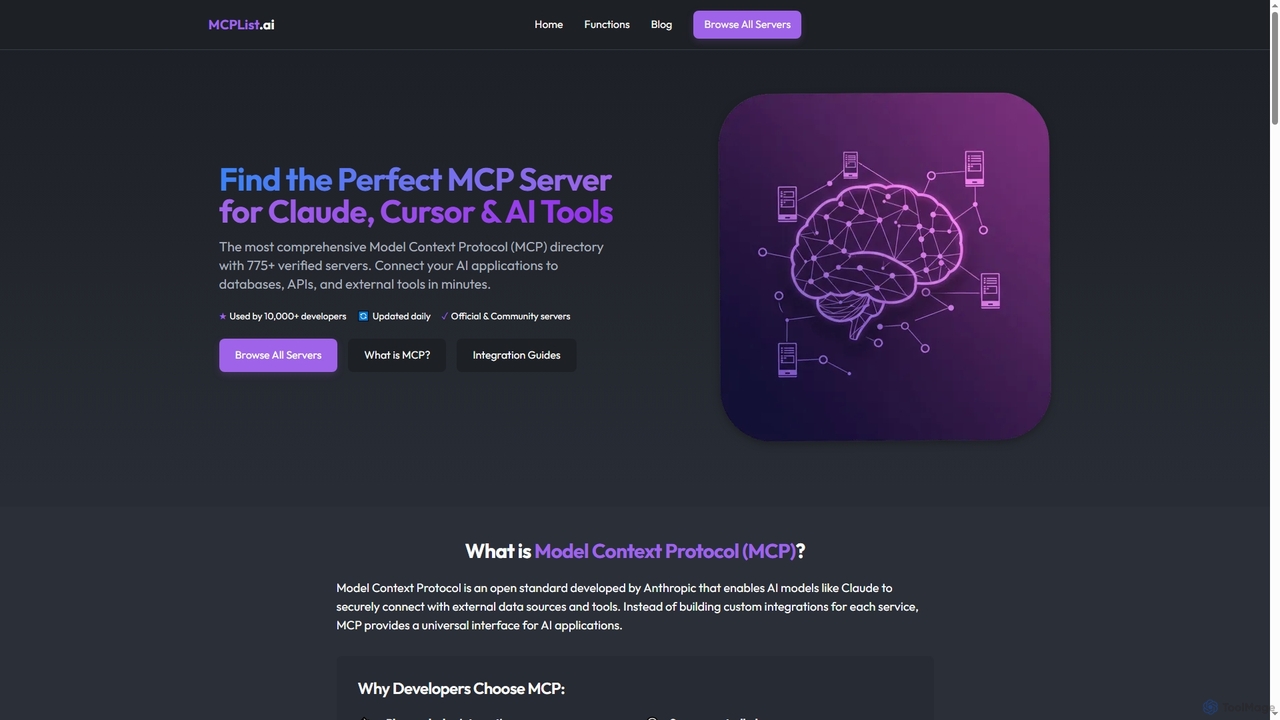
Mcplist is the most comprehensive directory of Model Context Protocol (MCP) servers, designed for developers. It features over 775 verified official and community servers, enabling AI applications like Claude and Cursor to seamlessly connect with external databases, APIs, and tools. The platform offers powerful search, filtering, and step-by-step integration guides to accelerate AI development.

3D
Visits 4.1KFavorites 133Likes 138

About Ai & Memory

Ai & Memory tools are advanced artificial intelligence systems designed to store, manage, and retrieve information over extended periods, enabling AI to learn from past interactions and maintain context across sessions. These solutions overcome the inherent statelessness of many traditional AI models by providing persistent knowledge retention. They empower AI agents to deliver more personalized, consistent, and intelligent responses, significantly enhancing user experience and decision-making capabilities.

Core Features

  • Long-Term Conversational Memory: Enables AI to recall previous dialogue turns, user preferences, and historical context across multiple interactions.
  • Knowledge Graph Integration: Connects AI with structured and unstructured data sources, allowing for deep contextual understanding and accurate information retrieval.
  • Contextual Recall: Facilitates the AI's ability to understand and utilize relevant information from its memory based on current queries or tasks.
  • Personalized Learning: Allows AI systems to adapt and refine their responses and behaviors over time, based on individual user interactions and feedback.
  • Semantic Search & Retrieval: Enhances the ability to find and present information based on meaning and relevance, rather than just keywords.

Applicable Scenarios

These tools are vital for applications requiring continuous learning and personalized interaction. They are widely adopted in customer service for consistent support, in educational platforms for adaptive learning paths, and in intelligent personal assistants for remembering user preferences and routines. Businesses leverage them to build more sophisticated and human-like AI agents that can maintain a coherent understanding of ongoing tasks and user needs.

How to Choose

When selecting an Ai & Memory solution, consider its memory capacity and scalability to handle growing data volumes. Evaluate its integration capabilities with your existing AI models and data infrastructure. Assess the level of data security and privacy features, especially for sensitive information. Finally, examine the customization options for tailoring memory retention policies and knowledge representation to your specific application requirements.

Featured tool rankings

Ai & Memory use cases

1

Personalized Customer Service Automation

Customer service departments utilize Ai & Memory tools to power chatbots and virtual assistants that remember past customer interactions, purchase history, and preferences. This allows the AI to provide highly personalized support, resolve issues more efficiently, and avoid repetitive questioning, leading to improved customer satisfaction and reduced agent workload.

2

Intelligent Personal Assistant Enhancement

Individuals benefit from AI assistants equipped with memory capabilities that recall personal routines, appointments, dietary preferences, and past requests. This enables the assistant to offer proactive suggestions, manage schedules effectively, and provide contextually relevant information, making daily life more organized and efficient.

3

Adaptive E-learning and Tutoring Systems

Educational platforms integrate Ai & Memory to track student progress, identify learning gaps, and remember individual learning styles. The AI tutor can then adapt course content, recommend personalized exercises, and provide targeted feedback, creating a more effective and engaging learning experience for each student.

4

Context-Aware Content Generation

Content creators and marketers use AI with memory to maintain consistency in tone, style, and factual details across large volumes of generated content. The AI remembers project briefs, brand guidelines, and previous drafts, ensuring that new content aligns perfectly with established narratives and avoids contradictions.

5

Enterprise Knowledge Management & Retrieval

Organizations deploy Ai & Memory solutions to build intelligent internal knowledge bases that remember and categorize vast amounts of company data, documents, and meeting notes. Employees can quickly retrieve precise information, understand project histories, and access institutional knowledge, boosting productivity and reducing information silos.

6

Healthcare Patient History Recall

In healthcare, AI systems with memory can store and recall complex patient histories, including diagnoses, treatments, medication lists, and allergies. This capability assists medical professionals in making more informed decisions, identifying potential risks, and ensuring continuity of care, ultimately improving patient outcomes.

Ai & Memory FAQ

What are Ai & Memory tools?

Ai & Memory tools are specialized artificial intelligence systems designed to give AI agents the ability to retain and recall information over time, much like human memory. They enable AI to learn from past interactions, maintain context across different sessions, and access a persistent knowledge base, moving beyond the limitations of stateless, single-interaction models.

How do Ai & Memory solutions enhance AI capabilities?

These solutions significantly enhance AI by providing persistent context and knowledge. This allows AI to engage in more natural, coherent, and personalized conversations, make more informed decisions based on historical data, and continuously learn and adapt over time. They transform AI from reactive tools into proactive, intelligent partners.

What are the key features to look for in an Ai & Memory tool?

When evaluating Ai & Memory tools, look for features such as robust long-term memory capacity, seamless integration with existing AI models (like LLMs), advanced contextual understanding, and efficient information retrieval mechanisms. Data security, privacy controls, and the ability to customize knowledge representation are also crucial considerations.

How does Ai & Memory differ from general AI or large language models (LLMs)?

While general AI and LLMs are powerful at processing information and generating responses, they are often "stateless" by default, meaning they don't inherently remember past interactions beyond the current prompt. Ai & Memory specifically adds this persistent recall capability, allowing LLMs to maintain context, learn from history, and provide consistent, personalized interactions over time, bridging the gap between single-turn responses and ongoing intelligence.

Who benefits most from using Ai & Memory tools?

A wide range of users and industries benefit. Customer service operations gain more effective chatbots, educators can create adaptive learning systems, and personal assistant users experience more intelligent and proactive support. Content creators achieve greater consistency, and enterprises can build more powerful knowledge management systems, all leveraging AI's enhanced ability to remember and learn.