
AIWorldNext
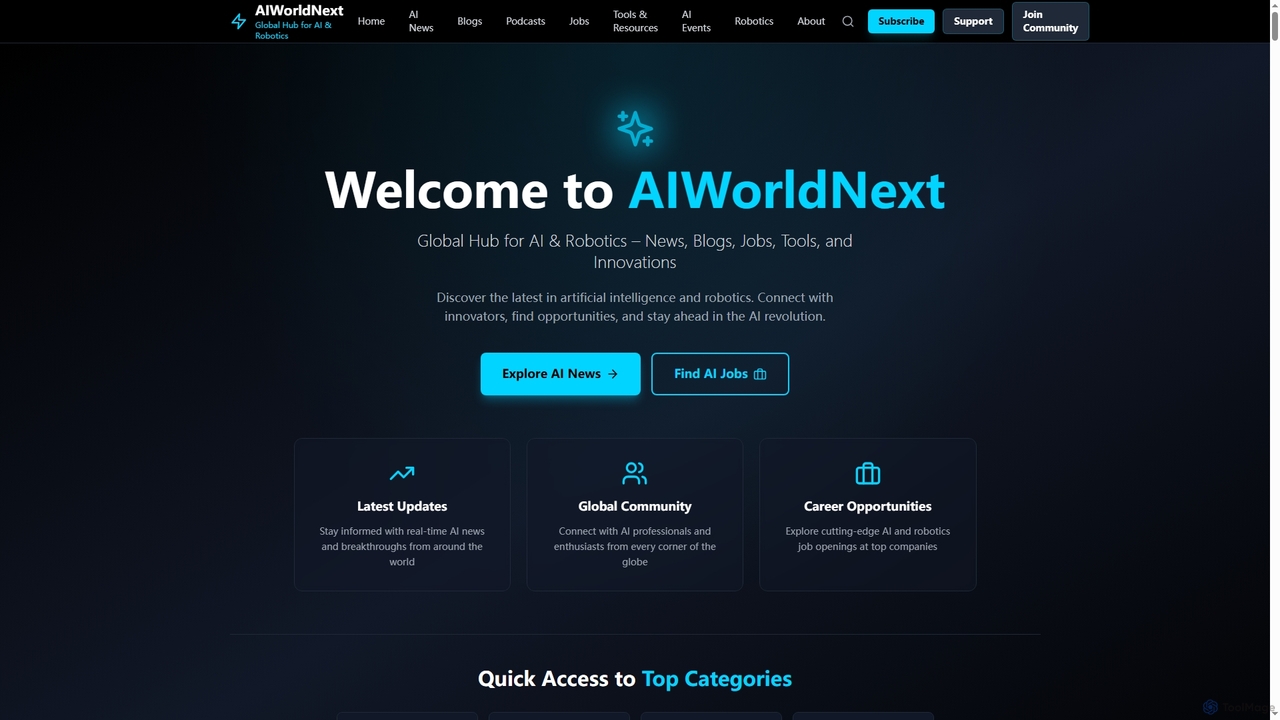
AIWorldNext is a premier global hub for artificial intelligence and robotics, offering a comprehensive platform for news, expert …
AIWorldNext is a premier global hub for artificial intelligence and robotics, offering a comprehensive platform for news, expert blogs, job opportunities, AI tool directories, and community engagement. It serves as a vital resource for professionals, researchers, and enthusiasts to stay informed and connected in the rapidly evolving AI landscape.
About Tool Directory
An AI Tool Directory is a curated, searchable database designed to help users discover, compare, and select artificial intelligence tools. As a specific type of AI Resource, it structures the vast landscape of AI applications into organized categories, making it simple to find relevant solutions. These directories serve as a central hub for professionals, creators, and developers, providing detailed information and user feedback to facilitate informed decision-making. They are essential for navigating the rapidly growing AI ecosystem efficiently.
Core Features
- Structured Categorization: Tools are organized by function (e.g., image generation, text analysis) and industry, simplifying discovery.
- Advanced Search & Filtering: Users can filter tools based on criteria like pricing, features, platform compatibility, and integration options.
- Detailed Tool Profiles: Each listing typically includes a comprehensive description, key features, pricing plans, and links to the official website.
- User Reviews and Ratings: Community-driven feedback helps assess a tool's real-world performance and reliability.
- Regular Updates: The directory is consistently updated with new tools and information on existing ones to reflect market changes.
Use Cases
AI Tool Directories are valuable for a wide range of users. Marketers use them to find content creation and automation tools. Developers search for specific APIs and platforms to integrate into their projects. Entrepreneurs and product managers conduct market research to analyze competitors and identify industry trends. Students and researchers also use them to explore the current state of AI technology.
How to Choose
When evaluating an AI Tool Directory, consider its comprehensiveness—how many tools are listed and how diverse are the categories. Check the frequency of updates to ensure the information is current. A high-quality directory will offer robust filtering options, in-depth tool profiles, and authentic user reviews. Finally, an intuitive user interface is crucial for an efficient and pleasant browsing experience.
Tool DirectoryUse Cases
Market Research for a New Venture
An entrepreneur planning to launch a new SaaS product uses an AI Tool Directory for competitive analysis. They filter by their target industry, such as 'Healthcare AI,' and specific functions like 'Patient Data Analysis.' This allows them to quickly identify all existing players, from large enterprises to emerging startups. By studying the detailed profiles, they can analyze feature sets, pricing models, and user reviews to find a unique value proposition and identify gaps in the current market, informing their product development strategy.
Selecting a Tool for a Marketing Campaign
A digital marketing manager needs an AI tool to generate social media content for an upcoming campaign. They access a tool directory and navigate to the 'Marketing' and 'Content Generation' categories. Using filters, they narrow the search to tools that support multiple languages, offer a free trial, and integrate with their scheduling platform. By comparing the top 3-4 options side-by-side and reading user reviews, they can confidently select a tool that fits their budget and technical requirements, saving hours of manual research.
Developer's Search for an API
A software developer is building an application that requires natural language processing (NLP) capabilities. Instead of building a model from scratch, she consults an AI Tool Directory. She filters for 'Developer Tools' and 'NLP APIs,' then further refines the results by programming language (e.g., Python) and specific features like 'Sentiment Analysis.' The directory provides direct links to API documentation and pricing tiers, allowing her to quickly evaluate and test several options to find the most efficient and cost-effective solution for her project.
Academic Research on AI Trends
A university student writing a thesis on the evolution of generative AI uses a tool directory as a primary data source. They can track the number of new tools launched in specific sub-categories (e.g., 'AI Music Generators', 'AI Video Generators') over time. The directory's historical data and categorization allow the student to analyze growth trends, identify emerging technologies, and cite specific examples of tools to support their research findings, adding a practical, data-driven dimension to their academic work.
Curating a Content Creator's Toolkit
A freelance content creator wants to upgrade their production workflow with AI. They browse a tool directory to build a personalized toolkit. They start in 'AI Video Editing' to find tools for automatic captioning, then move to 'AI Image Generators' for custom thumbnails, and finally explore 'AI Writing Assistants' to help script their content. The directory acts as a one-stop shop, allowing them to discover, bookmark, and compare tools across different categories to build an integrated and efficient content creation stack.
Corporate Vetting of Enterprise-Ready Tools
A procurement manager at a large corporation is tasked with finding an AI-powered customer service chatbot. Using an AI Tool Directory, they can specifically filter for 'Enterprise' solutions that offer features like SSO (Single Sign-On), advanced security compliance (e.g., GDPR, SOC 2), and dedicated support. The directory's user reviews from other corporate users provide valuable insights into scalability and reliability. This process streamlines the initial vetting phase, allowing the manager to create a qualified shortlist for in-depth demos and trials.