Coaching Best in category 1 results Personalized Feedback AI Tool

Popular AI tools in the Personalized Feedback field of Coaching include InstructorHub, etc., helping you quickly improve efficiency.

InstructorHub

InstructorHub

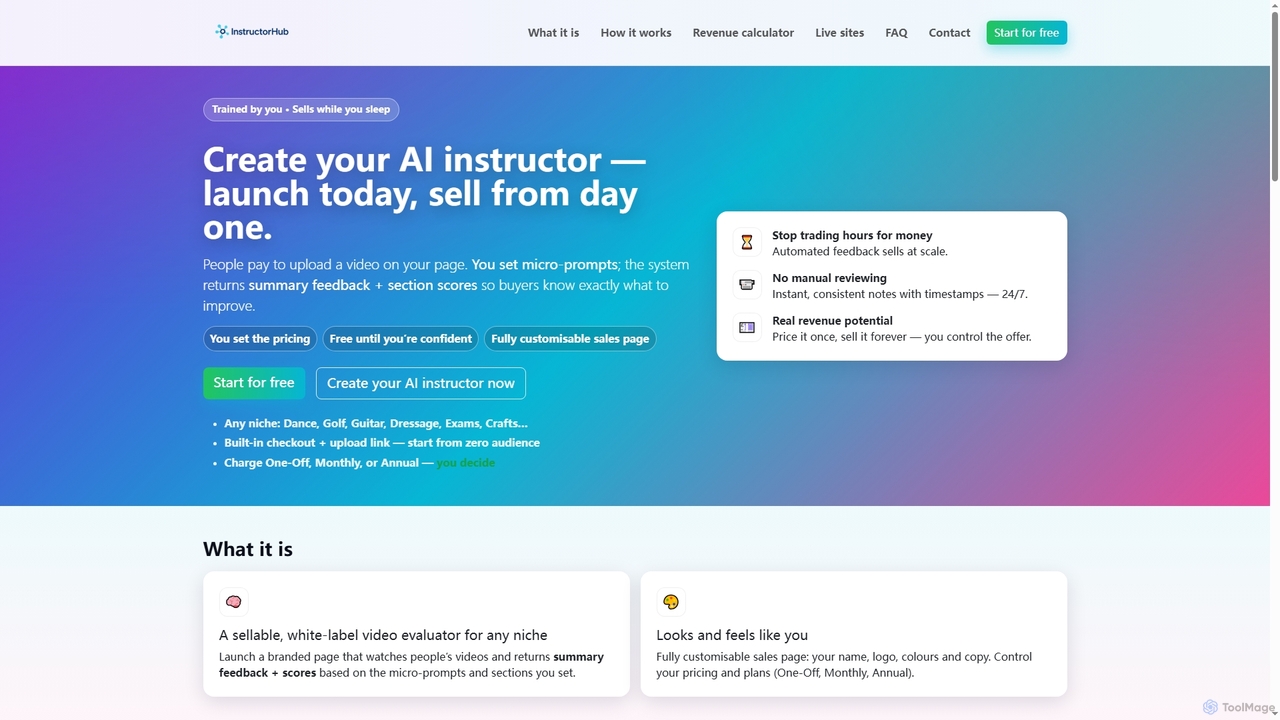
InstructorHub is an AI-powered platform that enables experts to create their own virtual instructors. It analyzes user-submitted videos, …

8.1K

About Personalized Feedback

Personalized Feedback tools are a specialized type of AI coaching assistant that analyzes user-submitted content to provide specific, data-driven suggestions for improvement. Leveraging technologies like Natural Language Processing (NLP) and speech analysis, these tools evaluate performance against predefined criteria such as clarity, confidence, or technical accuracy. This enables users to receive instant, objective feedback on tasks like public speaking, writing, or sales pitches, accelerating skill development. Unlike broader coaching platforms, their primary focus is the micro-level analysis of a specific performance or artifact.

Core Features

  • Content Analysis: Automatically evaluates text, audio, or video for specific metrics like filler words, tone, grammar, and structure.
  • Actionable Recommendations: Provides concrete, context-aware suggestions linked directly to specific parts of the user's submission.
  • Performance Scoring: Generates quantitative scores and benchmarks based on customizable rubrics or industry standards.
  • Progress Tracking: Visualizes user improvement over time across multiple practice sessions and submissions.

Applicable Scenarios

These tools are widely used in corporate training for sales and customer service teams, in education for writing and presentation skill development, and by individuals preparing for interviews or public speaking engagements. They are particularly effective in environments requiring consistent, scalable feedback for skill refinement.

Selection Criteria

When choosing a tool, consider the types of content it can analyze (text, audio, video), the depth and accuracy of its feedback, the ability to customize evaluation criteria, and its integration capabilities with Learning Management Systems (LMS) or Customer Relationship Management (CRM) platforms.

Personalized FeedbackUse Cases

1

Refining Public Speaking Skills

A corporate professional preparing for a major presentation uses a personalized feedback tool to practice their speech. They record a video of their delivery, and the AI analyzes factors such as speaking pace, use of filler words like 'um' and 'ah', vocal tone variation, and body language. The tool provides a detailed report with a confidence score and highlights specific moments for improvement, for instance, suggesting a slower pace in a complex section or more engaging gestures. This allows for iterative practice and measurable improvement before the actual event.

2

Improving Sales Pitch Effectiveness

A sales team uses an AI feedback tool to standardize and improve their sales pitches. New hires can practice delivering the company's value proposition, and the AI scores them on key criteria like mentioning all critical product features, maintaining an energetic tone, and asking probing questions. The system can compare their performance against top-performing sales reps, providing a clear benchmark. This scalable coaching method ensures all team members meet a high standard of communication, reducing ramp-up time for new employees.

3

Enhancing Academic Writing and Essays

A university student uses a personalized feedback tool to review their academic essay before submission. They upload the document, and the AI provides instant feedback on grammar, syntax, clarity, and argument structure. It can highlight run-on sentences, suggest more precise vocabulary, and check if the thesis statement is consistently supported throughout the paper. This process acts as a preliminary review, allowing the student to fix structural and grammatical issues, so they can focus on the quality of their research and arguments when seeking feedback from a professor.

4

Automating Initial Code Reviews

A software development team integrates a personalized feedback tool into their workflow for automated code reviews. When a junior developer submits code, the AI scans it for adherence to coding standards, potential bugs, and performance inefficiencies. It provides line-by-line comments and suggestions, such as 'This function can be refactored for better readability' or 'Variable name is not descriptive.' This frees up senior developers from routine checks, allowing them to focus on complex architectural issues, while also providing immediate learning opportunities for junior team members.

5

Preparing for Job Interviews

A job seeker practices for an upcoming interview using an AI feedback tool. They can select common interview questions (e.g., 'Tell me about yourself') and record their answers. The AI analyzes their response for clarity, conciseness, and the use of specific keywords relevant to the job description. For video recordings, it can also provide feedback on non-verbal cues like eye contact and posture. The tool generates a report suggesting ways to structure answers more effectively, for instance, by using the STAR (Situation, Task, Action, Result) method, helping the candidate feel more prepared and confident.

6

Quality Assurance for Customer Service Calls

A call center manager uses a personalized feedback tool to analyze recorded customer service interactions. Instead of manually listening to a small sample of calls, the AI can process hundreds of recordings, flagging interactions that deviate from company scripts or show low empathy scores. It provides agents with specific feedback, such as 'You interrupted the customer at 1:32' or 'Consider rephrasing your apology for a more empathetic tone.' This automated quality assurance process provides consistent, objective, and scalable coaching to the entire support team.

Personalized FeedbackFrequently Asked Questions