
ToolMage
Sign in

Best 1 Unit Conversion AI tools for Converters

Popular Unit Conversion AI tools in Converters include ToolsMaverick, helping you work more efficiently.

ToolsMaverick
Free

ToolsMaverick

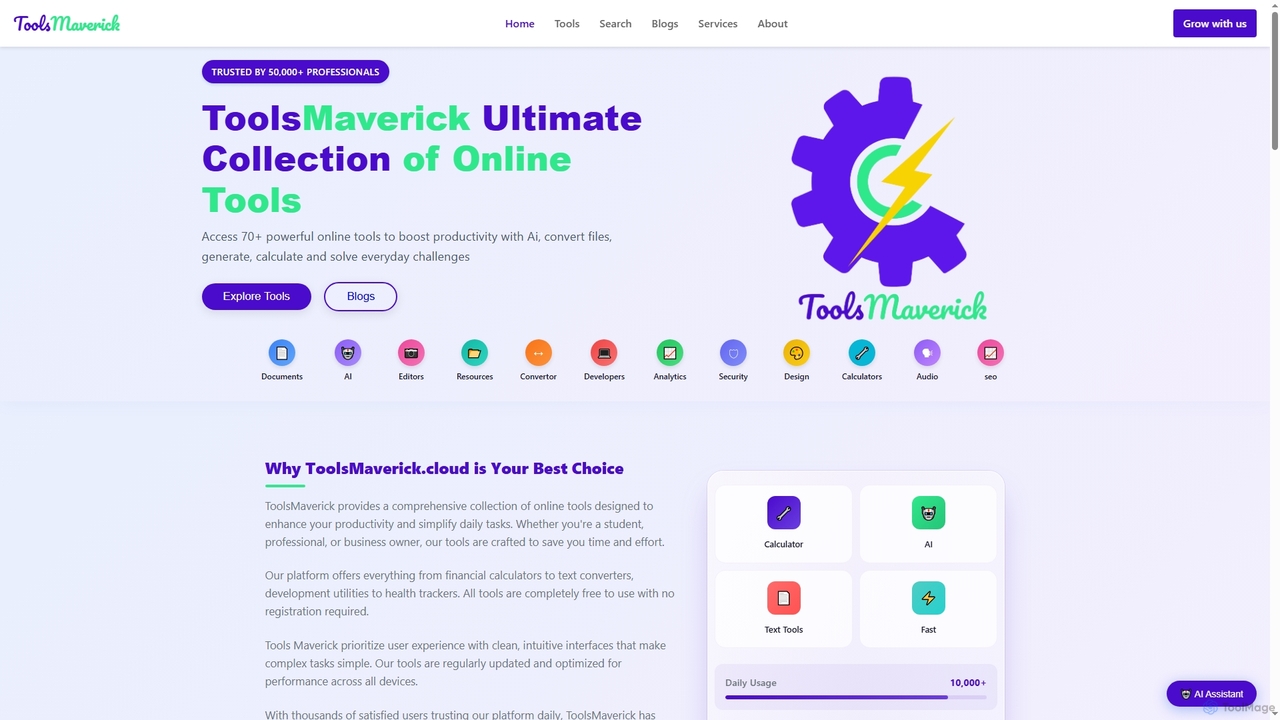
ToolsMaverick is a comprehensive, free online platform offering over 70 diverse utilities, including powerful AI tools, calculators, converters, SEO aids, and development tools. Designed for simplicity, it requires no sign-up, features no ads, and provides immediate access to enhance productivity for professionals, students, and everyday users.

Content Analysis
Visits 6.5KFavorites 139Likes 146

About Unit Conversion

Unit Conversion tools are digital utilities designed to accurately transform values from one unit of measurement to another. These tools leverage extensive databases of conversion factors and mathematical algorithms to ensure precision across various domains. They are essential for professionals, students, and everyday users who need to work with different measurement systems, facilitating global collaboration and data consistency.

Core Features

  • Comprehensive Unit Libraries: Support for a vast array of unit types including length, weight, volume, temperature, time, currency, and data.
  • Real-time Conversion: Provides instantaneous results as values are entered, enhancing efficiency.
  • Customizable Precision: Allows users to specify the number of decimal places or significant figures for tailored accuracy.
  • Batch Conversion: Enables the simultaneous conversion of multiple values or lists of data, saving considerable time.
  • User-friendly Interface: Features intuitive designs for easy input, clear display of results, and quick navigation.

Applicable Scenarios

These tools are indispensable in fields like engineering for converting specifications between metric and imperial systems, in scientific research for standardizing experimental data, and in international trade for managing product dimensions and weights across borders. They also assist in daily tasks such as adapting recipes or planning travel budgets.

How to Choose

When selecting a Unit Conversion tool, consider its unit coverage to ensure it supports all necessary types and specific units. Evaluate its accuracy and reliability, checking if conversion factors are up-to-date. Prioritize ease of use with an intuitive interface for quick and efficient conversions, and consider offline capability if mobile access without internet is crucial.

Unit Conversion use cases

1

International Engineering Project Management

Engineers working on global projects frequently encounter blueprints and material specifications in different measurement systems (e.g., metric vs. imperial). Unit conversion tools enable them to quickly and accurately convert dimensions, weights, and volumes, ensuring all team members and suppliers operate with standardized data, preventing costly errors and delays in construction or manufacturing processes.

2

Standardizing Engineering Designs

Engineers and architects frequently work with blueprints and specifications that may use different measurement systems (e.g., imperial in the US, metric in Europe). Unit conversion tools allow them to quickly and accurately convert dimensions, material properties, and tolerances, ensuring all components fit together correctly regardless of their origin. This prevents costly manufacturing errors and streamlines international collaboration on projects.

3

International Engineering Project Coordination

Engineers working on global projects frequently need to convert design specifications, material dimensions, and structural measurements between metric (e.g., meters, kilograms) and imperial (e.g., feet, pounds) systems. Unit conversion tools ensure all team members use consistent data, preventing costly errors and ensuring project compatibility across different regions.

4

Financial Analyst Currency Exchange

Financial analysts and investors dealing with international markets require real-time and accurate currency conversions for portfolio valuation, trade analysis, and expense reporting. Unit conversion tools, especially those with live data feeds, allow them to instantly convert values between different currencies, facilitating informed decision-making and precise financial reporting without manual lookups or outdated rates.

5

Scientific Data Standardization

Researchers in various scientific disciplines often collect data using different units (e.g., temperature in Celsius vs. Fahrenheit, volume in milliliters vs. cubic centimeters). Unit conversion tools allow them to quickly standardize all experimental results into a single, consistent unit for accurate analysis, comparison, and publication, ensuring data integrity.

6

Analyzing Scientific Research Data

Researchers in fields like physics, chemistry, and biology often collect data using various instruments that output measurements in different units. Before analysis or publication, all data must be converted to a consistent standard. Unit conversion tools ensure the accuracy of these transformations, preventing misinterpretations and facilitating cross-study comparisons. This is crucial for maintaining the integrity and reproducibility of scientific findings.

7

Scientific Research Data Standardization

Researchers in scientific fields often collect data using various instruments and methodologies, resulting in measurements in diverse units (e.g., Celsius vs. Kelvin, Pascals vs. PSI). Unit conversion tools are crucial for standardizing this data into a consistent format for accurate analysis, comparison, and publication, ensuring the integrity and reproducibility of scientific findings across different studies and labs.

8

Global Supply Chain and Logistics Management

Logistics professionals and import/export businesses must accurately convert cargo weight, volume, and dimensions to comply with international shipping regulations, customs declarations, and freight cost calculations. These tools streamline the process, ensuring correct documentation and avoiding delays or penalties due to unit discrepancies.

9

Facilitating International Trade and Logistics

Businesses involved in international trade must constantly deal with varying units for weight, volume, and currency. Unit conversion tools enable seamless conversion of product specifications, shipping container capacities, and financial figures to comply with different national standards and regulations. This ensures accurate invoicing, efficient cargo loading, and smooth customs clearance, minimizing delays and costs in global supply chains.

10

Adjusting Recipes for Culinary Arts

Chefs and home cooks often encounter recipes from different regions or eras that use unfamiliar measurement units (e.g., grams vs. ounces, milliliters vs. fluid ounces). Unit conversion tools allow them to accurately scale recipes up or down, or convert ingredient quantities to their preferred system. This ensures consistent results, prevents waste, and empowers culinary creativity without being hindered by measurement discrepancies.

11

E-commerce Product Listing Localization

E-commerce businesses selling globally need to present product information in local units to cater to diverse customer bases and comply with regional shipping regulations. Unit conversion tools help online retailers quickly convert product dimensions (length, width, height, weight) and other specifications into the preferred units of different marketplaces, improving customer experience and reducing misinterpretations.

12

Recipe Adaptation and Culinary Arts

Home cooks and professional chefs often encounter recipes from different countries or culinary traditions that use varying measurement units (e.g., grams to cups, milliliters to fluid ounces, Celsius to Fahrenheit for oven temperatures). Unit conversion tools enable precise scaling and adaptation of recipes, ensuring desired taste and texture.

13

Software Development Data Unit Handling

In software development, especially for systems programming, networking, or data storage solutions, developers frequently need to convert between different data units (e.g., bits to bytes, kilobytes to gigabytes). Unit conversion tools ensure accurate calculations for memory allocation, bandwidth measurement, and file size reporting, preventing potential bugs or performance issues arising from incorrect unit interpretations.

14

Financial Exchange Rate Calculation for Travel and Business

Travelers, international businesses, and financial analysts frequently need to convert currencies to understand costs, manage budgets, or process transactions across different monetary systems. Unit conversion tools provide real-time or historical exchange rates, allowing for accurate financial planning and expense reporting.

15

Planning International Travel

Travelers often need to convert various units when planning trips abroad. This includes converting temperatures (Celsius to Fahrenheit), distances (kilometers to miles), fuel consumption (liters per 100km to miles per gallon), and currency exchange rates. Unit conversion tools provide quick access to these essential conversions, helping travelers make informed decisions about packing, transportation, and budgeting, enhancing their overall travel experience.

16

Software Localization and Internationalization

Software developers building applications for a global audience must localize various units of measurement within their user interfaces. This includes converting distances (miles to kilometers), temperatures (Fahrenheit to Celsius), and weights (pounds to kilograms) based on the user's region, ensuring a culturally relevant and user-friendly experience.

17

Travel Planning & Budgeting

Travelers planning international trips often need to convert various units, such as currency for budgeting, temperatures for packing, and distances for navigation. Unit conversion tools provide quick access to these conversions, helping individuals accurately estimate costs, prepare appropriately for weather conditions, and understand travel distances, making the planning process smoother and more efficient.

18

Educational Support for Students

Students learning science, mathematics, or engineering often struggle with understanding and performing unit conversions. Unit conversion tools serve as an excellent educational aid, allowing students to practice conversions, verify their manual calculations, and visualize the relationships between different units. This hands-on experience reinforces their understanding of measurement systems and improves problem-solving skills in academic settings.

Unit Conversion FAQ

What are Unit Conversion tools?

Unit Conversion tools are digital applications or platforms designed to accurately transform numerical values from one unit of measurement to another. For example, they can convert meters to feet, kilograms to pounds, or Celsius to Fahrenheit. They are essential for ensuring consistency and accuracy when working with diverse measurement systems across various fields.

What are Unit Conversion tools?

Unit Conversion tools are digital applications or platforms designed to transform a quantity expressed in one unit of measurement into an equivalent quantity in another unit. They are a specialized type of converter, focusing exclusively on measurement units across various categories like length, weight, volume, temperature, and currency. These tools ensure accuracy by using standardized conversion factors and algorithms, making them essential for tasks requiring precise data handling.

What are Unit Conversion tools?

Unit Conversion tools are digital applications or platforms designed to transform a value from one unit of measurement to another, such as converting meters to feet, Celsius to Fahrenheit, or USD to EUR. They leverage mathematical formulas and conversion factors to provide accurate results. These tools are crucial for standardizing data, facilitating cross-system compatibility, and ensuring precision in various professional and daily tasks.

How do I choose a reliable Unit Conversion tool?

To choose a reliable unit conversion tool, prioritize accuracy by checking if it uses up-to-date, standardized conversion factors. Evaluate the breadth of supported unit categories and specific units to ensure it covers your needs. A user-friendly interface with clear input/output fields and real-time results is crucial for efficiency. Consider features like offline functionality, custom unit definitions, and batch processing if your workflow demands them. Finally, look for tools with a good reputation for reliability and regular updates.

How do Unit Conversion tools ensure accuracy?

These tools ensure accuracy by relying on established international standards, precise mathematical formulas, and comprehensive databases of conversion factors. High-quality unit conversion tools regularly update their internal data to reflect the latest scientific definitions, official standards, and real-time exchange rates for currency conversions, minimizing errors.

How do Unit Conversion tools ensure accuracy?

Unit Conversion tools ensure accuracy primarily through the use of established, precise mathematical formulas and conversion factors derived from scientific standards. For dynamic units like currency, they often integrate with reliable, real-time data feeds from financial institutions or global exchanges. Advanced tools may also allow users to verify or customize conversion factors, and offer precision control (e.g., number of decimal places) to meet specific accuracy requirements.

What's the difference between a general 'Converter' and a 'Unit Conversion' tool?

A general 'Converter' is a broad category that includes tools for transforming various types of data or formats, such as file converters (PDF to Word), video converters, or image converters. A 'Unit Conversion' tool, however, is a specific type of converter focused exclusively on transforming values between different units of measurement (e.g., length, weight, temperature, currency). While all unit conversion tools are converters, not all converters are unit conversion tools.

What types of units can these tools typically convert?

Unit Conversion tools can typically convert a wide array of unit types across different physical quantities. This includes common categories like length, mass, volume, temperature, time, speed, pressure, energy, data storage, and currency. More advanced tools may also offer specialized units relevant to specific scientific or engineering disciplines.

What types of units can Unit Conversion tools typically convert?

Unit Conversion tools are designed to handle a vast array of measurement units across numerous categories. Commonly supported categories include length (e.g., meters, feet, miles), weight/mass (e.g., kilograms, pounds, ounces), volume (e.g., liters, gallons, cubic meters), temperature (e.g., Celsius, Fahrenheit, Kelvin), speed (e.g., km/h, mph, m/s), area, time, pressure, energy, and digital storage. Many advanced tools also support currency exchange rates and custom-defined units, catering to diverse professional and personal needs.

How do Unit Conversion tools ensure accuracy?

Unit Conversion tools ensure accuracy through several mechanisms. Firstly, they rely on comprehensive, regularly updated databases of standardized conversion factors, often derived from international standards organizations. Secondly, they employ robust mathematical algorithms that perform calculations with high precision, minimizing rounding errors. Many tools also allow users to specify the desired level of precision (e.g., number of decimal places) and provide clear indications of the source of their conversion data, building trust in their results.

Who benefits most from using Unit Conversion tools?

Professionals in fields such as engineering, science, finance, and international trade benefit significantly from unit conversion tools, as they frequently encounter data in different measurement systems. Students, travelers, and even home cooks also find these tools invaluable for academic tasks, budgeting, or adapting recipes, ensuring precision in daily life.

Can Unit Conversion tools handle custom or obscure units?

Many advanced Unit Conversion tools offer the ability to handle custom or obscure units. This typically involves allowing users to input their own conversion factors or define new units based on existing ones. This feature is particularly valuable in specialized scientific, engineering, or industrial contexts where unique measurement systems or proprietary units might be in use, ensuring flexibility beyond standard conversions.

Who benefits most from using Unit Conversion tools?

A wide range of users benefits from Unit Conversion tools. Engineers and scientists rely on them for precise data standardization in research and development. Financial professionals use them for real-time currency exchange in global markets. Students find them invaluable for academic tasks involving different measurement systems. Additionally, travelers, chefs, and anyone dealing with international specifications or diverse measurement units in daily life can significantly benefit from their accuracy and convenience.

What is the difference between a general 'Converter' and a 'Unit Conversion' tool?

A general 'Converter' is a broad category of tools that can transform data or objects from one format or type to another. This might include file converters (e.g., PDF to Word), media converters (e.g., MP4 to MP3), or even currency converters. A 'Unit Conversion' tool, however, is a specific type of converter focused exclusively on transforming numerical values between different units of measurement within the same physical quantity (e.g., meters to feet, kilograms to pounds). While all unit conversion tools are converters, not all converters are unit conversion tools.

What is the difference between a general "Converter" and a "Unit Conversion" tool?

A general "Converter" is a broader category that encompasses tools for various types of data transformation, such as file format conversion (e.g., PDF to Word), video conversion, or image format conversion. In contrast, a "Unit Conversion" tool specifically focuses on transforming numerical values between different units of measurement within the same physical quantity, like converting a length from inches to centimeters, or a weight from grams to ounces.