ToolMage
Sign in

Best 1 Predictive Modeling AI tools for Data

Popular Predictive Modeling AI tools in Data include CulturePulse, helping you work more efficiently.

CulturePulse
Paid

CulturePulse

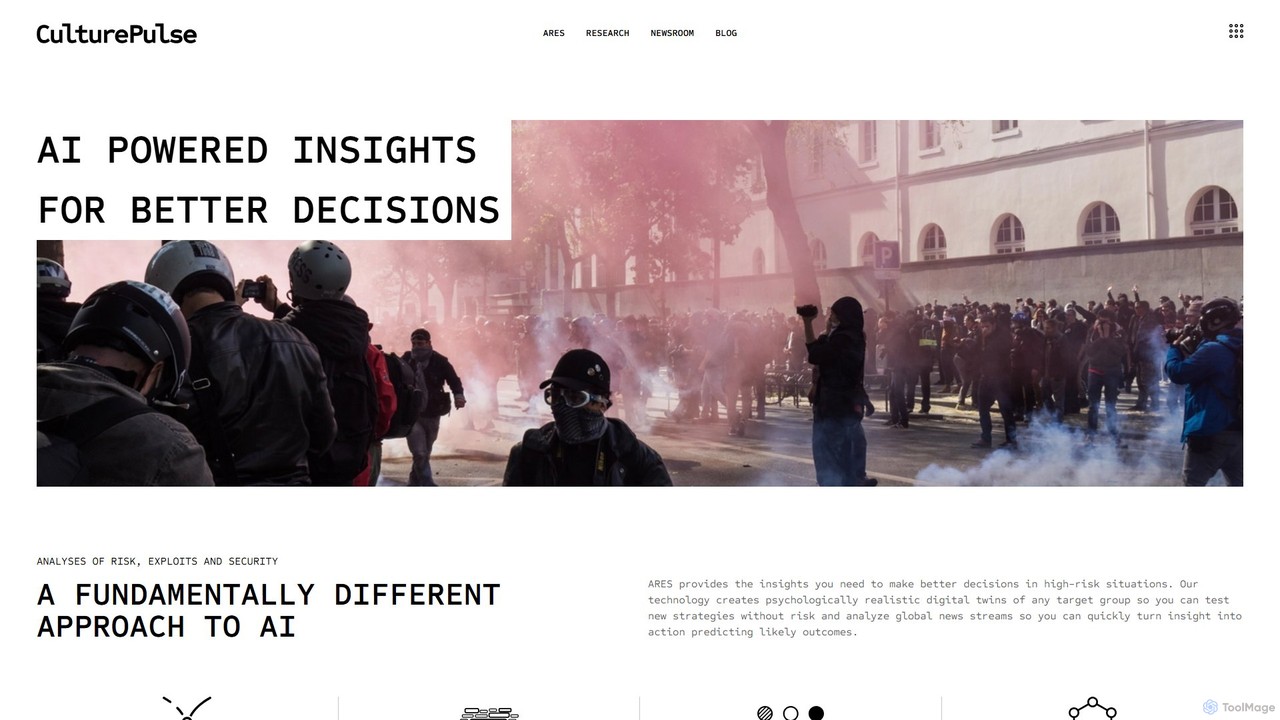
CulturePulse is an advanced AI platform that provides deep insights for high-stakes decision-making. It creates psychologically realistic digital twins of populations to simulate the impact of policies and strategies in a risk-free environment. By analyzing global data streams, it helps governments and businesses understand complex social dynamics, predict outcomes, and turn insight into action.

Risk Management
Visits 9.7KFavorites 148Likes 139

About Predictive Modeling

Predictive Modeling tools are a specialized category of analytics software that use statistical algorithms and machine learning to analyze historical data and predict future outcomes. These platforms automate building, testing, and deploying models that can forecast trends, behaviors, and events with a high degree of accuracy. Businesses leverage predictive modeling to make proactive, data-driven decisions, moving beyond historical reporting to anticipate future opportunities and risks. The core value lies in transforming raw data into actionable, forward-looking insights.

Core Features

  • Algorithm Library: Access a range of pre-built algorithms like regression, classification, and clustering for different prediction tasks.
  • Automated Feature Engineering: Automatically create and select the most relevant data variables to improve model accuracy.
  • Model Validation and Tuning: Test model performance against unseen data and automatically optimize its parameters.
  • Deployment and Integration: Easily deploy trained models via APIs to integrate predictions into other business applications.
  • Model Performance Monitoring: Continuously track the accuracy of deployed models and alert for performance degradation or data drift.

Use Cases

Predictive modeling is widely applied across industries such as finance for credit scoring, retail for demand forecasting, marketing for customer churn prediction, and manufacturing for predictive maintenance. It empowers roles like data analysts, marketing managers, and financial planners to anticipate future trends and optimize strategies accordingly.

How to Choose

When selecting a tool, consider the variety of algorithms offered, the ease of data integration with your existing systems, the level of automation in the model-building process, and scalability for handling large datasets. Also, evaluate the user interface to ensure it matches your team's technical skill level, from no-code platforms to code-first environments.

Predictive Modeling use cases

1

Customer Churn Prediction

A marketing manager at a subscription-based service needs to proactively reduce customer churn. Using a predictive modeling tool, they upload historical customer data, including usage patterns, subscription length, and support ticket history. The tool automatically builds a classification model that assigns a 'churn risk score' to each active customer. The marketing team can then target high-risk customers with personalized retention campaigns, such as special offers or proactive support, effectively reducing churn rates by 15-20%.

2

Sales and Demand Forecasting

A retail operations manager is responsible for inventory management across hundreds of stores. They use a predictive modeling tool to analyze past sales data, seasonality, promotional events, and economic indicators. The platform generates accurate weekly and monthly sales forecasts for each product category and store location. This allows the company to optimize stock levels, minimize overstocking costs, and prevent stockouts of popular items, improving supply chain efficiency and customer satisfaction.

3

Credit Risk Assessment

A loan officer at a financial institution must evaluate the risk of new loan applications quickly and accurately. By feeding historical loan data (including defaults and successful repayments) into a predictive modeling platform, the institution develops a robust credit scoring model. The model analyzes an applicant's financial profile and provides an instant risk score. This automates the initial screening process, ensures consistent and unbiased decision-making, and significantly reduces the rate of loan defaults.

4

Predictive Maintenance for Equipment

A plant manager in a manufacturing facility aims to prevent costly, unplanned equipment downtime. They deploy sensors on critical machinery to collect real-time operational data like temperature, vibration, and pressure. This data is fed into a predictive modeling tool that has been trained to recognize patterns preceding a failure. The system alerts maintenance teams about potential issues before they occur, allowing them to schedule repairs during planned downtime, extending equipment life and saving thousands in lost production.

5

Dynamic Pricing Optimization

An e-commerce manager for an online travel agency wants to maximize revenue by adjusting prices in real-time. They use a predictive modeling tool to analyze competitor pricing, booking demand, seasonality, and customer behavior data. The model predicts the optimal price for flights and hotels that maximizes both booking volume and profit margin. The system can automatically adjust prices on the website, responding instantly to market changes and increasing overall revenue.

6

Lead Scoring for Sales Conversion

A marketing operations specialist in a B2B tech company needs to prioritize leads for the sales team. They connect their CRM and marketing automation platform to a predictive modeling tool. The tool analyzes the attributes and behaviors of past customers who successfully converted (e.g., company size, job title, website engagement). It then builds a model to score new incoming leads based on their likelihood to convert, allowing the sales team to focus their efforts on the most promising prospects and increase their conversion rate.

Predictive Modeling FAQ

What is Predictive Modeling?

Predictive Modeling is a statistical process that uses machine learning and data mining to predict future outcomes based on historical data. Unlike tools that only report on past events, predictive modeling tools build mathematical models to forecast what is likely to happen next. These models identify patterns and relationships in data to generate predictions about future trends, customer behavior, or operational risks, enabling businesses to make proactive decisions.

How do I choose the right Predictive Modeling tool?

Choosing the right tool depends on several factors. Consider the following:

  • User Skill Level: Select a no-code/low-code platform for business users or a more advanced, code-friendly tool for data scientists.
  • Algorithm Availability: Ensure the tool supports the specific types of models you need (e.g., regression for forecasting, classification for churn prediction).
  • Integration: Check if it easily connects with your existing data sources, such as databases, CRMs, and data warehouses.
  • Scalability: Verify that the platform can handle the volume and velocity of your data as your business grows.

What is the difference between Predictive Modeling and Descriptive Analytics?

The key difference lies in their purpose. Descriptive Analytics, a common form of business intelligence, focuses on summarizing historical data to understand what has already happened (e.g., 'What were our sales last quarter?'). Predictive Modeling, on the other hand, uses that historical data to forecast what will happen in the future (e.g., 'What will our sales be next quarter?'). In short, descriptive analytics is backward-looking, while predictive modeling is forward-looking.

What are the key steps in a predictive modeling process?

A typical predictive modeling workflow involves several key steps. It starts with defining the business problem and collecting relevant data. Next is data preprocessing, which involves cleaning and formatting the data. The core step is model building, where an algorithm is selected and trained on the historical data. After training, the model is evaluated for accuracy and then deployed to make predictions on new, unseen data. Finally, the model's performance is continuously monitored to ensure it remains accurate over time.

Who typically uses Predictive Modeling tools?

Predictive Modeling tools are used by a wide range of professionals. Data scientists and analysts use them to build and fine-tune complex models. Business analysts and marketing managers use more user-friendly platforms to forecast sales, predict customer churn, and optimize campaigns. Financial analysts use them for risk assessment and fraud detection, while operations managers apply them for demand forecasting and predictive maintenance. The audience is expanding from technical experts to business decision-makers.