ToolMage
Sign in

Best 1 Search AI tools for Data & Content

Popular Search AI tools in Data & Content include Mcplist, helping you work more efficiently.

Mcplist
Free

Mcplist

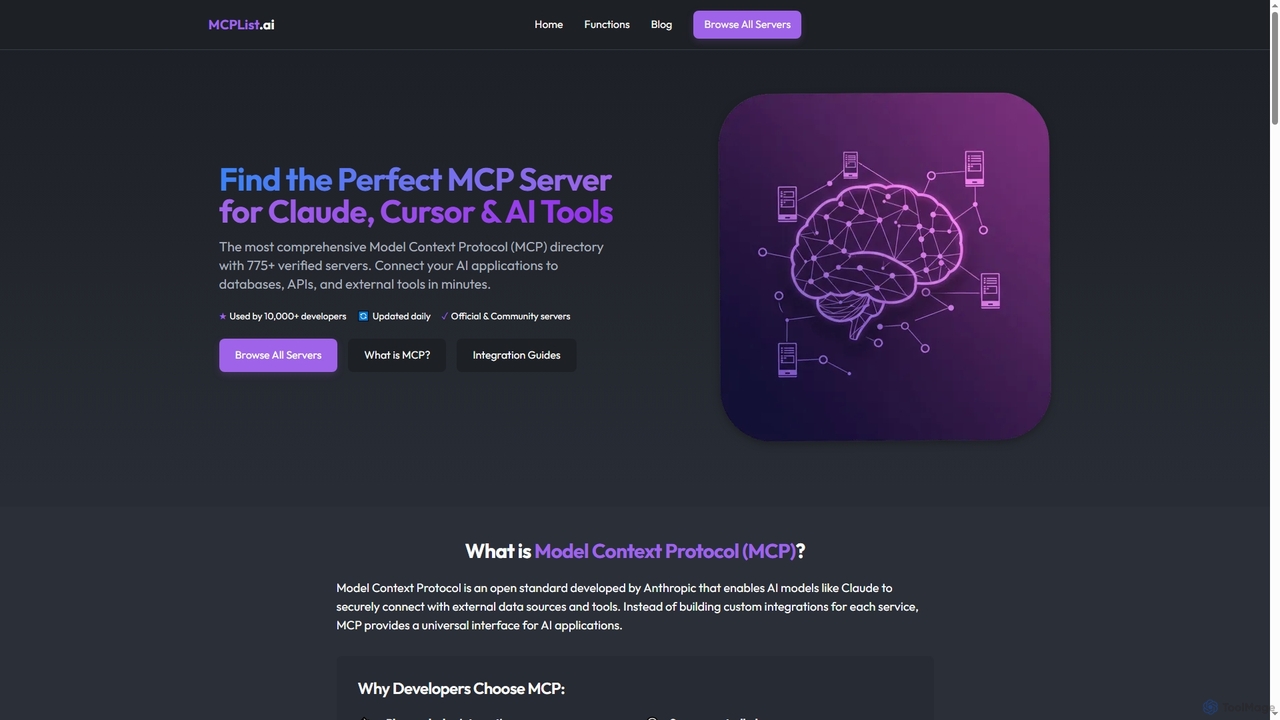
Mcplist is the most comprehensive directory of Model Context Protocol (MCP) servers, designed for developers. It features over 775 verified official and community servers, enabling AI applications like Claude and Cursor to seamlessly connect with external databases, APIs, and tools. The platform offers powerful search, filtering, and step-by-step integration guides to accelerate AI development.

3D
Visits 3.4KFavorites 130Likes 134

About Search

AI Search tools are advanced platforms that leverage artificial intelligence to significantly enhance information retrieval. These tools utilize natural language processing (NLP), machine learning, and semantic understanding to go beyond traditional keyword matching. Their primary value lies in delivering more accurate, relevant, and context-aware results, enabling users to find information faster and more efficiently across diverse data sources.

Core Features

  • Semantic Understanding: Interprets the meaning and intent behind queries, not just keywords.
  • Contextual Filtering: Refines search results based on user roles, location, or document metadata.
  • Personalized Results: Adapts search rankings and suggestions based on individual user behavior and preferences.
  • Natural Language Querying: Allows users to ask questions in conversational language, similar to human interaction.
  • Federated Search: Unifies and searches across multiple disparate internal and external data repositories.

Applicable Scenarios

AI Search is crucial for organizations managing vast amounts of information, from internal knowledge bases to customer-facing portals. It empowers employees to quickly access critical data and helps customers find precise answers, reducing support load and improving satisfaction. It also significantly boosts productivity in research and content discovery.

How to Choose

When selecting an AI Search solution, evaluate its ability to integrate with your existing data infrastructure and its proficiency in handling complex, natural language queries. Consider scalability for future data growth and user traffic, along with the level of customization and control offered to fine-tune relevance and ranking algorithms to your specific needs.

Featured tool rankings

Search use cases

1

Enhanced Internal Knowledge Base Search

For large enterprises, employees often struggle to find specific policies, project documents, or technical specifications within vast internal knowledge bases. AI Search tools allow staff to use natural language queries, like "How do I submit a travel expense report for international trips?", to instantly retrieve the most relevant and up-to-date information, significantly reducing search time and improving operational efficiency.

2

Intelligent Customer Support Portals

Customer service departments can deploy AI Search on their self-service portals to empower users. Instead of sifting through FAQs, customers can ask complex questions such as "What is the warranty policy for a refurbished laptop purchased last year?" and receive precise answers drawn from manuals, forums, and support articles, leading to higher customer satisfaction and reduced call volumes.

3

E-commerce Product Discovery

Online retailers can leverage AI Search to transform how customers find products. Shoppers can use descriptive, non-keyword phrases like "comfortable running shoes for flat feet" or "eco-friendly kitchen gadgets" to discover items that match their nuanced preferences, even if those exact terms aren't in the product title, boosting conversion rates and improving the shopping experience.

4

Research and Content Curation

Researchers, analysts, and content creators often need to sift through massive amounts of academic papers, news articles, and industry reports. AI Search tools enable them to quickly identify highly relevant information by understanding the context and relationships between concepts, accelerating literature reviews, trend analysis, and the discovery of unique insights for new content.

5

Legal Document Review

Legal professionals face the daunting task of reviewing thousands of pages of contracts, case files, and discovery documents. AI Search allows them to rapidly locate specific clauses, precedents, or factual details using semantic queries, such as "find all instances of force majeure clauses related to supply chain disruptions," drastically cutting down review time and improving accuracy in legal research.

6

Developer Code and Documentation Search

Software development teams can utilize AI Search to improve productivity. Developers can search internal code repositories and documentation using natural language, like "how to implement a secure authentication token in Python," to quickly find relevant code snippets, API documentation, or best practices, reducing redundant work and accelerating development cycles.

Search FAQ

What are AI Search tools?

AI Search tools are advanced software solutions that use artificial intelligence, including natural language processing (NLP) and machine learning, to understand the meaning and intent behind user queries. Unlike traditional keyword-based search, they deliver highly relevant and context-aware results by interpreting semantics, improving the accuracy and efficiency of information retrieval across various data sources.

How do AI Search tools differ from traditional search engines?

The primary difference lies in their approach to understanding queries. Traditional search engines primarily rely on keyword matching, while AI Search tools employ semantic understanding to grasp the context and intent of a query. This allows AI Search to provide more relevant, personalized, and comprehensive results, even for complex or ambiguously phrased questions, by going beyond exact word matches.

What are the key benefits of implementing AI Search?

Implementing AI Search offers several significant benefits: enhanced accuracy and relevance of search results, leading to faster information discovery; improved user experience through intuitive natural language querying; increased operational efficiency by reducing time spent searching; and better utilization of organizational data by making it more accessible and discoverable. It ultimately boosts productivity and decision-making.

What should I consider when choosing an AI Search solution?

When selecting an AI Search solution, consider its ability to seamlessly integrate with your existing data sources and systems. Evaluate its natural language processing capabilities for understanding complex queries, its scalability to handle growing data volumes, and the level of customization it offers for fine-tuning relevance and ranking. Also, assess its security features and user management options.

Can AI Search be integrated with existing enterprise systems?

Yes, most modern AI Search solutions are designed for seamless integration with a wide range of existing enterprise systems. This often includes content management systems (CMS), customer relationship management (CRM) platforms, enterprise resource planning (ERP) systems, internal databases, and cloud storage solutions. Integration is typically achieved through APIs, connectors, or pre-built plugins, allowing for a unified search experience across disparate data silos.