Sinaptic
Sinaptic is a browser extension that safeguards sensitive personal and health information (PII/PHI) from accidental leakage to AI …
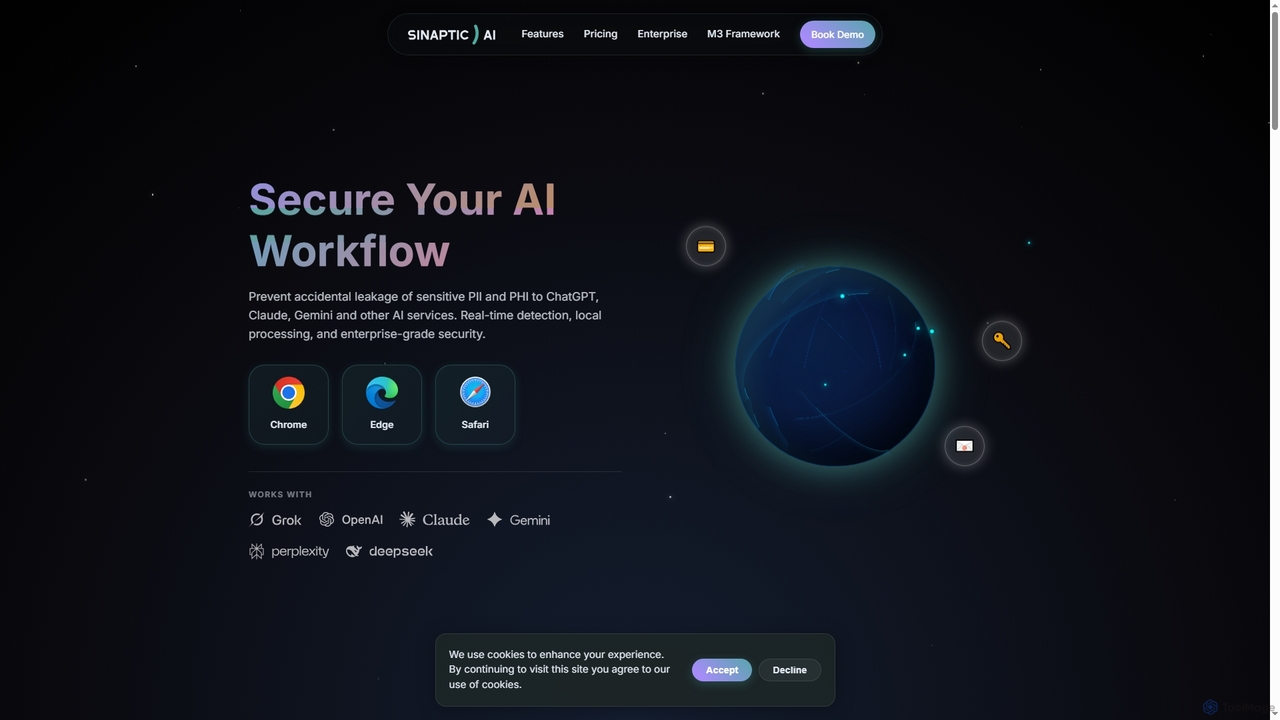
Sinaptic is a browser extension that safeguards sensitive personal and health information (PII/PHI) from accidental leakage to AI tools like ChatGPT, Claude, and Gemini. It offers real-time detection, local processing for privacy, and enterprise-grade security to ensure data protection in AI workflows.
About Data Security
AI Data Security tools are a class of solutions that leverage machine learning to proactively identify, classify, and protect sensitive data against evolving threats. These tools utilize advanced algorithms for anomaly detection and user behavior analytics, moving beyond traditional, rule-based security measures. They are essential for automating compliance, preventing data breaches, and managing access policies in complex cloud and on-premise environments. The primary advantage of AI in data security is its ability to adapt to new attack vectors and detect subtle insider threats that static systems often miss.
Core Features
- Threat Detection & Response: Uses AI to analyze network traffic and user behavior in real-time to identify and neutralize potential threats like malware or unauthorized access.
- Automated Data Classification: Automatically scans, discovers, and categorizes sensitive data (e.g., PII, financial records) across various storage systems to ensure proper handling.
- Insider Threat Detection: Models normal user behavior to accurately flag suspicious activities, such as unusual data access patterns or large data transfers.
- Compliance Automation: Continuously monitors data handling processes to ensure adherence to regulations like GDPR, CCPA, and HIPAA, and generates automated reports.
Use Cases
AI Data Security tools are critical in sectors handling sensitive information. Financial institutions use them to protect customer financial data and prevent fraud. Healthcare organizations rely on them to secure electronic health records (EHR) and comply with HIPAA. Tech companies deploy these tools to safeguard intellectual property and source code from both external attacks and internal risks.
How to Choose
When selecting an AI Data Security tool, first assess its integration capabilities with your existing infrastructure, including cloud platforms (AWS, Azure) and SIEM systems. Evaluate the tool's detection accuracy, specifically its false positive and false negative rates, to avoid alert fatigue. Consider its scalability to handle growing data volumes and ensure it supports the specific regulatory frameworks, like GDPR or HIPAA, that your organization must comply with.
Data SecurityUse Cases
Automate Sensitive Data Discovery for Compliance
A compliance officer at a global financial firm is tasked with ensuring GDPR compliance across all data repositories. Using an AI Data Security tool, they initiate an automated scan of cloud storage, databases, and shared drives. The AI engine identifies and tags Personally Identifiable Information (PII) and sensitive financial data based on content and context, creating a comprehensive data inventory. This process, which would take months manually, is completed in days, providing a real-time map of sensitive data and enabling the officer to apply appropriate protection policies and generate compliance reports instantly.
Detect and Prevent Insider Threats in Real-Time
A security analyst at a tech company needs to protect valuable source code. The AI Data Security platform establishes a baseline of normal data access behavior for each developer. When a developer who typically works on the front-end suddenly starts downloading large volumes of back-end source code outside of normal working hours, the AI flags this as a high-risk anomaly. The analyst receives an immediate alert with contextual details, allowing them to investigate and temporarily suspend the user's access, preventing a potential intellectual property theft before it occurs.
Secure Cloud Infrastructure Misconfigurations
A DevOps team manages a complex AWS environment with hundreds of S3 buckets and EC2 instances. An AI-powered Cloud Security Posture Management (CSPM) tool continuously scans their cloud configurations against industry best practices and compliance frameworks. The tool detects an S3 bucket that was accidentally made public during a recent deployment. It automatically triggers an alert, provides step-by-step remediation guidance, and in some configured cases, can automatically revert the permission setting to private. This prevents a major data leak of customer information stored in the bucket, reducing the mean time to remediation (MTTR) from hours to minutes.
Enhance Security Incident Response with AI
A Security Operations Center (SOC) team is overwhelmed by thousands of daily alerts from various security tools. An AI-driven Security Orchestration, Automation, and Response (SOAR) platform is deployed to help. When a potential breach is detected, the AI correlates alerts from firewalls, endpoint protection, and identity systems to construct a complete attack timeline. It automatically enriches the incident data with threat intelligence, identifies the root cause, and suggests a prioritized list of remediation actions. This allows the SOC team to focus on critical threats, reducing investigation time by over 80% and enabling a much faster, more effective response.
Automate Data Access Governance
A hospital's IT administrator needs to enforce the principle of least privilege for Electronic Health Records (EHR) to comply with HIPAA. An AI-powered data governance tool analyzes actual data usage patterns of doctors, nurses, and administrative staff. Based on this analysis, it recommends fine-grained access policies, suggesting the removal of excessive permissions for users who don't require access to certain patient data for their roles. The administrator can review and approve these recommendations, automating a complex and error-prone manual review process and significantly strengthening data security and compliance posture.
Prevent Advanced Phishing and Malware Attacks
An organization's employees are constantly targeted by sophisticated phishing emails that bypass traditional signature-based filters. An AI email security tool is implemented to analyze not just keywords, but also the context, sender reputation, and linguistic patterns of incoming emails. It identifies a spear-phishing attempt impersonating the CEO, which uses subtle psychological cues rather than malicious links. The AI flags the email as highly suspicious and quarantines it before it reaches any employee's inbox, preventing potential financial loss and credential theft from a highly targeted attack.