AstraSQL
AstraSQL is an AI-powered agent that transforms natural language queries into complex, correct SQL, enabling privacy-first database analytics. …
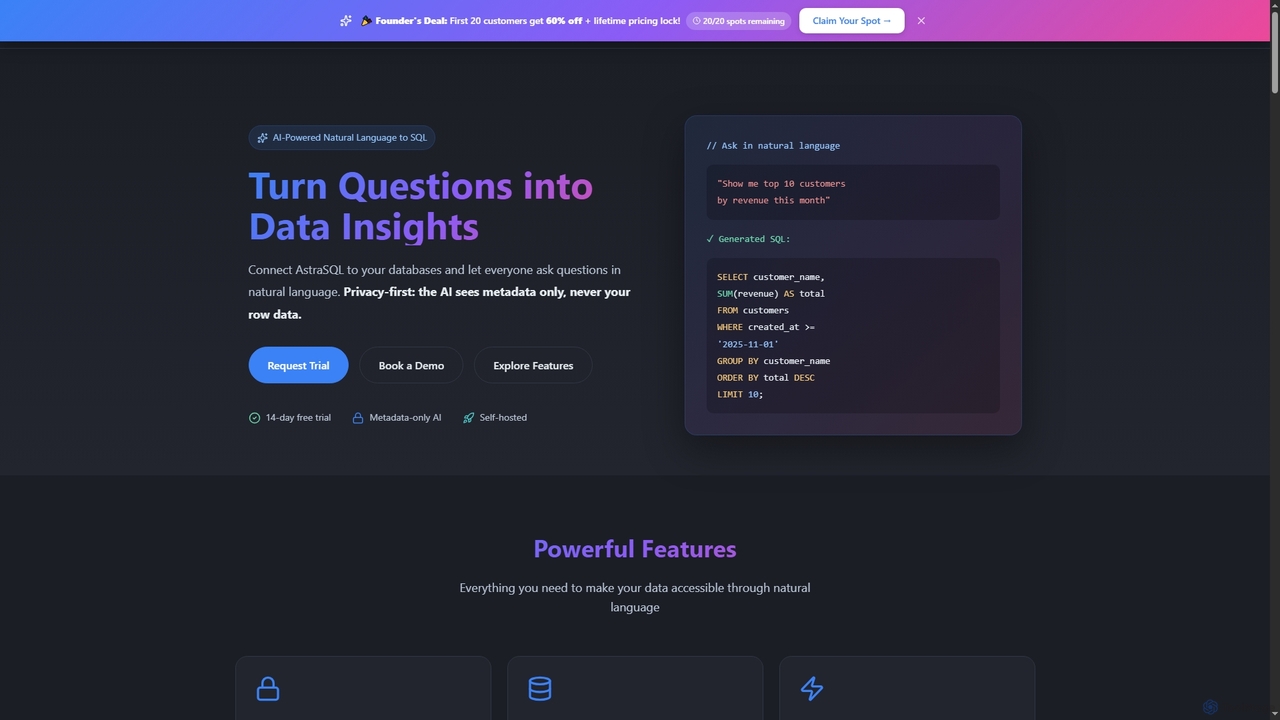
AstraSQL is an AI-powered agent that transforms natural language queries into complex, correct SQL, enabling privacy-first database analytics. It supports multiple databases, offers interactive dashboards, and ensures enterprise-grade security, making data accessible to non-technical users.
About Query Tools
Query Tools are AI-powered applications designed to simplify and enhance the process of retrieving, analyzing, and interacting with data from various sources, particularly within database management. These tools leverage natural language processing (NLP) and machine learning to translate user questions into executable queries, enabling non-technical users to access and understand complex datasets. They empower users to extract insights, generate reports, and perform data exploration with unprecedented ease and speed, bridging the gap between raw data and actionable intelligence.
Core Features
- Natural Language Querying: Allows users to ask questions in plain English or other human languages, which the AI translates into structured database queries (e.g., SQL).
- Automated Query Generation: Automatically constructs complex queries based on user intent, reducing the need for manual coding and syntax knowledge.
- Data Visualization Integration: Often includes built-in or integrated features to visualize query results, making data insights more accessible and understandable.
- Intelligent Data Exploration: Provides suggestions, identifies patterns, and highlights anomalies in data based on user queries, facilitating deeper analysis.
- Multi-Source Data Access: Connects to various database types (SQL, NoSQL) and data warehouses, allowing unified querying across different platforms.
Use Cases
Query Tools are invaluable for business analysts, marketing professionals, and operational managers who need quick access to data without relying on IT departments. They are used to generate on-demand sales reports, analyze customer behavior trends, or monitor operational metrics by simply asking questions in natural language, significantly accelerating decision-making processes.
How to Choose
When selecting Query Tools, consider the range of supported data sources and database types, the accuracy and flexibility of its natural language processing capabilities, and its integration with existing business intelligence or data visualization platforms. Evaluate the ease of use for non-technical staff, the security features for data access, and the scalability to handle growing data volumes and user demands.

Query ToolsUse Cases
Generating On-Demand Sales Performance Reports
Sales managers often need immediate insights into regional sales, product performance, or individual rep metrics. Query Tools allow them to simply ask, "Show me last quarter's sales by region for product X," and receive a visualized report instantly, eliminating delays from manual data extraction or IT requests. This enables agile strategy adjustments and performance monitoring.
Analyzing Customer Behavior for Marketing Campaigns
Marketing teams can leverage Query Tools to understand customer demographics, purchase history, and engagement patterns. By querying "Which customer segments purchased product Y in the last 6 months and responded to email campaign Z?", they can quickly identify target audiences for personalized campaigns, optimizing marketing spend and improving conversion rates.
Monitoring Operational Metrics and Supply Chain Efficiency
Operations managers can use Query Tools to track key performance indicators (KPIs) like inventory levels, delivery times, or production bottlenecks. A query like "What are the average delivery times for supplier A in the past month, broken down by product category?" provides immediate data to identify inefficiencies and make timely adjustments to the supply chain.
Financial Data Exploration for Budgeting and Forecasting
Financial analysts can utilize Query Tools to explore complex financial datasets without writing SQL. They can ask questions such as "Compare Q1 expenses across departments for the last three years" or "Show revenue trends for service X," facilitating more accurate budget planning, variance analysis, and future financial forecasting.
HR Data Analysis for Workforce Planning and Talent Management
HR professionals can gain insights into employee demographics, performance, and retention rates. By querying "What is the average tenure of employees in department Y who joined after 2020?" or "Identify departments with the highest turnover rates," they can inform strategic workforce planning, identify training needs, and improve talent retention initiatives.
Ad-hoc Data Discovery for Business Intelligence
Business intelligence teams and data scientists can use Query Tools for rapid, ad-hoc data discovery and hypothesis testing. Instead of waiting for data engineers to prepare specific datasets, they can directly query "Are there correlations between customer support tickets and product returns in the last year?" to quickly validate assumptions and guide deeper analytical projects.