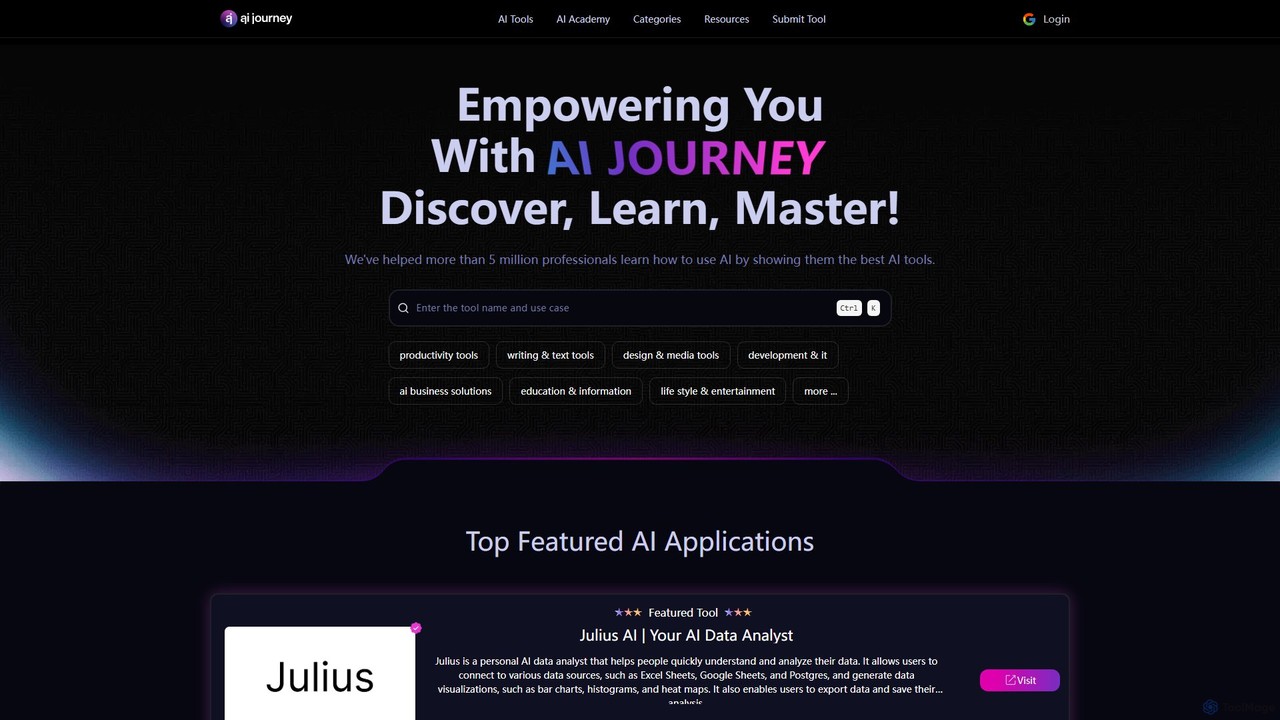
Education & Information AI tools are a class of applications designed to enhance learning, streamline research, and personalize knowledge acquisition. Leveraging technologies like natural language processing (NLP) and machine learning, these tools can summarize complex documents, generate study materials, and provide instant answers to questions. They are widely used by students, researchers, and lifelong learners to accelerate understanding and organize information efficiently. Their key advantage lies in transforming vast amounts of unstructured data into accessible, structured knowledge.
Core Features
- Personalized Learning Paths: Adapts educational content and difficulty based on individual user performance and learning pace.
- Automated Content Summarization: Condenses long articles, research papers, or books into concise summaries and key points.
- Interactive Q&A and Tutoring: Provides instant, conversational answers and detailed explanations on a wide range of subjects.
- Study Aid Generation: Automatically creates flashcards, quizzes, and mind maps from notes or documents to reinforce learning.
- Research Assistance: Helps users find relevant sources, extract data from literature, and identify trends in academic information.
Use Cases
These tools are applicable in academic institutions, corporate training, and personal development. For example, a university student can use an AI tool to quickly grasp the core arguments of dense research papers, while a corporate trainer can create interactive learning modules for new employee onboarding, tailored to different roles.
How to Choose
When selecting a tool, consider the specific learning goal (e.g., language acquisition vs. scientific research), the types of content it supports (text, PDF, video), its integration capabilities with other platforms like Learning Management Systems (LMS), and the accuracy and reliability of its information processing.