ToolMage
Sign in

Best 1 Business Operations AI tools for Erp

Popular Business Operations AI tools in Erp include OptimumHQ, helping you work more efficiently.

OptimumHQ
Paid

OptimumHQ

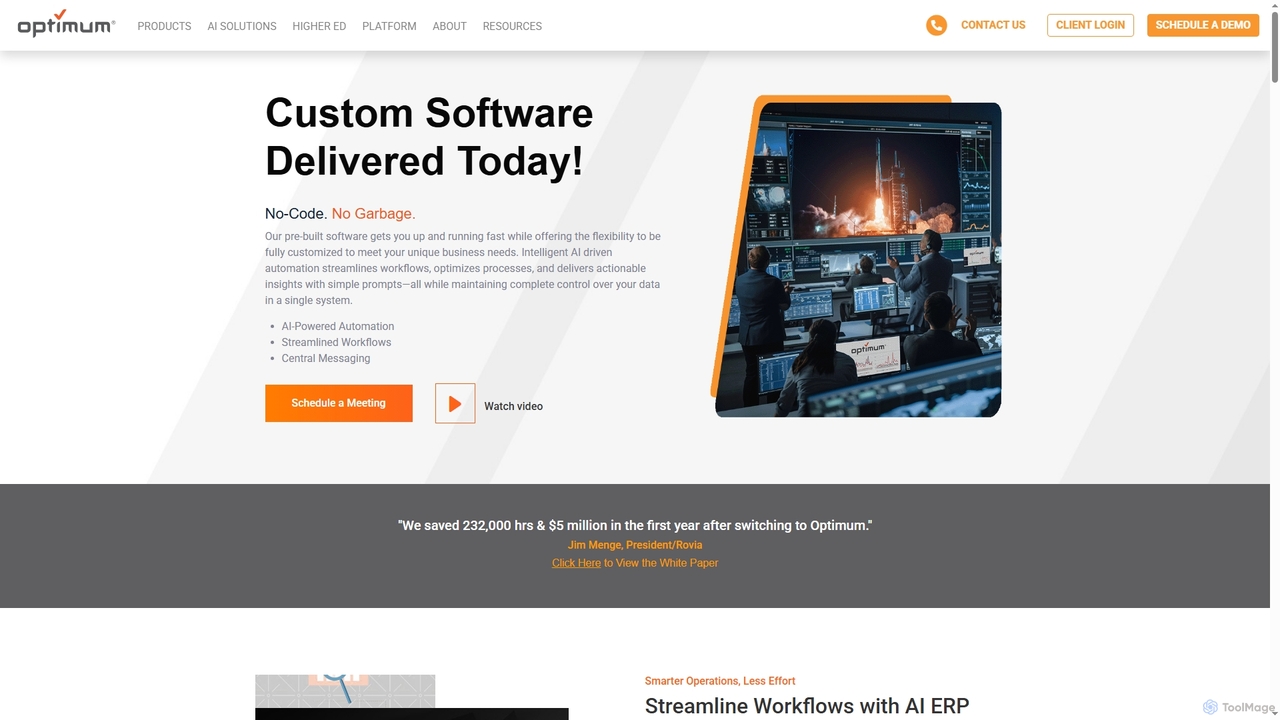
OptimumHQ is a no-code adaptive software platform that empowers businesses to rapidly create custom solutions, leveraging AI-driven automation for streamlined workflows, optimized processes, and actionable insights across ERP, CRM, messaging, and digital forms.

3D
Visits 43.3KFavorites 162Likes 157

About Business Operations

Business Operations AI tools are a specialized subset of Enterprise Resource Planning (ERP) solutions, leveraging artificial intelligence to optimize and automate core business processes. These tools integrate advanced analytics, machine learning, and natural language processing to enhance decision-making, streamline workflows, and improve overall operational efficiency. They empower organizations to move beyond traditional data management, transforming raw data into actionable insights for strategic growth and agility.

Core Features

  • Intelligent Process Automation: Automates repetitive and rule-based tasks across departments, from finance to HR, using AI and RPA.
  • Predictive Analytics for Operations: Utilizes machine learning to forecast operational needs, identify potential bottlenecks, and optimize resource allocation.
  • AI-Powered Workflow Optimization: Analyzes existing workflows, suggests improvements, and dynamically adapts processes for maximum efficiency.
  • Smart Resource Management: Optimizes the allocation of human, financial, and material resources based on real-time data and predictive models.
  • Enhanced Compliance & Risk Management: Monitors operational activities for compliance, identifies anomalies, and mitigates risks through AI-driven insights.

Applicable Scenarios

These tools are crucial for businesses aiming to enhance efficiency, reduce costs, and improve responsiveness across their operational landscape. They are particularly beneficial for manufacturing, logistics, retail, and service industries where complex processes and large data volumes are common. Roles such as operations managers, supply chain directors, and finance controllers heavily rely on these AI solutions to drive strategic improvements.

How to Choose

When selecting Business Operations AI tools, prioritize solutions that offer seamless integration with your existing ERP or business systems to ensure data consistency. Evaluate the depth of AI capabilities, focusing on predictive accuracy, automation flexibility, and the ability to learn and adapt. Consider scalability to accommodate future growth, user-friendliness for quick adoption, and robust security features to protect sensitive operational data. Finally, assess vendor support and the availability of customization options to align with unique business requirements.

Business Operations use cases

1

Automating Invoice Processing and Reconciliation

A finance department uses AI-powered Business Operations tools to automatically extract data from incoming invoices, validate against purchase orders, and reconcile payments. This reduces manual data entry errors, accelerates the payment cycle, and frees up accounting staff to focus on more strategic financial analysis, saving up to 70% of processing time.

2

Optimizing Supply Chain Logistics with Predictive AI

A logistics manager employs Business Operations AI to analyze historical sales data, weather patterns, and global events to predict demand fluctuations and optimize inventory levels. This proactive approach minimizes stockouts, reduces carrying costs, and improves delivery times, leading to a 15% reduction in logistics expenses and enhanced customer satisfaction.

3

Enhancing Customer Service with AI-driven Support Automation

A customer service department integrates AI-powered Business Operations tools to automate responses to common inquiries, route complex issues to the correct agent, and provide agents with real-time customer insights. This improves first-contact resolution rates by 20%, reduces agent workload, and ensures a consistent, high-quality customer experience across all channels.

4

Automating HR Onboarding and Employee Lifecycle Management

An HR department utilizes Business Operations AI to automate the entire employee onboarding process, from document collection and compliance checks to system access provisioning. This streamlines administrative tasks, ensures regulatory adherence, and provides a smoother experience for new hires, reducing onboarding time by 40% and improving HR team efficiency.

5

Predictive Maintenance for Manufacturing Equipment

A manufacturing plant implements Business Operations AI to monitor sensor data from machinery in real-time, predicting potential equipment failures before they occur. This enables proactive maintenance scheduling, minimizes costly downtime, and extends the lifespan of critical assets, leading to a 25% reduction in unplanned maintenance costs and increased production uptime.

6

Automating Marketing Campaign Performance Analysis

A marketing team leverages Business Operations AI to automatically collect and analyze data from various marketing channels (social media, email, ads). The AI identifies top-performing campaigns, suggests budget reallocations, and predicts future campaign effectiveness. This leads to a 30% improvement in ROI for marketing spend and allows marketers to focus on creative strategy rather than manual reporting.

Business Operations FAQ

What are Business Operations AI tools?

Business Operations AI tools are software solutions that use artificial intelligence to automate, optimize, and enhance various core business processes. They leverage machine learning, predictive analytics, and natural language processing to transform raw data into actionable insights, improving efficiency, reducing costs, and supporting strategic decision-making across departments like finance, HR, supply chain, and customer service. These tools are often integrated with broader ERP systems to provide comprehensive operational intelligence.

How do Business Operations AI tools differ from traditional ERP systems?

While traditional ERP systems focus on centralizing and managing business data and processes, Business Operations AI tools go a step further by adding intelligence. ERP provides the framework for data, but AI tools analyze that data to predict trends, automate complex decisions, and optimize processes autonomously. They transform reactive data management into proactive operational intelligence, offering capabilities like predictive maintenance, intelligent automation, and dynamic resource allocation that traditional ERP systems typically lack without AI integration.

What are the key benefits of implementing Business Operations AI?

Implementing Business Operations AI offers several key benefits. Firstly, it significantly enhances operational efficiency by automating repetitive tasks and optimizing workflows, leading to cost reductions. Secondly, it improves decision-making through predictive analytics, allowing businesses to anticipate challenges and opportunities. Thirdly, it boosts agility and responsiveness, enabling organizations to adapt quickly to market changes. Finally, it frees up human capital from mundane tasks, allowing employees to focus on strategic, value-added activities, fostering innovation and growth.

Who can benefit most from Business Operations AI tools?

A wide range of professionals and organizations can benefit significantly from Business Operations AI tools. This includes operations managers seeking to streamline processes, supply chain directors aiming for optimized logistics, finance controllers looking to automate reconciliation, and HR leaders focused on efficient employee lifecycle management. Businesses in manufacturing, retail, logistics, healthcare, and professional services, especially those dealing with large volumes of data and complex workflows, stand to gain the most by leveraging AI to enhance their operational capabilities and competitive edge.

What are the common challenges when implementing Business Operations AI?

Implementing Business Operations AI can present several challenges. Data quality and availability are crucial; poor data can lead to inaccurate AI insights. Integration with existing legacy systems can be complex and costly. There's also the need for specialized AI talent to develop, deploy, and maintain these solutions. Resistance to change from employees, concerns about data privacy and security, and the challenge of accurately measuring ROI are also common hurdles. Overcoming these requires careful planning, robust data governance, and a clear change management strategy.