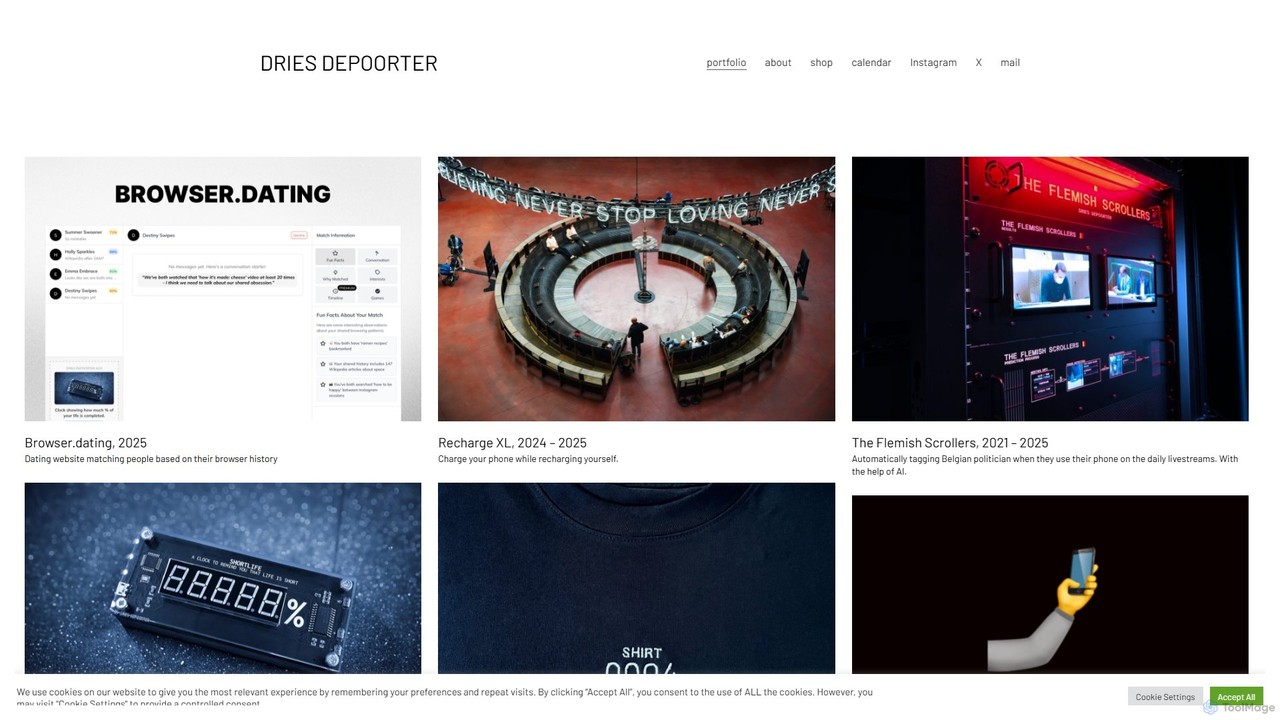
Dries Depoorter
Dries Depoorter is a Belgian technology artist and speaker who explores the themes of privacy, surveillance, and social …
Dries Depoorter is a Belgian technology artist and speaker who explores the themes of privacy, surveillance, and social media through AI-powered installations, apps, and websites. His work critically examines the impact of modern technology on society.
About Ai Projects
AI Projects are collections of artificial intelligence initiatives, often open-source, community-driven, or in early developmental stages, that showcase innovative applications and research in AI. These projects leverage cutting-edge AI models, algorithms, and data to explore new frontiers, offering a dynamic space for collaboration, learning, and rapid prototyping. Positioned within the broader "Experimental" category, AI Projects represent the forefront of AI innovation, where ideas are tested, refined, and shared before potentially evolving into commercial products or established solutions.
Core Features
- Open-Source Codebases: Access to source code for transparency, customization, and community contributions.
- Collaborative Development Platforms: Environments that facilitate teamwork among developers, researchers, and enthusiasts.
- Research Prototypes & Demos: Early versions of AI applications demonstrating novel concepts or capabilities.
- Model & Dataset Sharing: Platforms for sharing pre-trained AI models, datasets, and training methodologies.
- Community Forums & Support: Spaces for discussion, problem-solving, and knowledge exchange among project participants.
Applicable Scenarios
AI Projects are invaluable for AI researchers seeking to build upon existing work, open-source developers looking to contribute to cutting-edge technology, and students eager to gain practical experience with real-world AI applications. Startups often utilize these projects for rapid prototyping of new features or to integrate specialized AI functionalities without starting from scratch. They also serve as a hub for enthusiasts to explore the latest advancements and contribute to the future of AI.
How to Choose
When selecting an AI Project, consider its primary focus and alignment with your goals, whether it's research, development, or learning. Evaluate the project's community activity and support, as a vibrant community often indicates better documentation and ongoing development. Assess the technology stack and required expertise to ensure it matches your capabilities. Finally, review the project's licensing terms, especially if you plan to adapt or integrate it into commercial applications.

Ai ProjectsUse Cases
Contributing to Open-Source AI Development
AI developers and enthusiasts can actively contribute their coding skills, bug fixes, and feature enhancements to open-source AI projects. This allows them to collaborate with a global community, improve existing AI models or applications, and gain valuable experience working on cutting-edge technologies, directly impacting the project's evolution and benefiting the wider AI ecosystem.
Exploring & Learning New AI Techniques
Students, researchers, and aspiring AI professionals can delve into various AI projects to understand novel algorithms, machine learning frameworks, and data processing techniques. By examining the code, running experiments, and participating in discussions, they gain hands-on experience and deepen their theoretical knowledge of emerging AI methodologies beyond textbook examples.
Rapid Prototyping for Startups & MVPs
Startups and innovators can leverage existing AI projects as foundational components for building minimum viable products (MVPs) or proof-of-concept applications. Instead of developing complex AI functionalities from scratch, they can integrate pre-built models or modules, significantly accelerating development cycles and reducing initial resource investment for testing market viability.
Collaborative AI Research & Experimentation
Research teams and academic institutions can utilize AI project platforms to collaborate on shared research problems, experiment with different AI models, and collectively analyze results. These environments provide a structured way to manage code, track experiments, and share findings, fostering a more efficient and transparent research process across distributed teams.
Showcasing Personal AI Portfolio & Skills
Individual AI developers and data scientists can use their contributions to or forks of AI projects as a dynamic portfolio to demonstrate their technical skills and practical experience. By highlighting their active involvement in real-world AI initiatives, they can effectively showcase their expertise to potential employers or collaborators, proving their ability to work on complex AI challenges.
Finding Niche or Specialized AI Solutions
Businesses or individuals with highly specific AI needs, which might not be met by mainstream commercial tools, can explore AI projects for niche or specialized solutions. These projects often address unique problems or leverage less common AI approaches, providing tailored functionalities that can be adapted or further developed to fit precise requirements, offering innovative alternatives.