Memepreneur
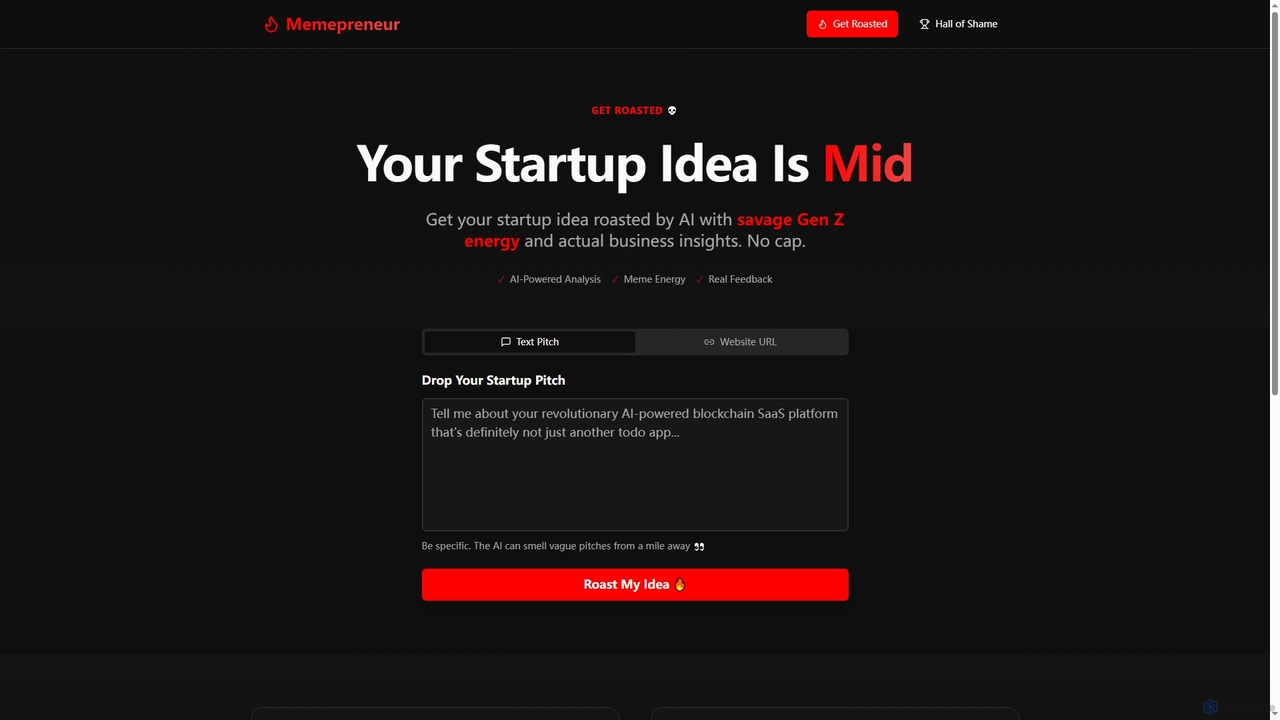
Memepreneur is an AI-powered tool designed for founders to get brutally honest, Gen Z-style feedback on their startup …
Memepreneur is an AI-powered tool designed for founders to get brutally honest, Gen Z-style feedback on their startup ideas. It combines savage humor with genuine business insights to help entrepreneurs refine their pitches and validate concepts.
About Idea Validation
Idea Validation tools are AI-powered platforms designed to assess the market viability of a new business, product, or feature before significant resources are committed. They leverage AI to analyze market data, simulate user responses, and gather targeted feedback to provide data-driven insights. This process helps entrepreneurs and product managers mitigate risks, refine concepts, and make informed decisions based on potential customer interest rather than intuition. These tools are a crucial part of the Feedback ecosystem, focusing specifically on the pre-launch or conceptual stage of development.
Core Features
- AI Market Analysis: Automatically analyzes market size, trends, competitor landscape, and target audience demographics to gauge initial potential.
- Landing Page Simulation: Creates and tests mock landing pages to measure user interest through metrics like email sign-ups and click-through rates.
- Automated Survey Generation: Generates and distributes targeted surveys to specific user segments to collect qualitative and quantitative feedback on a concept.
- Viability Scoring: Provides a data-driven score or comprehensive report that predicts an idea's potential for success based on collected data.
- Audience Targeting: Identifies and reaches specific demographic or psychographic profiles for more relevant and accurate feedback.
Use Cases
These tools are primarily used by startup founders, product managers in established companies, marketing teams, and solo innovators. They are essential during the initial stages of the product development lifecycle, from brainstorming a new app to testing a new feature for a SaaS platform or evaluating a niche for an e-commerce store.
How to Choose
When selecting an Idea Validation tool, consider the validation methods offered (e.g., surveys, landing pages, market analysis). Evaluate the quality and reach of their audience panel or targeting capabilities. Also, assess the depth of the analytics and reporting provided, as well as its integration capabilities with other marketing or development tools.

Idea ValidationUse Cases
Validating a New SaaS App Idea
A startup founder has an idea for a new project management SaaS tool but is unsure about market demand. Instead of spending months on development, they use an idea validation tool. First, the AI analyzes the competitive landscape and identifies a niche audience of remote creative teams. Then, the founder creates a simple landing page simulation highlighting the app's unique selling proposition: AI-powered task prioritization. They run a small, targeted ad campaign driving traffic to this page. The tool tracks email sign-ups for a 'waitlist,' providing a clear, quantitative measure of interest. A 15% conversion rate validates the core concept, giving the founder the confidence to proceed with building an MVP.
Testing a New Feature for an Existing Product
A product manager at an established e-commerce platform wants to introduce a premium 'AI-powered personal shopper' feature. To validate if users would pay for it, they use an idea validation tool to create a targeted survey. The survey is sent to a segment of their most active customers. It explains the feature concept with mockups and asks directly about their willingness to pay a specific monthly fee. The tool's AI analyzes the responses, identifying not only the percentage of interested users but also correlating interest with user spending habits. The results show high interest among high-value customers, providing a strong business case for development.
Evaluating a Niche E-commerce Product
An entrepreneur wants to launch an online store selling sustainable, AI-designed pet accessories. Before investing in inventory and manufacturing, they use an idea validation tool's market analysis feature. They input their core concept, and the AI scans social media trends, search volume data, and competitor pricing. The report indicates a growing interest in 'eco-friendly pet products' but reveals high competition in the dog accessories market. However, it identifies an underserved niche: sustainable accessories for cats and smaller pets. Based on this data, the entrepreneur pivots their strategy to focus on this specific niche, significantly increasing their chances of success.
Testing Different Book Concepts for Authors
A non-fiction author has three potential ideas for their next book on productivity. To decide which one has the most audience appeal, they use an idea validation tool. For each concept, they create a short summary, a potential cover design, and a table of contents. The tool then runs a micro-survey campaign targeting readers interested in self-improvement and business books. Respondents are asked to rank the concepts and indicate which one they would be most likely to purchase. The data clearly shows that the concept focusing on 'Productivity for Creative Professionals' significantly outperforms the others, guiding the author's writing efforts effectively.
Gauging Demand for a New Online Course
An expert in digital marketing wants to create an online course but is torn between teaching 'Advanced SEO Strategies' or 'AI in Marketing'. They use an idea validation tool to create two simulated course landing pages. Each page details the curriculum, instructor bio, and a proposed price. An 'early bird' sign-up form is included to capture interest. By driving traffic from their professional network and social media channels to both pages, they can directly compare conversion rates. The 'AI in Marketing' page receives three times more sign-ups, providing clear evidence of higher market demand and helping the creator focus their content development efforts where they will have the most impact.
Building a Business Case for a Corporate Project
An innovation manager within a large financial corporation proposes developing an internal AI tool to automate compliance checks. To get budget approval, she needs to present a solid business case. She uses an idea validation tool to survey employees in the legal and compliance departments. The AI-generated survey asks about their current pain points, time spent on manual checks, and perceived value of an automated solution. The tool analyzes the results and generates a report quantifying potential time savings (e.g., an estimated 10,000 hours per year) and highlighting strong internal demand. This data-backed report is far more persuasive than a simple proposal, helping her secure the necessary funding from senior management.