Mybrandfoundry
An AI-powered suite of tools designed to build a complete brand identity. It helps users generate unique brand …
An AI-powered suite of tools designed to build a complete brand identity. It helps users generate unique brand names, design logos, find font pairings, create color palettes, and compile a comprehensive brand style guide.
ainameit
ainameit is an AI-powered business name generator that helps entrepreneurs find unique, brandable names in minutes. It provides …
ainameit is an AI-powered business name generator that helps entrepreneurs find unique, brandable names in minutes. It provides personalized name suggestions, matching taglines, and instantly checks domain availability across multiple TLDs, streamlining the entire branding process from idea to domain registration.
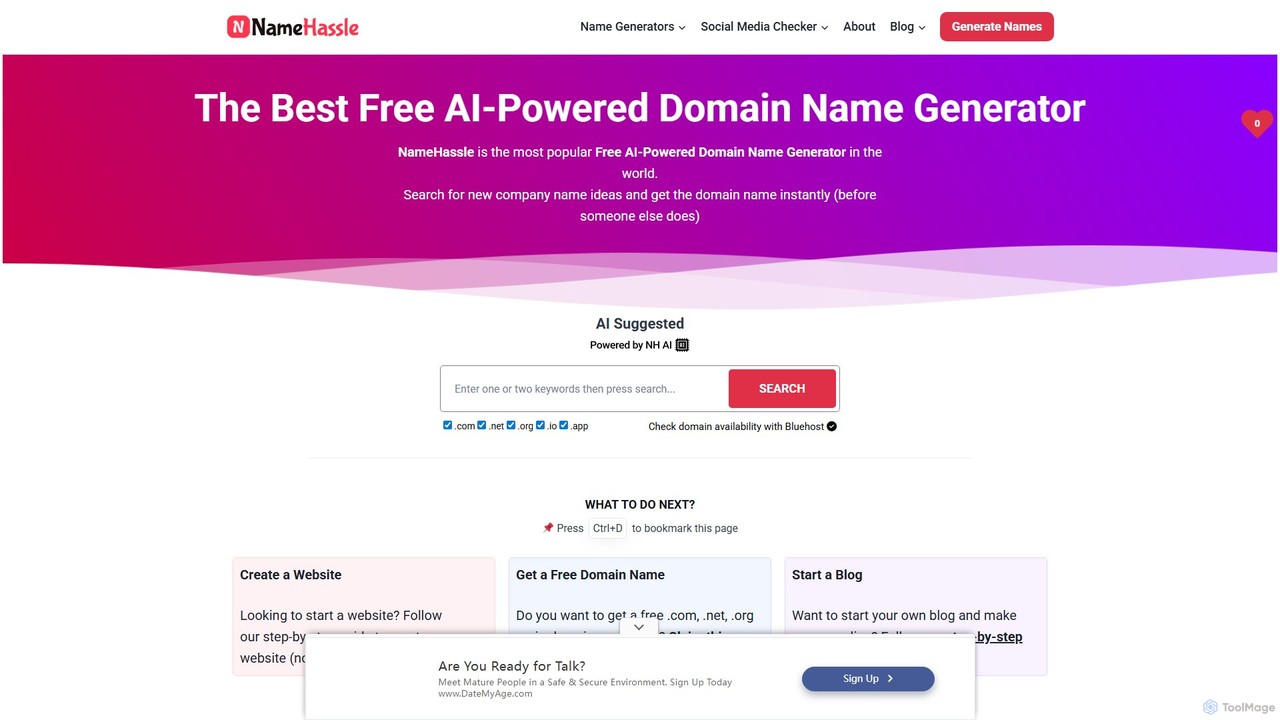
NameHassle
NameHassle is a free, AI-powered suite of tools for branding. It excels as a domain and business name …
NameHassle is a free, AI-powered suite of tools for branding. It excels as a domain and business name generator, providing instant, creative ideas while checking real-time domain availability, social media usernames, and trademark status. Ideal for startups, bloggers, and entrepreneurs, it streamlines the process of building a strong, consistent online brand identity.
About Generator
Generators are AI-powered tools that automatically create various forms of content, data, or code based on user inputs or predefined parameters. Leveraging advanced machine learning models like large language models (LLMs) and generative adversarial networks (GANs), these tools can produce unique and contextually relevant outputs across diverse domains. They empower individuals and businesses to accelerate content creation, automate repetitive tasks, and explore new creative possibilities, significantly boosting productivity and innovation.
Core Features
- Text Generation: Crafting articles, marketing copy, emails, scripts, and more from prompts.
- Image & Art Generation: Producing unique visuals, illustrations, and photos from textual descriptions or sketches.
- Code Generation: Writing code snippets, functions, or entire scripts in various programming languages.
- Audio & Music Generation: Composing original music, sound effects, or voiceovers.
- Data Synthesis: Creating synthetic datasets for training AI models or testing applications.
Use Cases
AI Generators are widely adopted in content creation, marketing, software development, and design. Content creators use them to overcome writer's block and scale output, while marketers generate diverse ad copy and social media content. Developers leverage them for rapid prototyping and boilerplate code, and designers explore endless visual concepts. They are also crucial for researchers needing synthetic data for privacy-sensitive applications.
How to Choose
When selecting an AI Generator, consider the specific output type and quality required, as different tools excel in various domains (e.g., text, image, code). Evaluate the customization options and control offered, ensuring it aligns with your creative or technical needs. Assess integration capabilities with existing workflows and platforms, and compare pricing models. Finally, consider the user interface's ease of use and the community support available for troubleshooting and learning.

GeneratorUse Cases
Generating Marketing Copy for Product Launches
Marketing teams often need a high volume of diverse ad copy for new product launches across multiple channels. An AI Generator allows marketers to input product features and target audience, instantly receiving numerous variations of headlines, slogans, and body text. This significantly reduces the time spent on copywriting, enables A/B testing with a wider range of options, and ensures consistent messaging while exploring creative angles.
Creating Unique Visuals for Social Media
Social media managers constantly require fresh, engaging visuals to maintain audience interest. Using an AI Image Generator, they can input text prompts describing desired scenes, styles, or objects, and quickly generate unique images, illustrations, or even short animations. This eliminates the need for extensive stock photo searches or costly graphic design, allowing for rapid content iteration and a distinct brand aesthetic.
Automating Code Snippet Generation for Developers
Software developers frequently write repetitive boilerplate code or need quick solutions for specific functions. An AI Code Generator can take natural language descriptions of desired functionality (e.g., "create a Python function to sort a list of numbers") and output ready-to-use code snippets. This accelerates development cycles, reduces manual coding errors, and allows developers to focus on more complex problem-solving rather than routine tasks.
Composing Background Music for Video Content
Video content creators, podcasters, and filmmakers often struggle to find unique, royalty-free background music that perfectly fits their content's mood. An AI Music Generator enables them to specify genre, mood, tempo, and instrumentation, generating original musical pieces tailored to their project. This provides a cost-effective and efficient way to produce custom soundtracks, enhancing the overall production quality without licensing complexities.
Synthesizing Realistic Data for Software Testing
QA engineers and data scientists frequently need large, realistic datasets for testing software applications or training machine learning models, especially when real data is sensitive or scarce. An AI Data Generator can create synthetic data that mimics the statistical properties and patterns of real-world data without compromising privacy. This ensures robust testing, accelerates model development, and allows for safe experimentation in various scenarios.
Drafting Personalized Email Responses for Customer Service
Customer service representatives often handle a high volume of similar inquiries, requiring personalized yet consistent responses. An AI Text Generator can be integrated into CRM systems, allowing agents to input key details of a customer's query and instantly generate a draft email response. This significantly reduces response times, ensures brand voice consistency, and frees up agents to focus on more complex customer issues, improving overall service efficiency.