ToolMage
Sign in

Best 1 Governance Risk And Compliance AI tools

Popular Governance Risk And Compliance AI tools include DSALTA, helping you work more efficiently.

DSALTA

DSALTA

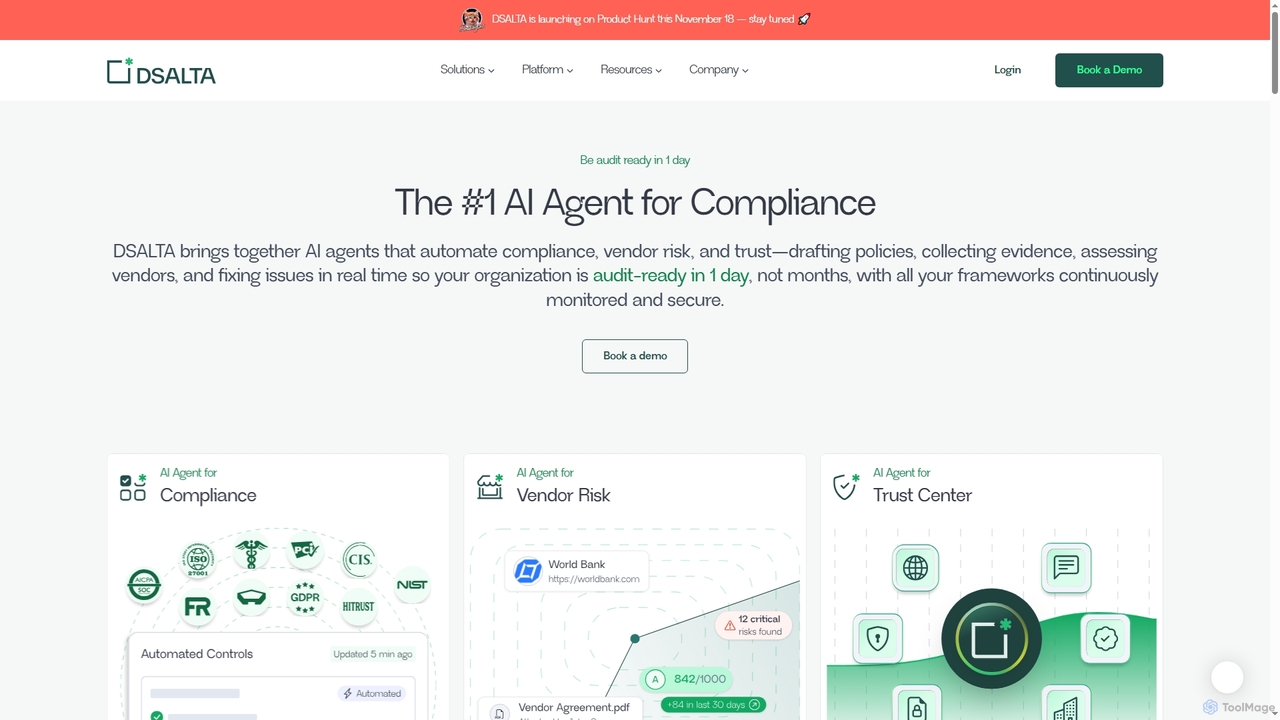
DSALTA is an AI-powered all-in-one platform that automates vendor risk, compliance, and trust management. It helps organizations achieve audit readiness in days, not months, by drafting policies, collecting evidence, assessing vendors, and fixing issues in real-time. With continuous monitoring and AI-driven remediation, DSALTA streamlines GRC workflows, reduces manual effort, and enhances security posture. A 14-day free trial is available.

Compliance Automation
Visits 9.8KFavorites 115Likes 116

About Governance Risk And Compliance

Governance, Risk, and Compliance (GRC) AI tools are AI-powered solutions designed to automate, optimize, and enhance an organization's GRC processes. These tools leverage advanced machine learning, natural language processing, and predictive analytics to identify, assess, and mitigate risks, ensure regulatory adherence, and enforce internal policies. They provide real-time insights, reduce manual effort, and improve decision-making across complex operational landscapes, helping businesses maintain integrity and avoid penalties.

Core Features

  • Automated Compliance Monitoring: Continuously scans data and activities against regulatory requirements and internal policies, flagging deviations.
  • Real-time Risk Assessment: Utilizes AI to analyze vast datasets for emerging threats, vulnerabilities, and potential risk exposures, providing predictive insights.
  • Regulatory Intelligence: Automatically tracks changes in laws and regulations, alerting organizations to new compliance obligations and impacts.
  • Anomaly Detection: Identifies unusual patterns in transactions, user behavior, or data that may indicate fraud, security breaches, or policy violations.
  • Policy Enforcement & Audit: Automates the application of internal policies and streamlines audit evidence collection and reporting.

Applicable Scenarios

Organizations across highly regulated sectors like finance, healthcare, and legal leverage GRC AI tools to manage their complex compliance and risk landscapes. Compliance officers use them for continuous regulatory monitoring, while risk managers deploy them for predictive risk modeling and mitigation strategies. Legal teams benefit from automated contract analysis and policy adherence checks, ensuring robust governance frameworks are maintained.

How to Choose

When selecting a GRC AI tool, prioritize solutions with comprehensive regulatory coverage relevant to your industry and robust integration capabilities with existing enterprise systems. Evaluate the transparency and explainability of the AI models, especially for critical risk assessments. Consider scalability to accommodate future growth and the quality of reporting and dashboard features for actionable insights. Data security and privacy features are also paramount.

Governance Risk And Compliance use cases

1

Automating Regulatory Compliance Monitoring

For financial institutions, compliance officers face the challenge of continuously monitoring vast transactions and communications against evolving regulations like AML or GDPR. GRC AI tools automatically scan and analyze data streams, flagging suspicious activities or non-compliant patterns in real-time. This reduces manual review time by up to 70% and ensures proactive identification of potential breaches, significantly lowering the risk of fines and reputational damage.

2

Enhancing Real-time Risk Assessment

Enterprise risk managers in manufacturing or supply chain industries need to identify and mitigate operational and supply chain risks swiftly. GRC AI platforms ingest data from various sources—market trends, geopolitical events, supplier performance—to predict potential disruptions or vulnerabilities. By providing predictive risk scores and scenario analysis, these tools enable proactive decision-making, minimizing financial losses and ensuring business continuity.

3

Proactive Fraud Detection and Prevention

E-commerce platforms and insurance companies are constantly battling sophisticated fraud schemes. GRC AI tools analyze transaction histories, user behavior, and network patterns to detect anomalies indicative of fraud, such as unusual spending spikes or multiple claims from a single IP address. This allows security teams to intervene before significant losses occur, improving detection rates by over 50% compared to traditional rule-based systems.

4

Streamlining Internal Audit Processes

Internal audit teams in large corporations often spend extensive time manually collecting and analyzing data for audit trails. GRC AI solutions automate the aggregation of audit evidence from disparate systems, identify high-risk areas for focused auditing, and even generate preliminary audit reports. This accelerates the audit cycle, frees up auditors for more strategic analysis, and ensures a more thorough and consistent audit process.

5

Managing Data Privacy and GDPR Compliance

Healthcare providers and tech companies handling sensitive personal data must strictly adhere to data privacy regulations like GDPR or CCPA. GRC AI tools help map data flows, identify personal identifiable information (PII), monitor data access, and automate consent management. They ensure that data processing activities comply with legal requirements, reducing the risk of data breaches and demonstrating accountability to regulators.

6

Enforcing Corporate Policies and Ethics

Large organizations struggle to ensure consistent adherence to internal policies, codes of conduct, and ethical guidelines across all departments. GRC AI tools can analyze internal communications, employee activities, and document usage to detect potential policy violations or conflicts of interest. This proactive monitoring helps foster a culture of compliance, reduces internal misconduct, and protects the company's reputation and legal standing.

Governance Risk And Compliance FAQ

What are Governance, Risk, and Compliance (GRC) AI tools?

Governance, Risk, and Compliance (GRC) AI tools are software solutions that leverage artificial intelligence to automate and enhance an organization's GRC functions. They integrate AI technologies like machine learning, natural language processing, and predictive analytics to streamline processes such as regulatory monitoring, risk assessment, policy enforcement, and audit management. These tools aim to provide real-time insights, reduce manual effort, and improve decision-making, helping businesses navigate complex regulatory landscapes and mitigate potential threats effectively.

How do AI tools enhance GRC processes?

AI tools significantly enhance GRC processes by offering capabilities beyond traditional methods. They can process and analyze vast amounts of structured and unstructured data much faster, identifying patterns, anomalies, and emerging risks that human analysts might miss. This leads to more accurate and proactive risk assessments, continuous compliance monitoring, and automated policy enforcement. AI also improves efficiency by automating routine tasks, freeing up GRC professionals to focus on strategic initiatives and complex problem-solving, ultimately leading to stronger governance and reduced operational costs.

What should I consider when choosing a GRC AI solution?

When selecting a GRC AI solution, several factors are crucial. First, assess its regulatory coverage to ensure it aligns with your industry-specific compliance needs. Second, evaluate its integration capabilities with your existing IT infrastructure and data sources. Third, consider the transparency and explainability of its AI models, especially for critical decision-making. Fourth, look for scalability to support future growth and evolving requirements. Finally, prioritize solutions with robust data security and privacy features, along with comprehensive reporting and analytics dashboards for actionable insights.

How do GRC AI tools differ from traditional GRC software?

Traditional GRC software primarily relies on rule-based systems and manual data input for compliance and risk management. GRC AI tools, however, introduce advanced automation and intelligence. They can learn from data, adapt to new information, and make predictive analyses without explicit programming for every scenario. This allows for continuous, real-time monitoring, proactive risk identification, and dynamic adaptation to regulatory changes, offering a more agile, efficient, and insightful approach compared to the often reactive and labor-intensive nature of traditional GRC systems.

Which industries benefit most from GRC AI tools?

Industries operating under stringent regulatory frameworks and managing high volumes of sensitive data benefit most from GRC AI tools. This includes financial services (banking, insurance, investment firms) for anti-money laundering (AML), fraud detection, and market abuse surveillance. Healthcare benefits from managing patient data privacy (HIPAA, GDPR) and clinical trial compliance. Legal and consulting firms use them for contract analysis and regulatory research. Additionally, manufacturing and energy sectors leverage GRC AI for operational risk management, environmental compliance, and supply chain integrity.