
ToolMage
Sign in

Best 1 Digital Insurance AI tools for Insurtech

Popular Digital Insurance AI tools in Insurtech include Inka, helping you work more efficiently.

Inka
Free

Inka

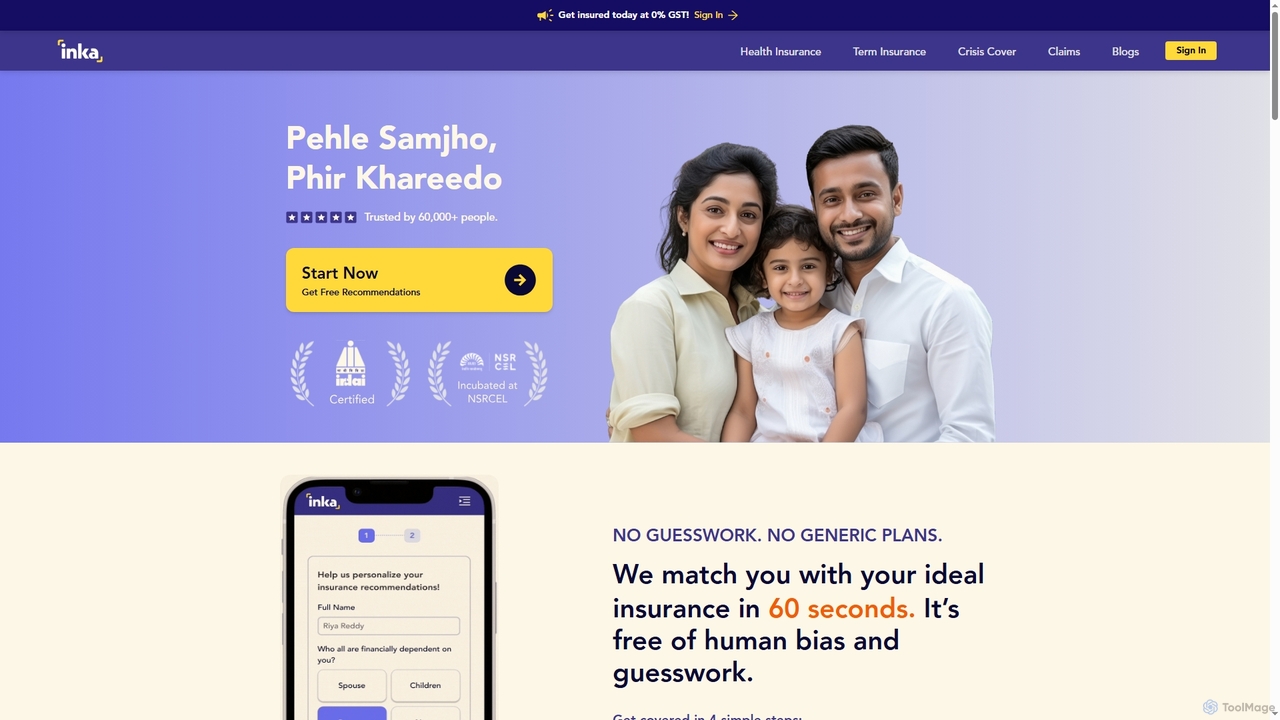
Inka is an AI-powered insurtech platform that provides hyper-personalized insurance recommendations and simplified claim support. It analyzes over 2,400 data points to match users with ideal health, term, and crisis cover plans, eliminating guesswork and human bias. With its 24/7 AI advisor, Vaani, Inka makes understanding and managing insurance accessible and transparent for everyone.

Personal Advisor
Visits 24.5KFavorites 115Likes 109

About Digital Insurance

Digital Insurance tools leverage advanced digital technologies like AI, big data, and IoT to transform traditional insurance processes. These platforms streamline operations from policy issuance and underwriting to claims management and customer engagement. Their primary value lies in enhancing efficiency, personalizing customer experiences, and enabling data-driven risk assessment for a more agile and responsive insurance ecosystem.

Core Features

  • Automated Underwriting: AI-driven analysis of vast data sets for faster, more accurate risk assessment and policy pricing.
  • Personalized Policy Design: Tailoring insurance products and premiums based on individual behavior, data, and real-time risk profiles.
  • Digital Claims Processing: Streamlining claim submission, verification, and payout through online portals, mobile apps, and AI-powered fraud detection.
  • Enhanced Customer Engagement: Utilizing chatbots, virtual assistants, and personalized communication for 24/7 support and proactive service.
  • IoT-driven Risk Monitoring: Integrating data from connected devices for dynamic risk assessment and preventive measures.

Applicable Scenarios

Insurance providers use digital insurance platforms to modernize their legacy systems, reduce operational costs, and launch innovative, customer-centric products. Startups leverage these tools to build agile, data-driven insurance models from the ground up, offering niche or on-demand coverage.

How to Choose

When selecting Digital Insurance tools, evaluate their integration capabilities with existing systems, the breadth of AI and data analytics features for underwriting and claims, and the level of customization offered for policy design. Consider also the vendor's compliance with regulatory standards and their commitment to data security and privacy.

Digital Insurance use cases

1

Automating Car Insurance Underwriting

Automotive insurers utilize digital insurance platforms to automate the underwriting process for car insurance. By integrating telematics data, driving behavior analytics, and external data sources, AI algorithms can instantly assess risk profiles, calculate personalized premiums, and issue policies in real-time, significantly reducing manual review time and improving pricing accuracy.

2

Automating Claims Adjudication

Insurance adjusters utilize Digital Insurance platforms to automate the initial review and adjudication of claims. By feeding claim documents, images, and reports into an AI system, the platform can quickly verify policy details, assess damage severity, and flag potential discrepancies or fraud, significantly accelerating the payout process for straightforward cases and allowing human adjusters to focus on complex claims.

3

Personalized Health Insurance Plans

Health insurance providers employ digital tools to offer highly personalized health plans. Leveraging data from wearables, health apps, and medical records (with user consent), these platforms can create dynamic policies that adjust premiums based on healthy lifestyle choices, provide preventive care recommendations, and offer tailored wellness programs, enhancing customer engagement and health outcomes.

4

Personalizing Auto Insurance Premiums

Auto insurance providers leverage telematics data and AI algorithms from Digital Insurance tools to offer highly personalized premiums. Based on real-time driving behavior (speed, braking, mileage), these tools can dynamically adjust policy costs, rewarding safe drivers with lower rates and encouraging better driving habits, leading to fairer pricing and reduced accident risks for the insurer.

5

Streamlining Property Claims Processing

Property insurers use digital insurance solutions to expedite claims processing for home and property damage. Customers can submit claims via mobile apps, upload photos or videos of damage, and AI-powered image recognition and natural language processing can quickly assess damage severity, detect potential fraud, and facilitate faster settlements, improving customer satisfaction during stressful times.

6

Detecting Health Insurance Fraud

Health insurance companies deploy Digital Insurance solutions equipped with machine learning to identify fraudulent claims. The AI analyzes vast datasets of medical records, billing codes, and patient histories to detect unusual patterns, duplicate claims, or suspicious provider behaviors that might indicate fraud, thereby protecting the company from significant financial losses and ensuring resources are allocated appropriately.

7

Streamlining Life Insurance Underwriting

Life insurance underwriters use Digital Insurance platforms to expedite the underwriting process. By integrating data from various sources like electronic health records, public databases, and lifestyle questionnaires, AI can rapidly assess an applicant's risk profile, often providing instant quotes or reducing the need for extensive medical exams, making policy issuance faster and more accessible for customers.

8

On-Demand Travel Insurance

Travel insurance companies deploy digital platforms to offer flexible, on-demand travel insurance. Travelers can purchase coverage for specific trips, activities, or durations directly through mobile apps, with policies dynamically generated based on destination, travel risks, and personal preferences. This provides instant coverage and caters to modern travel habits.

9

Enhancing Customer Onboarding with AI Chatbots

Insurance companies utilize AI-powered chatbots within their Digital Insurance ecosystem to enhance customer onboarding. These chatbots guide new applicants through the policy selection process, answer common questions about coverage, collect necessary information, and even assist with initial document submission, providing a seamless, 24/7 support experience and reducing the workload on human agents.

10

Proactive Risk Management for Businesses

Commercial insurers leverage digital insurance tools to provide businesses with proactive risk management solutions. By integrating IoT sensors in facilities or supply chains, these platforms monitor operational risks in real-time, alert businesses to potential issues (e.g., equipment malfunction, environmental hazards), and offer preventive advice, helping to mitigate losses and reduce claim frequency.

11

Enhancing Customer Service with AI Chatbots

Insurance companies integrate AI-powered chatbots and virtual assistants into their digital insurance platforms to provide 24/7 customer support. These chatbots can answer common policy questions, guide users through claim submission, provide policy updates, and even assist with policy renewals, freeing up human agents for more complex inquiries and improving overall service accessibility.

12

Predictive Maintenance for Property Insurance

Property insurers integrate IoT device data (e.g., smart home sensors for water leaks, fire alarms) with Digital Insurance analytics to offer predictive maintenance insights. The system alerts policyholders to potential issues before they cause significant damage, allowing for proactive repairs. This not only reduces the frequency and severity of claims but also fosters a stronger, more proactive relationship between the insurer and the insured.

Digital Insurance FAQ

What is Digital Insurance?

Digital Insurance refers to the application of advanced technologies like artificial intelligence, machine learning, big data, and automation to revolutionize the insurance industry. It focuses on digitizing and optimizing every aspect of the insurance value chain, from product development and distribution to underwriting, claims processing, and customer service, making insurance more efficient, personalized, and accessible. It's a key component of the broader Insurtech movement.

What are Digital Insurance tools?

Digital Insurance tools are software solutions that apply advanced digital technologies, including AI, big data, and automation, to various aspects of the insurance value chain. They aim to modernize operations, enhance customer experience, and enable data-driven decision-making from product development and distribution to underwriting, claims, and customer service.

How does Digital Insurance differ from traditional insurance?

Digital Insurance primarily differs from traditional insurance in its reliance on technology for core operations. Traditional insurance often involves manual, paper-based processes, limited data analysis, and standardized products. Digital Insurance, conversely, leverages AI for real-time risk assessment, offers highly personalized policies, automates claims processing for speed and accuracy, and provides seamless digital customer experiences, moving away from conventional, often cumbersome, methods.

How do Digital Insurance tools differ from traditional insurance?

Digital Insurance tools fundamentally differ from traditional insurance by leveraging technology to automate processes, personalize offerings, and provide real-time interactions. Unlike paper-based, manual processes, digital insurance offers instant policy issuance, AI-driven risk assessment, mobile-first claims, and proactive customer engagement, leading to greater efficiency and customer satisfaction.

What are the key benefits of using Digital Insurance platforms?

The key benefits of using Digital Insurance platforms include significantly improved operational efficiency through automation, enhanced customer experience with personalized services and 24/7 support, more accurate risk assessment and pricing via data analytics, and the ability to rapidly develop and launch innovative insurance products. They also help reduce fraud and operational costs.

What are the main benefits of adopting Digital Insurance solutions?

Adopting Digital Insurance solutions brings several significant benefits. These include enhanced operational efficiency through automation, leading to faster processing times for underwriting and claims. It enables more accurate risk assessment and fraud detection, reducing financial losses. Furthermore, it allows for the creation of highly personalized insurance products, improving customer satisfaction and retention through seamless digital interactions and responsive service.

What key technologies power Digital Insurance platforms?

Digital Insurance platforms are powered by a suite of cutting-edge technologies. Artificial Intelligence (AI) and Machine Learning (ML) are central for data analysis, risk modeling, and automation. Big Data analytics processes vast amounts of information for insights. The Internet of Things (IoT) provides real-time data from connected devices (e.g., telematics, smart homes). Blockchain technology can enhance security and transparency in transactions, while cloud computing provides scalable infrastructure.

What should I consider when choosing a Digital Insurance solution?

When choosing a Digital Insurance solution, consider its core functionalities (e.g., underwriting, claims, customer service), its integration capabilities with your existing IT infrastructure, the scalability of the platform, and its compliance with industry regulations and data security standards. Also, evaluate the vendor's expertise and support services.

How does AI contribute to Digital Insurance?

AI plays a crucial role in Digital Insurance by powering automated underwriting, fraud detection, personalized risk assessment, and intelligent claims processing. AI algorithms analyze vast amounts of data to identify patterns, predict risks, and automate decision-making, leading to faster, more accurate, and more efficient insurance operations across the board.

How can I choose the right Digital Insurance platform for my business?

Choosing the right Digital Insurance platform involves evaluating several factors. Assess its compatibility and integration capabilities with your existing IT infrastructure and legacy systems. Consider the platform's specific AI and automation features, ensuring they align with your operational needs, such as claims automation or personalized policy generation. Prioritize solutions with robust data security, regulatory compliance, and proven scalability. Finally, evaluate user experience for both employees and customers, along with vendor support and pricing models.