
Resume Worded
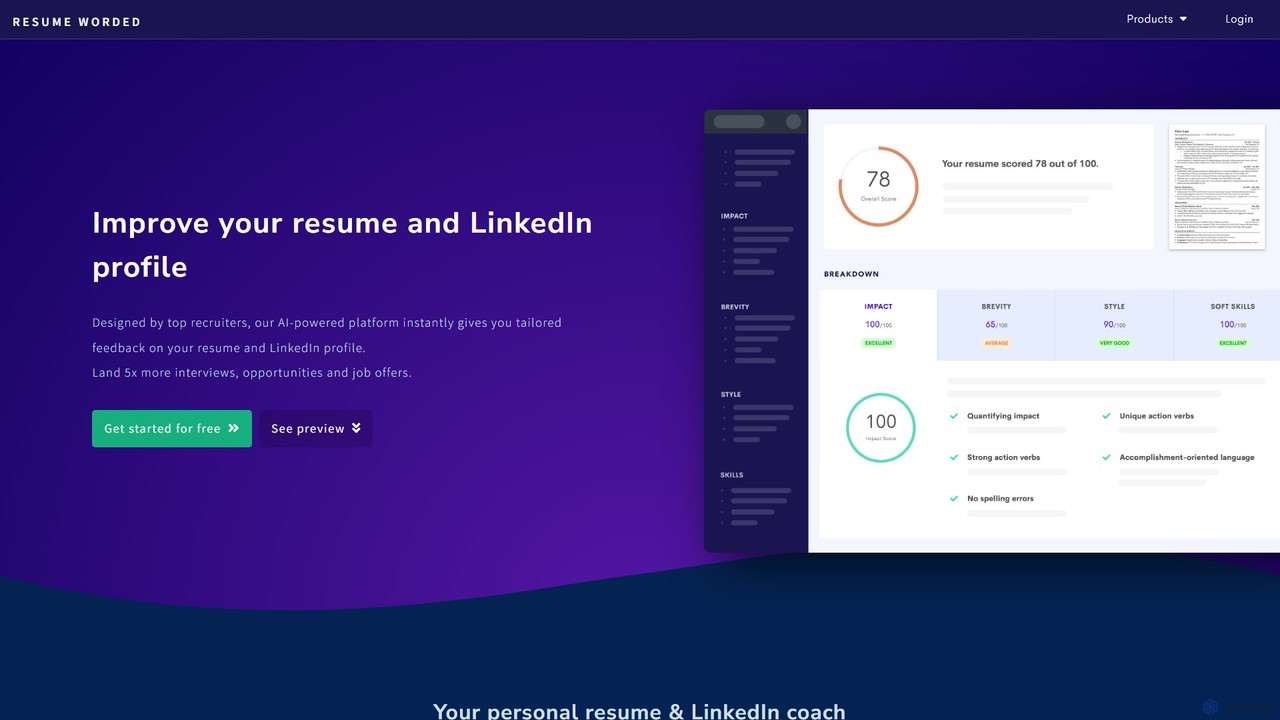
Resume Worded is an AI-powered career platform that provides instant, personalized feedback on your resume and LinkedIn profile. …
Resume Worded is an AI-powered career platform that provides instant, personalized feedback on your resume and LinkedIn profile. Designed by top recruiters, it helps you optimize your application materials to bypass applicant tracking systems (ATS) and land 5x more interviews.
About Optimization
Job Search Optimization tools are AI-powered platforms designed to enhance your application materials for specific opportunities. These tools use natural language processing (NLP) to analyze job descriptions and compare them against your resume, cover letter, or professional profiles. Their primary goal is to increase your chances of passing through automated screening systems (ATS) and catching the attention of human recruiters. By providing data-driven feedback and keyword suggestions, they help you tailor each application with precision and efficiency.
Core Features
- ATS Compatibility Check: Simulates how Applicant Tracking Systems parse your resume, identifying formatting issues and keyword gaps.
- Keyword Matching & Analysis: Extracts key terms and skills from a job description and suggests how to incorporate them into your documents.
- Content & Style Feedback: Provides recommendations on readability, use of action verbs, and the overall impact of your resume content.
- LinkedIn Profile Enhancement: Offers suggestions for optimizing your headline, summary, and skills sections to improve visibility to recruiters.
Use Cases
These tools are ideal for active job seekers applying to multiple roles, career changers needing to reframe their experience, and professionals in competitive fields. For example, a software engineer can use them to tailor their resume for a top tech company, or a marketing manager can quickly customize their cover letter for a startup role, ensuring key qualifications are highlighted.
How to Choose
When selecting a tool, consider its scope of features (resume only vs. full suite including cover letters and LinkedIn). Evaluate the quality of its keyword analysis and the relevance of its suggestions. Also, assess the user interface for ease of use and check for integrations with job boards or professional networks to streamline your workflow.
OptimizationUse Cases
Passing Automated Resume Screening (ATS)
A recent graduate applies for a competitive marketing coordinator position. They upload their resume and the job description into an AI optimization tool. The tool scans the resume, highlighting that it lacks key terms like 'SEO,' 'content calendar,' and 'Google Analytics' mentioned in the job post. It also flags a two-column format that is difficult for ATS to parse. The graduate revises their resume based on the suggestions, increasing its match score from 45% to 85% and significantly improving their chances of being seen by a recruiter.
Crafting a Custom Cover Letter in Minutes
A software developer is applying to ten similar roles. Instead of writing each cover letter from scratch, they use an AI tool. They input their base cover letter and a new job description. The AI analyzes the new role's requirements (e.g., 'Python,' 'AWS,' 'agile methodologies') and suggests specific sentences and project examples to add, ensuring the letter is highly relevant. This process reduces the time spent per application from 30 minutes to less than 5 minutes.
Improving LinkedIn Profile for Recruiter Visibility
A project manager wants to attract more inbound opportunities from recruiters. They use an AI optimization tool to analyze their LinkedIn profile. The tool suggests rewriting their headline to be more specific (e.g., 'Certified PMP | Agile Project Manager Driving SaaS Implementations'), adding measurable achievements to their experience descriptions, and including a list of 20+ relevant skills. After implementing the changes, their profile views from recruiters increase by 40% within a month.
AI-Powered Interview Question Preparation
A data scientist has an upcoming interview. They paste the job description into an AI tool that specializes in interview optimization. The tool generates a list of likely technical and behavioral questions based on the required skills like 'machine learning models,' 'A/B testing,' and 'stakeholder communication.' It also provides frameworks for answering these questions, helping the candidate structure their thoughts and practice their responses effectively.
Reframing a Resume for a Career Change
A teacher is transitioning into a corporate training role. Their original resume is heavily focused on academic achievements. Using an AI optimization tool, they analyze job descriptions for corporate trainers. The AI helps identify transferable skills like 'curriculum development,' 'stakeholder engagement,' and 'performance assessment' and suggests how to rephrase their teaching experience using corporate language. This helps recruiters see their potential in the new field.
Analyzing Job Fit and Application Strategy
A user experience designer feels overwhelmed by the number of open positions. They use an advanced AI job search platform that not only finds jobs but also optimizes their strategy. The tool analyzes their profile and resume to calculate a 'match score' for each listing, allowing them to focus on the most suitable opportunities. It also tracks their application success rates, providing insights into which types of roles or companies respond most favorably.