
Arbius
Arbius is a decentralized peer-to-peer network for machine learning, creating a global marketplace for AI compute. It enables …
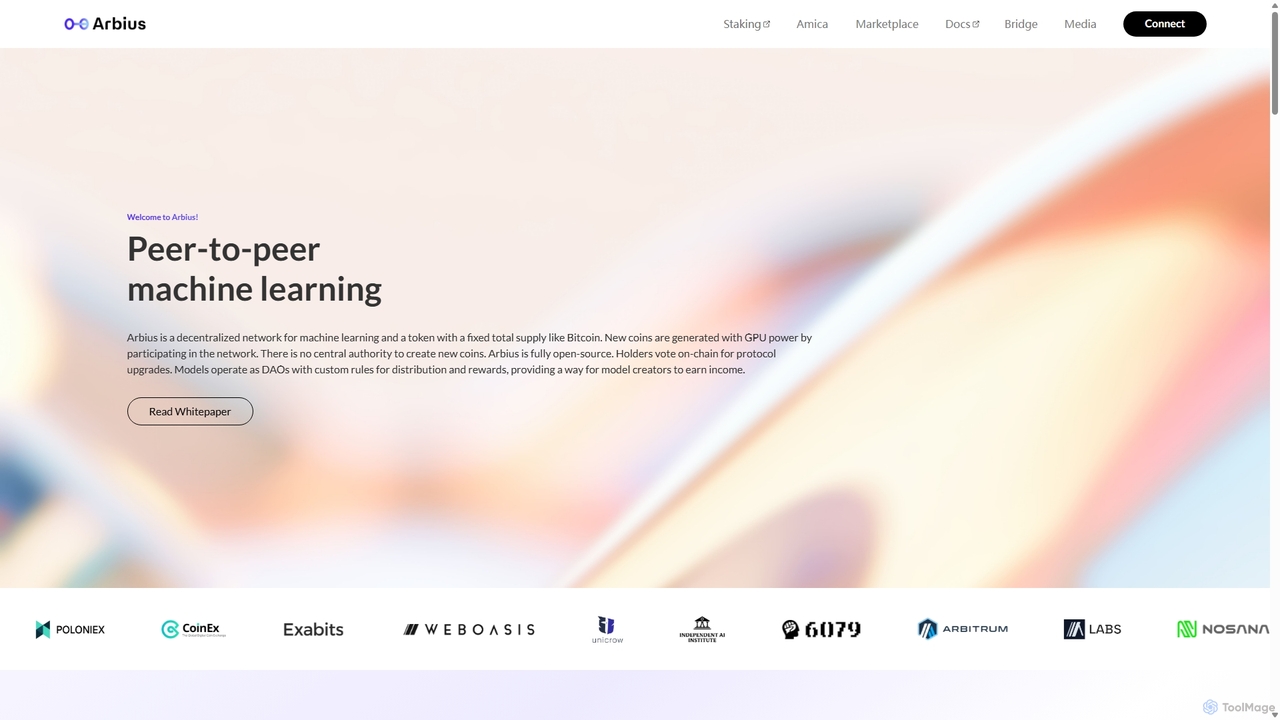
Arbius is a decentralized peer-to-peer network for machine learning, creating a global marketplace for AI compute. It enables model creators to monetize their work and users to access AI models in a censorship-resistant environment, powered by its native token, AIUS, and a Proof-of-Useful-Work mechanism.
About Marketplace
An AI Model Marketplace is a centralized platform for discovering, accessing, and deploying pre-trained artificial intelligence models. These platforms function like an app store for AI, hosting a vast library of models for tasks ranging from natural language processing to computer vision. They streamline the process of integrating AI into applications by providing standardized APIs, detailed documentation, and community-vetted resources. This approach significantly reduces development time and lowers the barrier to entry for building AI-powered products.
Core Features
- Extensive Model Library: Access a diverse collection of models searchable by task, framework, and license.
- API-Based Deployment: Integrate models into applications via simple API calls without managing infrastructure.
- Model Versioning: Track and manage different versions of models to ensure reproducibility and updates.
- Community and Reviews: Leverage user ratings, discussions, and community support to evaluate model quality.
- Monetization Tools: Provides options for developers to sell access to their custom-trained models.
Use Cases
Developers and data scientists use these marketplaces to rapidly prototype applications, benchmark new research, and find specialized models for industries like finance, healthcare, and retail. Businesses leverage them to accelerate AI adoption without the high cost of in-house model development.
How to Choose
When selecting a marketplace, consider the diversity and quality of its model catalog, the clarity of its licensing terms for commercial use, the ease of integration via its API, and the pricing structure. Also, evaluate the strength of the community and the quality of model documentation.
MarketplaceUse Cases
Rapid Prototyping for Startups
A software developer at a startup needs to add a text summarization feature to their new productivity app. Instead of spending weeks building and training a model, they browse an AI Model Marketplace, find a suitable pre-trained summarization model, and integrate it using its API. This allows them to launch a functional prototype in days, not months, enabling faster user feedback and iteration.
Accessing State-of-the-Art Models for Research
An academic researcher is working on a new computer vision algorithm. To validate their results, they need to compare its performance against established benchmarks like ResNet or YOLO. They use a model marketplace to easily find, download, and run these state-of-the-art models, ensuring their research is compared against current industry standards and accelerating the publication process.
Fine-Tuning a Language Model for Niche Marketing
A digital marketing agency wants to generate specialized ad copy for the legal industry. General-purpose language models lack the specific terminology. They select a powerful base model from a marketplace and fine-tune it using a dataset of legal documents and successful ad campaigns. The result is a custom model that produces highly relevant, effective copy, improving campaign performance.
Monetizing a Custom-Built AI Model
A data science consultant develops a highly accurate predictive model for customer churn in the e-commerce sector. To generate passive income, they publish the model on a marketplace. They set a pay-per-call pricing model, allowing e-commerce businesses worldwide to access their specialized model via an API without needing to hire a full-time data scientist.
Enhancing Enterprise Systems with AI
A large retail corporation wants to automate the process of tagging products in their inventory images. Their internal IT team explores a model marketplace to find a reliable, commercially-licensed object detection model. They choose a model with robust documentation and a clear service-level agreement (SLA), allowing them to securely integrate it into their existing inventory management software.
Educational Exploration and Skill Development
A student learning about machine learning uses a model marketplace as a hands-on educational tool. They can explore different model architectures, from text generators to image classifiers, and interact with them through simple web interfaces. This provides practical experience and a deeper understanding of AI capabilities beyond theoretical knowledge, helping them build a portfolio of small projects.