Dappier
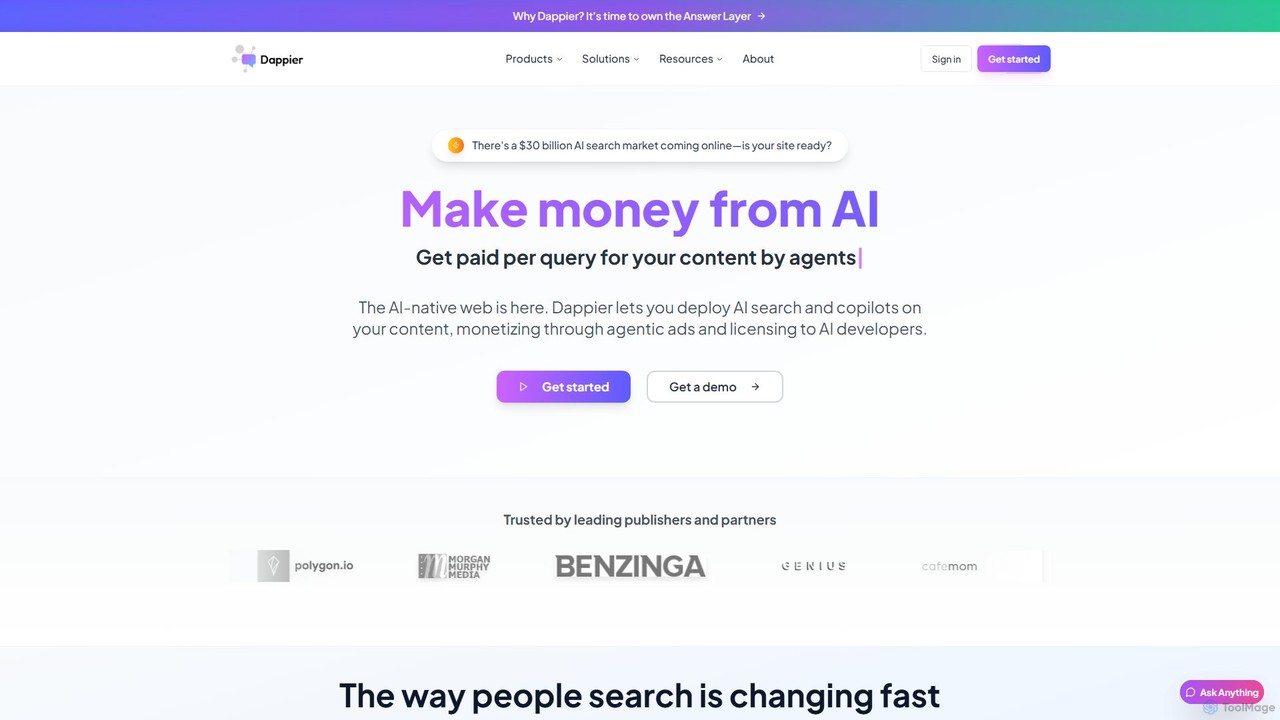
Dappier is a full-stack monetization platform for the AI era, enabling publishers and website owners to deploy AI …
Dappier is a full-stack monetization platform for the AI era, enabling publishers and website owners to deploy AI search and copilots trained on their own content. It helps creators earn revenue through contextual agentic ads and by licensing their content to AI developers via a dedicated marketplace.
About Content Licensing
AI Content Licensing tools are platforms that use artificial intelligence to manage, track, and monetize digital assets through licensing agreements. These tools leverage AI for functions like content recognition, usage monitoring, and dynamic royalty calculation to streamline the complex process of licensing images, music, or text. This enables creators and businesses to efficiently generate revenue from their intellectual property while ensuring compliance and preventing unauthorized use. As a key component of monetization, these tools transform static assets into active income streams.
Core Features
- AI-Powered Content Recognition: Uses computer vision or audio fingerprinting to identify and catalog licensable assets across various platforms.
- Automated Usage Tracking: Scans the web and other media to detect both authorized and unauthorized use of licensed content in real-time.
- Dynamic Royalty Management: Automatically calculates and distributes royalties based on complex, multi-tiered licensing terms and usage data.
- Smart Contract Generation: Creates and manages legally sound licensing agreements based on predefined templates and user-specific parameters.
- Predictive Licensing Analytics: Analyzes market data to suggest optimal pricing, identify licensing opportunities, and forecast revenue.
Applicable Scenarios
These tools are essential for stock media agencies (photos, videos, music), large media corporations, news organizations syndicating content, and software companies licensing code. They are also increasingly used by independent creators, artists, and musicians who want to protect and monetize their work on a global scale without manual oversight.
Selection Criteria
When choosing a tool, evaluate the type of content it supports (e.g., image, video, audio). Assess the accuracy of its AI tracking technology and the flexibility of its royalty calculation engine. Also, consider its integration capabilities with your existing Digital Asset Management (DAM) systems and the scalability of its platform to handle your asset volume.
Content LicensingUse Cases
Automating Royalty Payments for a Stock Photo Agency
A stock photography agency manages a portfolio of millions of images from thousands of photographers. Manually tracking usage and calculating royalties is unfeasible. By implementing an AI Content Licensing tool, the agency automates the entire process. The AI scans the web to find where images are used, verifies them against active licenses, and automatically calculates the precise royalty splits based on each photographer's contract. This reduces administrative overhead by over 80% and ensures photographers are paid accurately and on time, increasing creator satisfaction and trust.
Licensing Music Tracks for Digital Advertising
An independent musician wants to license their music for use in online ads and YouTube videos. They upload their catalog to an AI-powered licensing platform. The AI analyzes each track, automatically tagging it with metadata like genre, mood, and instrumentation. This makes their music easily discoverable by marketers searching for specific types of audio. When a marketer licenses a track, the platform generates a smart contract, processes the payment, and provides the musician with detailed analytics on where and how their music is being used, opening up a global revenue stream with minimal effort.
Syndicating News Articles to Partner Publications
A large news organization wants to monetize its archive of articles by syndicating them to smaller, regional publications. They use an AI licensing platform to manage the process. The platform allows partner publications to browse the content catalog and purchase licenses based on usage terms (e.g., online only, limited time). The AI monitors the partners' websites to ensure compliance with the licensing terms, such as proper attribution and removal after the license expires. This creates a scalable syndication model that generates recurring revenue without requiring a dedicated sales and compliance team.
Protecting and Monetizing Brand-Related User-Generated Content
A fashion brand encourages customers to post photos on social media using their products with a specific hashtag. To legally use these high-quality images in their marketing, they use an AI tool to contact creators, secure licensing rights, and manage payments. The AI identifies the best user-generated content (UGC), automates the outreach to the creator for permission, and generates a simple licensing agreement. This allows the brand to build a large, authentic visual library while fairly compensating their customers, turning brand advocates into paid content partners.
Managing Software Component Licensing and Compliance
A software development company creates and sells reusable code components to other developers. They need to manage various license types (e.g., subscription, perpetual, usage-based) and ensure compliance. An AI licensing tool automates this by integrating with their distribution platform. It generates license keys, tracks usage via API calls, and automatically invoices clients based on their chosen plan. The AI also monitors public repositories like GitHub to detect unauthorized use of their proprietary code, protecting their intellectual property and revenue streams.
Licensing Video Game Assets to Other Developers
A video game studio has created a large library of high-quality 3D models, textures, and sound effects. To generate additional revenue, they decide to license these assets to smaller indie game developers. They use an AI-powered marketplace to host their assets. The AI helps by automatically generating different license tiers (e.g., for single-project use, unlimited use) and suggesting prices based on market trends. It also provides a secure delivery system for the assets and handles all transaction processing, allowing the studio to monetize its creative work beyond its own games.