
ToolMage
Sign in

Best 1 Uncensored Content AI tools for Nsfw

Popular Uncensored Content AI tools in Nsfw include Open Spoken AI, helping you work more efficiently.

Open Spoken AI
Freemium

Open Spoken AI

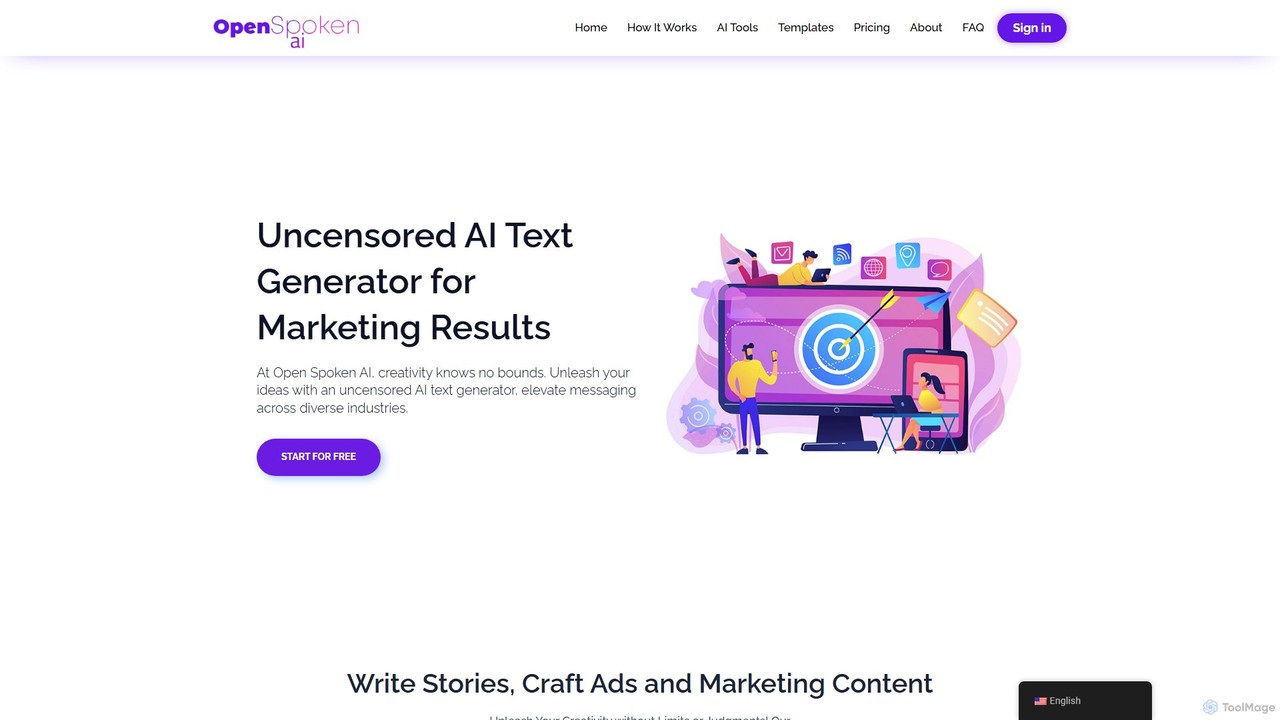
Open Spoken AI is an uncensored AI text generator designed for limitless creativity. It specializes in producing unrestricted content, including NSFW material, for marketing, storytelling, and industries facing censorship. With a suite of templates and AI chat experts, it empowers users to create compelling, human-like text for ads, blogs, and stories without fear of filters or judgment.

Storytelling
Visits 10.8KFavorites 142Likes 156

About Uncensored Content

Uncensored Content AI tools are a specialized category of generative models designed to operate with minimal or no content filters. Unlike mainstream AI, they are built on language or diffusion models where safety protocols are relaxed or removed, allowing for the creation of content on sensitive, adult, or controversial topics. This provides users, such as writers and artists, with greater creative freedom to explore complex themes without restrictive content policies. These tools are particularly valued for their ability to handle prompts that would typically be blocked by standard platforms.

Core Features

  • Minimal Filtering: Generates text and images on a wide spectrum of topics, including NSFW and sensitive subjects, that are often restricted by other models.
  • Adjustable Safety Controls: Often allows users to set their preferred level of content restriction, from moderate to fully disabled, for tailored outputs.
  • Enhanced Creative Freedom: Empowers creators to explore mature themes, complex narratives, and provocative art without AI censorship interfering with the creative process.
  • Persona Fidelity: Maintains character consistency in role-playing and storytelling, even when dealing with challenging, dark, or morally ambiguous dialogue and scenarios.

Use Cases

These tools are primarily used by creative professionals like fiction authors, game developers, and artists who require unrestricted AI assistance for mature storytelling, character design, or conceptual art. They are also utilized in research environments for studying model behavior on sensitive topics and by individuals seeking personalized, unfiltered AI companions for role-playing and private conversation.

How to Choose

When selecting an Uncensored Content tool, evaluate the underlying model's quality and coherence for your specific need (text vs. image). Assess the true level of filtering—some are less restrictive rather than completely uncensored. Prioritize platforms with clear privacy policies, especially regarding the handling of sensitive generated data. Finally, consider the user interface's ease of use and whether API access is available for more advanced integrations.

Uncensored Content use cases

1

Crafting Mature-Themed Fictional Narratives

Fiction authors writing in genres like dark fantasy, horror, or psychological thrillers often need to explore complex and grim scenarios. Using an uncensored content AI, a writer can generate dialogue, plot points, or descriptive passages involving violence, moral ambiguity, or other mature themes without triggering content filters. For example, they can develop a villain's backstory or script a tense, realistic confrontation, ensuring the AI partner contributes constructively to the narrative's intended tone and depth, rather than refusing the prompt.

2

Developing Complex Video Game Characters

Game developers designing characters for mature-rated games require dialogue and backstories that reflect complex personalities, including flaws and dark pasts. An uncensored AI can act as a brainstorming partner to create authentic dialogue for an anti-hero, generate lore for a grim world, or outline traumatic events that shape a character's motivations. This allows for the creation of more nuanced and believable characters that resonate with players in a story-driven game, without the AI imposing artificial moral boundaries on the creative process.

3

Creating Boundary-Pushing Conceptual Art

Digital artists exploring provocative or controversial themes can use uncensored AI image generators to visualize concepts that standard platforms might block. An artist could generate imagery related to political commentary, social taboos, or abstract representations of the human psyche without restriction. This enables a fuller spectrum of artistic expression, allowing the creation of powerful, thought-provoking pieces that challenge viewers' perspectives. The tool becomes an extension of their creative vision, rather than a gatekeeper of acceptable ideas.

4

Simulating Sensitive Scenarios for Research

Researchers in fields like sociology, psychology, or cybersecurity may need to generate text data related to sensitive topics for analysis. An uncensored AI can simulate conversations or produce texts about extremism, misinformation, or other socially charged issues. This generated data can then be used to train detection models, study linguistic patterns of harmful content, or analyze public discourse in a controlled environment, providing valuable insights without the ethical and practical challenges of collecting such data from real-world sources.

5

Building Unrestricted AI Role-Playing Companions

Users seeking a personalized AI companion for role-playing or conversation often desire an experience without artificial constraints. An uncensored model allows for the creation of AI personas with complex, realistic, and sometimes flawed personalities. Users can engage in deep, multifaceted conversations or intricate role-playing scenarios that might touch on mature themes, ensuring the AI companion remains in character and provides an immersive, authentic interaction that is not interrupted by content policy warnings or refusals.

6

Red Teaming and AI Safety Vulnerability Testing

AI safety researchers and developers use uncensored models for 'red teaming'—a process of adversarially testing a system to find its flaws. By using a model with no guardrails, they can systematically probe for vulnerabilities, biases, or potential for misuse in other AI systems. This allows them to identify how a model might generate harmful, inaccurate, or undesirable content when prompted in specific ways. The findings are then used to build more robust safety filters and alignment techniques for mainstream, public-facing AI models.

Uncensored Content FAQ

What are Uncensored Content AI tools?

Uncensored Content AI tools are generative artificial intelligence models, for text or images, that have been designed with minimal or no content restrictions. Unlike mainstream models that have extensive safety filters to prevent the generation of NSFW, violent, or controversial topics, these tools are intentionally configured to allow a much wider range of outputs. Their primary purpose is to provide creative freedom for users like authors, artists, and developers who need to explore mature or complex themes without being blocked by AI safety policies.

How do uncensored AI models differ from standard ones like GPT-4?

The primary difference lies in their safety and alignment layers. Standard models like GPT-4 undergo extensive 'alignment' training to make them helpful, harmless, and honest, which includes strict filters against a wide range of topics. Uncensored models, on the other hand, either bypass this alignment process or use models where it has been deliberately reduced. This results in several key distinctions:

  • Content Policy: Standard models have strict policies and will refuse prompts deemed inappropriate. Uncensored models will attempt to answer almost any prompt.
  • Output Predictability: Standard models are more predictable and controlled. Uncensored models can produce more volatile and unexpected results.
  • Use Case Focus: Standard models are designed for general-purpose, safe applications. Uncensored models are niche tools for creative freedom and research where restrictions are a hindrance.
What are the main considerations when using Uncensored Content AI?

Using uncensored AI requires a responsible approach. Key considerations include:

  • Ethical Implications: Be mindful of the potential to create harmful, misleading, or unethical content. The absence of filters places the responsibility for ethical use entirely on the user.
  • Accuracy and Bias: These models can still generate factually incorrect information (hallucinate) and may reflect strong biases present in their training data, often without the mitigating effects of alignment.
  • Privacy and Security: Understand the platform's data policy. Since you may be generating sensitive content, ensure you know how your prompts and the generated outputs are stored and used.
  • Legal and Platform Compliance: While the tool itself may be uncensored, the content you create and how you distribute it may still be subject to local laws or the terms of service of other platforms where you share it.
Who are the primary users of Uncensored Content AI tools?

The user base for uncensored AI tools is diverse but typically falls into a few key groups who find standard AI models too restrictive for their specific needs:

  • Creative Writers and Storytellers: Authors of fiction, especially in genres like horror, crime, or dark fantasy, who need to explore mature themes without interruption.
  • Game Developers: Professionals creating characters, dialogue, and world-building lore for games with mature ratings.
  • Artists and Designers: Individuals creating conceptual or provocative art that may touch on subjects filtered by mainstream image generators.
  • AI Researchers and Developers: Teams conducting safety research, red teaming, or studying the unfiltered behavior of large language models.
  • Role-Playing Enthusiasts: Individuals seeking highly customizable and unrestricted AI companions for immersive storytelling and conversation.
How do I choose the right Uncensored Content AI for my project?

Choosing the right tool depends on your specific goals. Consider the following factors:

  • Content Type: Do you need text generation, image generation, or both? The quality of models can vary significantly between these modalities.
  • Model Quality: Look for reviews or examples of the underlying AI model's coherence, creativity, and ability to follow complex instructions. A powerful but unfiltered model is more useful than a weak one.
  • Level of Control: Does the tool offer adjustable settings for creativity, style, or the degree of filtering? More control allows for more fine-tuned results.
  • Privacy Policy: This is crucial. Review how the service handles your data. Opt for services with strong privacy commitments, especially if your work is sensitive or proprietary.
  • Interface and Accessibility: Choose a tool with a user interface that matches your technical skill level. Some offer simple web interfaces, while others provide APIs for integration into other applications.