ToolMage
Sign in

Best 1 Sales And Marketing AI tools

Popular Sales And Marketing AI tools include Sloane, helping you work more efficiently.

Sloane
Freemium

Sloane

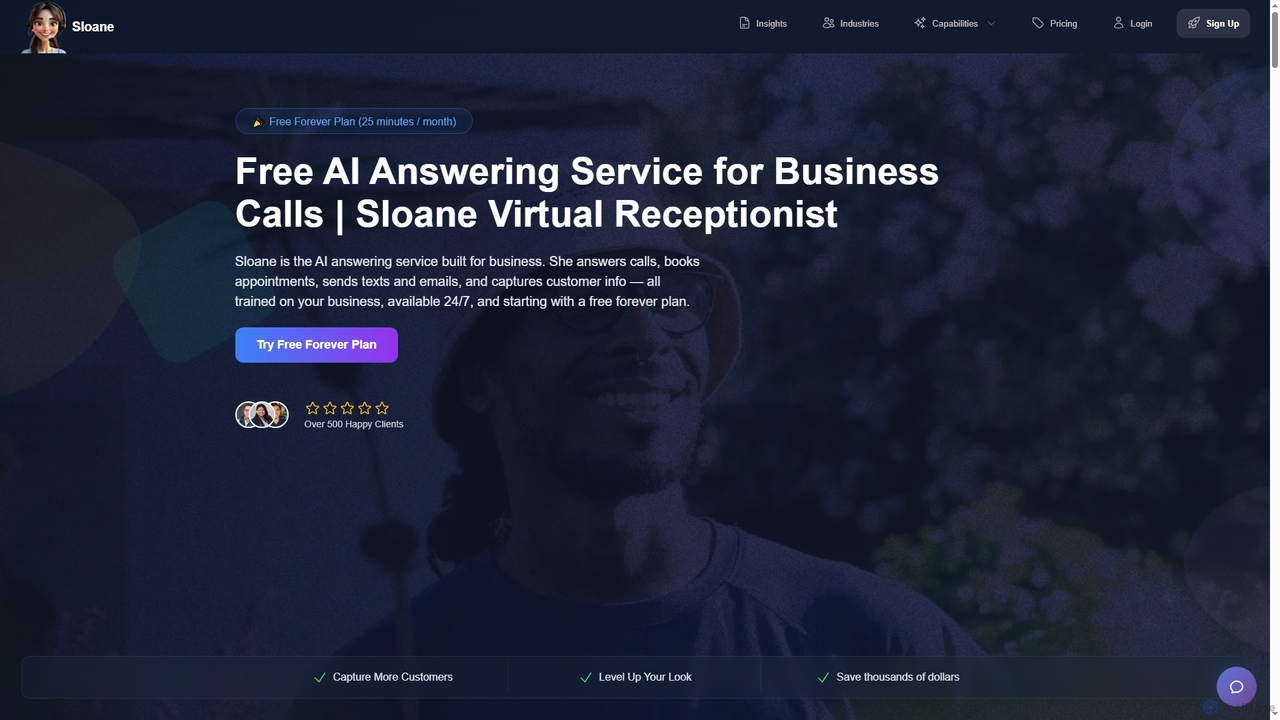
Sloane is an AI-powered virtual receptionist service designed for businesses to handle calls 24/7. It answers calls, books appointments, screens spam, sends texts and emails, and captures customer information, all while being customizable to your brand's voice and trained on your business data. It offers a free forever plan and aims to save businesses time and money.

3D
Visits 13.1KFavorites 154Likes 159

About Sales And Marketing

Sales And Marketing AI tools are AI-powered solutions designed to automate, optimize, and personalize various aspects of the sales and marketing funnel. These tools leverage machine learning, natural language processing, and predictive analytics to enhance efficiency and effectiveness. They help businesses attract, engage, convert, and retain customers more intelligently, transforming traditional workflows into data-driven strategies. By analyzing vast datasets, they provide actionable insights and enable hyper-targeted communications, driving growth and improving customer experiences.

Core Features

  • Lead Scoring & Prediction: Automatically identify and prioritize high-potential leads based on behavioral data and historical patterns.
  • Content Generation & Optimization: Create marketing copy, email drafts, social media posts, and ad creatives, often optimizing them for performance.
  • Personalized Customer Engagement: Deliver tailored messages and product recommendations across channels, enhancing individual customer journeys.
  • Automated Customer Support: Deploy AI chatbots and virtual assistants to handle routine inquiries and provide instant support 24/7.
  • Sales Forecasting & Performance Analysis: Predict future sales trends and analyze team performance to inform strategic decision-making.

Use Cases

These tools are widely adopted by marketing teams, sales departments, and customer service professionals across various industries. They are crucial for businesses aiming to scale their outreach, personalize customer interactions, and make data-driven decisions. Typical applications include automating email campaigns, optimizing ad spend, qualifying leads efficiently, and providing instant customer support.

How to Choose

When selecting Sales And Marketing AI tools, consider their integration capabilities with your existing CRM and marketing platforms. Evaluate the specific features offered, such as lead scoring accuracy or content generation versatility, to match your business needs. Assess scalability to ensure the tool can grow with your operations, and prioritize solutions with robust data privacy and security measures. Finally, compare pricing models and user-friendliness for a sustainable investment.

Sales And Marketing use cases

1

Automating Lead Qualification and Nurturing

Sales development representatives utilize AI tools to efficiently qualify and nurture leads from extensive databases. The AI analyzes lead behavior, demographics, and engagement history to assign scores, then triggers personalized email sequences or chatbot interactions. This allows SDRs to focus solely on high-potential prospects, significantly reducing manual screening time and boosting conversion rates.

2

Personalizing Marketing Campaigns at Scale

Marketing managers leverage AI to create and execute highly personalized campaigns across diverse channels like email, social media, and ads. AI segments audiences, generates tailored ad copy and content, and optimizes delivery schedules for maximum impact. This approach leads to a substantial increase in customer engagement and a higher return on investment for marketing expenditures.

3

Enhancing Customer Service with AI Chatbots

Customer service teams deploy AI chatbots to provide instant, consistent support around the clock. These chatbots handle common inquiries, offer product information, and guide users through troubleshooting steps. Complex issues are seamlessly escalated to human agents. This strategy drastically reduces customer wait times, improves satisfaction scores, and frees human agents for more intricate problem-solving.

4

Predictive Sales Forecasting and Strategy

Sales directors employ AI to accurately forecast future sales and identify key performance drivers. The AI analyzes historical sales data, market trends, and current pipeline activity to generate precise predictions and highlight factors influencing team performance. This empowers leadership to make informed decisions, optimize resource allocation, and proactively adjust sales strategies to meet targets.

5

Generating Engaging Content for Digital Channels

Content creators and social media managers use AI to rapidly brainstorm ideas and draft compelling content. AI assists in outlining blog posts, crafting social media captions, and even suggesting visual concepts based on target audience data and marketing objectives. This significantly increases content output, ensures a consistent online presence, and allows creators more time for strategic content planning.

6

Competitive Analysis and Market Trend Identification

Product marketing specialists utilize AI to continuously monitor competitor activities and identify emerging market trends. AI scans vast amounts of online data, including news, social media, and reviews, to provide actionable insights into competitor strategies, product launches, and evolving consumer preferences. This enables businesses to adapt quickly, inform product development, and gain a competitive edge.

Sales And Marketing FAQ

What are Sales And Marketing AI tools?

Sales And Marketing AI tools are software solutions that use artificial intelligence, such as machine learning and natural language processing, to automate, optimize, and personalize sales and marketing processes. They aim to improve efficiency, enhance customer engagement, and drive revenue by providing data-driven insights and automating repetitive tasks. Common applications include lead scoring, content generation, and personalized outreach.

How do AI tools improve sales and marketing ROI?

AI tools enhance ROI by increasing lead quality and conversion rates through predictive analytics and personalization. They reduce operational costs by automating routine tasks like email campaigns and customer support. Furthermore, AI provides deeper insights into customer behavior and market trends, enabling more effective resource allocation and optimized campaign performance, ultimately leading to higher returns on investment.

What specific tasks can AI automate in sales and marketing?

AI can automate a wide range of tasks, including lead scoring and prioritization, personalized email and ad campaign deployment, content generation (e.g., blog outlines, social media posts), customer service via chatbots, sales forecasting, and market research analysis. These automations free up human teams to focus on strategic initiatives and complex problem-solving.

How to choose the right AI tool for sales and marketing?

Choosing the right AI tool involves several factors: assess its integration capabilities with your existing CRM and marketing automation platforms. Evaluate the specific features that align with your core needs, such as advanced analytics or robust content generation. Consider the tool's scalability, ease of use, data security protocols, and pricing structure to ensure it meets both current and future business requirements.

What are the common challenges when implementing AI in sales and marketing?

Common challenges include ensuring high-quality data for AI models, integrating new AI tools with existing legacy systems, and training staff to effectively use and trust AI-driven insights. Other hurdles involve managing initial setup costs, addressing data privacy and ethical concerns, and accurately measuring the return on investment from AI initiatives. Overcoming these requires careful planning and strategic implementation.