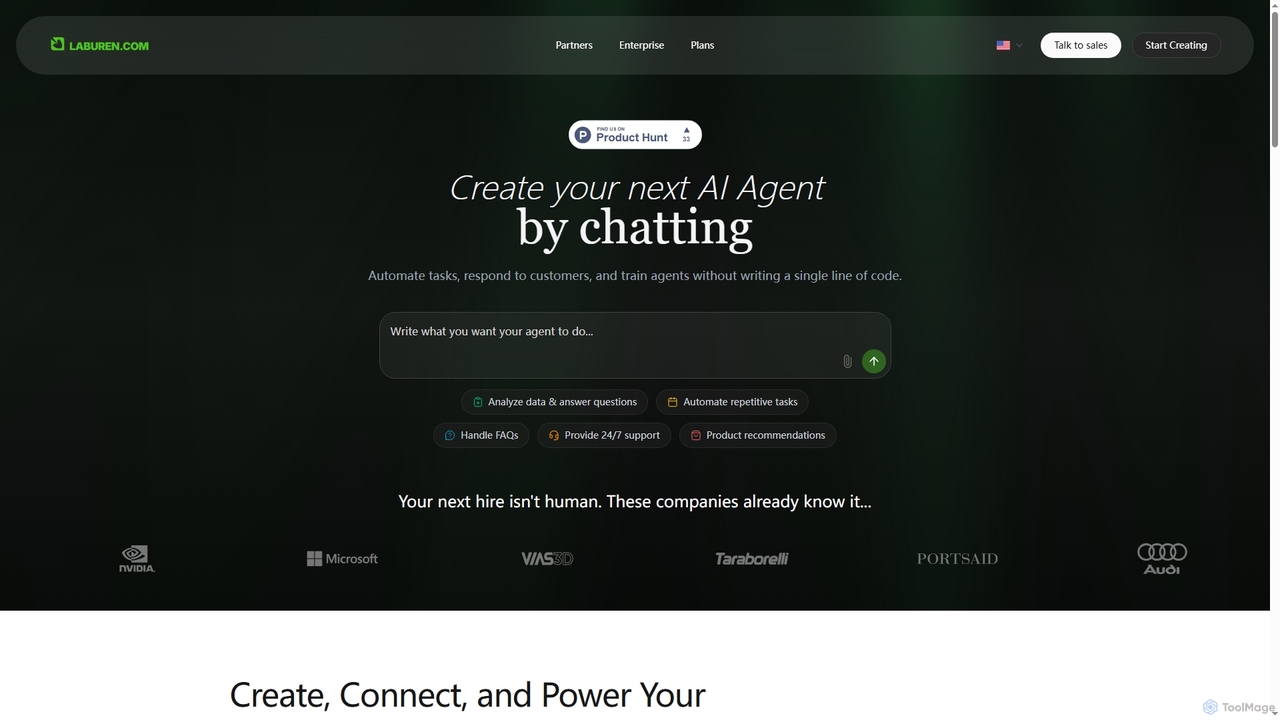
Laburen
Laburen is a no-code AI agent platform that empowers businesses to automate tasks, customer support, sales, and administration. …
Laburen is a no-code AI agent platform that empowers businesses to automate tasks, customer support, sales, and administration. It allows users to create and train AI employees through a simple chat interface, integrating seamlessly with existing business tools to boost productivity and scale operations.
About Workflow Automation
Workflow Automation tools are a category of AI-powered solutions designed to streamline and automate repetitive tasks and complex processes across various business functions. These tools leverage artificial intelligence, machine learning, and integration capabilities to execute predefined or intelligent actions, significantly reducing manual effort and human error. They are crucial for enhancing operational efficiency, accelerating decision-making, and freeing up human resources for more strategic initiatives, particularly within sales and marketing operations.
Core Features
- Task Orchestration: Automate sequences of tasks across different applications and platforms, ensuring smooth process flow.
- Intelligent Data Processing: Automatically extract, transform, and route data based on AI-driven insights, improving data accuracy and utility.
- Conditional Logic & Decision Making: Execute actions based on predefined rules or AI-analyzed conditions, enabling dynamic workflow adjustments.
- System Integration: Seamlessly connect and exchange data between various software systems (CRM, ERP, marketing platforms), creating a unified ecosystem.
- Real-time Monitoring & Reporting: Track automated workflows, identify bottlenecks, and generate performance analytics for continuous optimization.
Use Cases
Businesses across industries utilize workflow automation to manage everything from customer onboarding and support to internal HR processes and financial reporting. In sales and marketing, they automate lead qualification, personalized email sequences, social media content scheduling, and campaign performance tracking, allowing teams to focus on high-value interactions.
How to Choose
When selecting a workflow automation tool, consider its integration capabilities with your existing tech stack, the complexity of workflows it can handle, its scalability, ease of use (low-code/no-code options), and pricing model. Evaluate the AI features for intelligent decision-making and data processing, and ensure it offers robust analytics and reporting to measure impact.
Workflow AutomationUse Cases
Automating Lead Nurturing Sequences
Sales teams use AI workflow automation to automatically send personalized follow-up emails, schedule calls, and update CRM records based on lead engagement (e.g., website visits, email opens, content downloads). This ensures timely and relevant communication without manual intervention, significantly improving lead conversion rates and sales efficiency.
Streamlining Social Media Content Distribution
Marketing teams leverage these tools to automatically schedule and publish posts across multiple social media platforms, repurpose content for different channels, and track engagement metrics. This optimizes content reach, ensures consistent brand messaging, and saves significant time that would otherwise be spent on manual scheduling and monitoring.
Automating Customer Support Ticket Routing
Customer service departments employ workflow automation to analyze incoming support tickets using natural language processing, automatically categorize them, and route them to the most appropriate agent or department. This accelerates resolution times, improves customer satisfaction, and ensures that complex issues reach specialized personnel efficiently.
Personalizing Email Marketing Campaigns
Marketers use AI-driven workflows to segment audiences dynamically based on behavior, preferences, and purchase history, then automatically trigger highly personalized email campaigns with relevant product recommendations or content. This boosts engagement, improves conversion rates, and creates a more tailored customer experience.
Automating Data Entry and CRM Updates
Sales and operations teams utilize automation to automatically extract information from forms, emails, or documents and update CRM systems, eliminating manual data entry errors and ensuring customer data is always current and accurate. This significantly reduces administrative overhead and improves data integrity across the organization.
Automating Sales Proposal Generation
Sales professionals use workflow automation to automatically pull client data from CRM, product information from databases, and pre-approved templates to generate customized sales proposals or contracts. This drastically reduces the time spent on administrative tasks, ensures brand consistency, and speeds up the sales cycle, allowing reps to focus more on client relationships.