AI Town
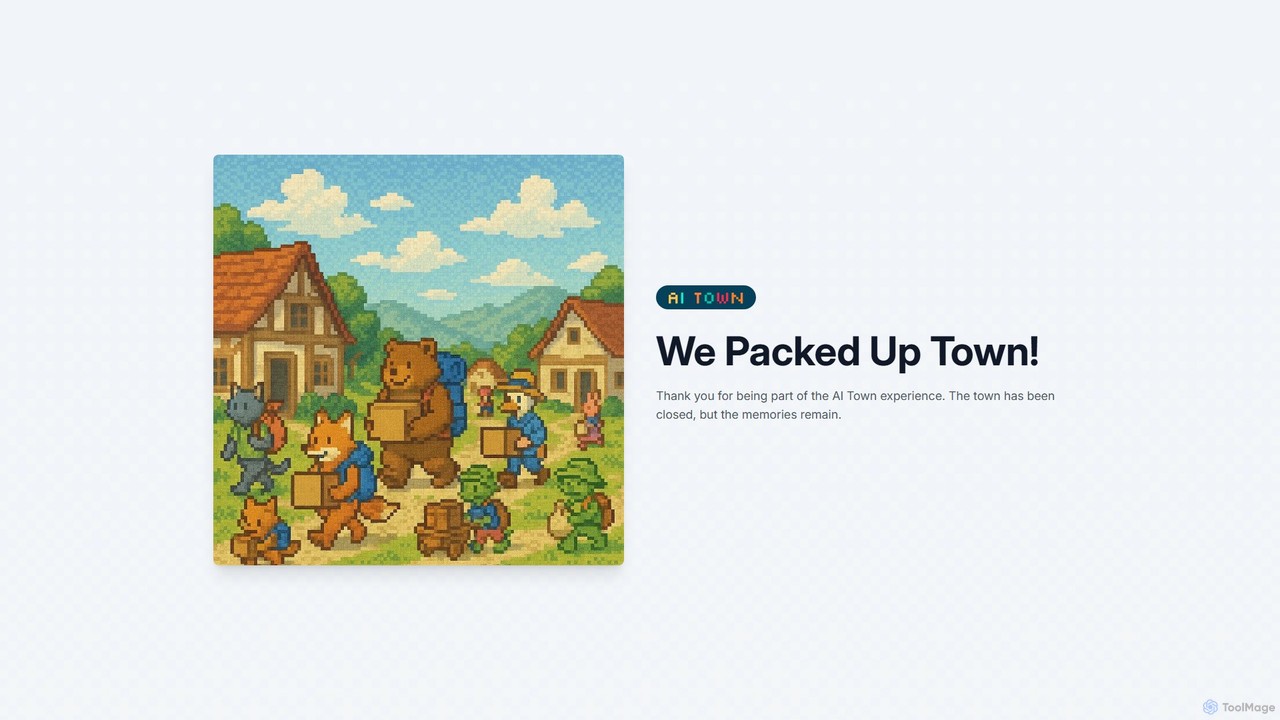
An open-source starter kit for building a virtual town where AI characters live, chat, and form relationships. It …
An open-source starter kit for building a virtual town where AI characters live, chat, and form relationships. It serves as a customizable simulation environment for exploring emergent social behaviors in autonomous AI agents.
About Virtual World
Virtual World AI tools are platforms that leverage artificial intelligence to create, manage, and interact within highly immersive and dynamic digital environments. These tools utilize AI for advanced content generation, intelligent non-player character (NPC) behavior, and realistic physics, pushing the boundaries of digital interaction. They are essential for developing sophisticated metaverse experiences, advanced gaming, realistic training simulations, and comprehensive digital twins, offering unparalleled levels of realism and interactivity.
Core Features
- Dynamic Environment Generation: AI algorithms automatically create vast, detailed, and evolving virtual landscapes, objects, and structures.
- Intelligent NPC Behavior: AI-driven characters exhibit complex decision-making, learning capabilities, and natural interactions, enhancing immersion.
- Real-time Interaction & Physics: AI enhances realistic object manipulation, environmental responses, and user immersion through advanced physics engines.
- Content Personalization: AI adapts virtual experiences, narratives, and content dynamically to individual user preferences and actions.
- Data-driven Simulation: AI analyzes real-world data to construct highly accurate digital twins or training environments for precise modeling.
Use Cases
These tools are widely adopted across various sectors. Game developers use them for procedural world generation and intelligent enemy AI, while architects and urban planners create digital twins for simulating city development and infrastructure. Enterprises deploy them for highly realistic training scenarios, and metaverse creators leverage them for dynamic content and interactive social spaces.
How to Choose
When selecting a Virtual World AI tool, consider its scalability for handling large environments and user bases, integration capabilities with existing design pipelines, and the sophistication of its AI for content generation and NPC intelligence. Evaluate the real-time rendering performance, customization options, and the overall cost-effectiveness for your specific project needs.

Virtual WorldUse Cases
Metaverse Content Creation
Metaverse developers and digital artists utilize Virtual World AI tools to rapidly generate diverse assets, environments, and interactive elements. By inputting textual descriptions or concept art, AI can create 3D models, textures, and entire virtual landscapes, significantly accelerating the content pipeline. This allows teams to iterate on designs faster, populate vast digital spaces efficiently, and bring complex virtual worlds to life with reduced manual effort, saving up to 70% of asset creation time.
Advanced Gaming Development
Game designers and developers leverage Virtual World AI tools to create more dynamic and intelligent gaming experiences. AI can procedurally generate vast game worlds, design complex level layouts, and imbue non-player characters (NPCs) with sophisticated behaviors, learning capabilities, and adaptive strategies. This results in highly replayable games with emergent gameplay, where AI opponents offer challenging and varied encounters, enhancing player engagement and reducing the need for extensive manual scripting for every scenario.
Immersive Training Simulations
Enterprises and educational institutions utilize Virtual World AI tools to create highly realistic and adaptive training environments. For example, medical professionals can practice complex surgical procedures in a virtual operating room with AI-driven patient responses, or pilots can train for emergency scenarios in a simulated cockpit with dynamic weather and system failures. AI personalizes the training experience, provides real-time feedback, and generates varied scenarios, leading to more effective skill development and improved decision-making under pressure.
Digital Twin for Urban Planning
City planners and urban developers employ Virtual World AI tools to create comprehensive digital twins of cities or specific urban areas. These digital replicas, powered by AI, can simulate various aspects like traffic flow, pedestrian movement, environmental impacts, and infrastructure performance under different conditions. This allows planners to test proposed developments, analyze the effects of policy changes, and optimize urban designs before physical implementation, leading to more sustainable and efficient city planning with reduced risks and costs.
Virtual Prototyping & Testing
Engineers and product designers utilize Virtual World AI tools to create virtual prototypes of products, machinery, or complex systems. AI-driven simulations allow for rigorous testing of designs under various stress conditions, performance metrics, and user interactions without the need for physical models. This accelerates the design cycle, identifies potential flaws early, and optimizes product functionality, leading to significant cost savings in manufacturing and a faster time-to-market for innovative solutions.
Virtual Event & Social Platforms
Event organizers and community managers leverage Virtual World AI tools to create dynamic and engaging virtual event spaces and social platforms. AI can personalize attendee experiences by recommending relevant content or connections, facilitate natural interactions between avatars through advanced natural language processing, and dynamically adjust environment elements based on user presence. This enhances participant engagement, fosters stronger community bonds, and offers scalable solutions for hosting large-scale virtual conferences, concerts, or social gatherings with rich, interactive features.