ToolMage
Sign in

Best 1 Learning AI tools for Student

Popular Learning AI tools in Student include FGenEds, helping you work more efficiently.

FGenEds
Freemium

FGenEds

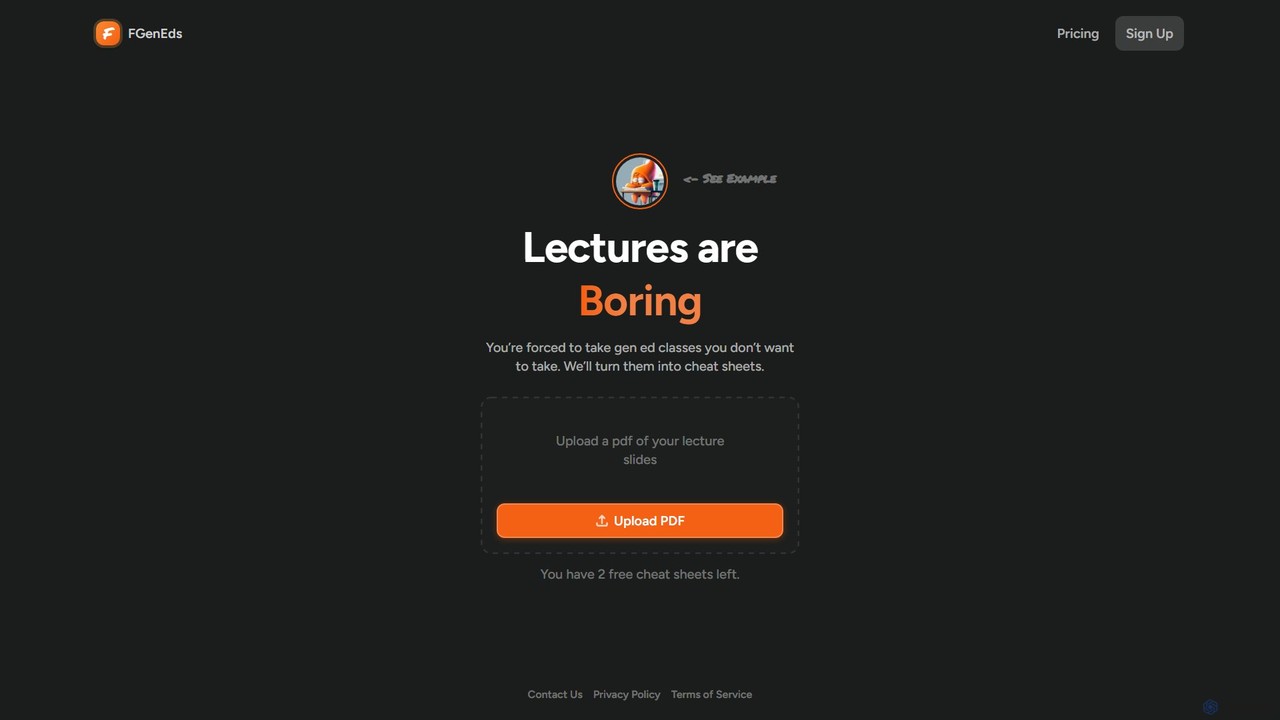
FGenEds is an AI-powered tool designed for students that instantly transforms lengthy PDF lecture slides into concise, easy-to-digest cheat sheets. Simply upload your slides, and the AI will extract key concepts, definitions, and important information, creating a perfect study guide to help you prepare for exams and save valuable time.

Study Tools
Visits 5KFavorites 145Likes 149

About Learning

AI Learning tools are applications that leverage artificial intelligence to create personalized, interactive, and efficient educational experiences for students. These tools use technologies like Natural Language Processing (NLP) to understand a student's knowledge gaps, explain complex concepts, and generate tailored practice materials. Their primary value lies in transforming passive study into an active, adaptive process, helping learners master subjects faster and with greater comprehension within their academic journey.

Core Features

  • Personalized Tutoring: Provides one-on-one guidance and adaptive learning paths that adjust difficulty based on user performance.
  • Concept Explanation: Breaks down complex topics, theories, or formulas into simple, easy-to-understand explanations.
  • Automated Content Generation: Creates summaries, quizzes, and flashcards directly from lecture notes, textbooks, or articles.
  • Interactive Practice & Feedback: Offers conversational practice for languages or step-by-step guidance for problem-solving with instant feedback.

Use Cases

These tools are widely used by students from high school to university, as well as lifelong learners. They are particularly effective for exam preparation, tackling difficult STEM subjects, learning a new language, or summarizing dense research papers and textbooks to accelerate understanding.

How to Choose

When selecting an AI Learning tool, consider the specific subjects it covers, its teaching methodology (e.g., Socratic method, spaced repetition), the quality of its feedback, and its ability to work with your own study materials. Also, evaluate the user interface and whether its pricing model aligns with your budget and study needs.

Featured tool rankings

Learning use cases

1

Mastering Complex Scientific Concepts

A university student struggling with quantum mechanics uses an AI learning tool to ask specific questions. The AI provides analogies, visual aids, and step-by-step breakdowns of complex equations. It then generates a short quiz to test their understanding. If the student answers incorrectly, the tool offers a different explanation, ensuring they grasp the concept before moving on.

2

Automated Flashcard Creation for Exams

A medical student uploads their digital lecture notes into an AI tool. The AI automatically identifies key terms, definitions, and concepts, generating a comprehensive set of digital flashcards in minutes. The tool then uses a spaced repetition algorithm to schedule review sessions, helping the student memorize large volumes of information efficiently for their final exams.

3

Interactive Language Pronunciation Practice

A student learning French uses an AI tutor to practice speaking. They read sentences aloud, and the AI provides real-time feedback on their pronunciation, intonation, and rhythm. It highlights specific phonemes they struggle with and offers targeted exercises, allowing them to improve their accent and conversational fluency without the pressure of speaking with a native speaker.

4

Summarizing Research Papers for a Literature Review

A graduate student needs to review dozens of academic papers for their thesis. They use an AI tool to upload PDFs of the papers. The AI generates concise summaries of each paper, highlighting the research question, methodology, and key findings. This allows the student to quickly assess the relevance of each paper, saving hours of reading time and accelerating the literature review process.

5

Personalized Math Problem Solving Practice

A high school student struggling with calculus gets a personalized set of practice problems from an AI tool. The tool adapts the difficulty based on their performance, providing easier questions when they make mistakes and more challenging ones as they improve. For each problem, it offers optional hints and detailed, step-by-step solutions, targeting their specific weak areas.

6

Getting Instant Feedback on Essay Drafts

Before submitting a history essay, a student uploads their draft to an AI learning tool. The tool provides instant feedback on grammar, clarity, and sentence structure. It also checks the logical flow of their arguments and suggests areas where the reasoning could be strengthened or where more evidence is needed, acting as a preliminary review before the professor sees it.

Learning FAQ

What are AI Learning tools?

AI Learning tools are software applications that use artificial intelligence to provide personalized educational support for students. Unlike static content like videos or texts, they interact with the user, adapting to their learning pace and style. Key features include explaining complex topics, generating practice quizzes from study materials, and offering instant feedback to help students learn more effectively.

How do I choose the right AI Learning tool?

To choose the right AI Learning tool, consider these factors:

  • Subject Coverage: Ensure the tool specializes in the subject you need, whether it's math, science, languages, or humanities.
  • Learning Method: Look for tools that match your learning style, such as visual explanations, interactive problem-solving, or gamified quizzes.
  • Feedback Quality: A good tool provides specific, actionable feedback that helps you understand your mistakes, not just tells you if you're right or wrong.
  • Content Sources: Check if you can upload your own materials (like PDFs or notes) for a more customized experience.
What's the difference between AI Learning tools and online courses?

The main difference is interactivity and personalization. Online courses typically offer a static, one-size-fits-all curriculum of videos and readings. In contrast, AI Learning tools create a dynamic, two-way learning experience. They can answer a student's specific questions, adapt problem difficulty in real-time, and provide personalized feedback, making the learning process more tailored to individual needs.

Can AI Learning tools replace human teachers?

AI Learning tools are best viewed as powerful supplements, not replacements, for human teachers. They excel at providing scalable, 24/7 personalized practice and instant feedback on specific tasks. However, human teachers provide mentorship, inspiration, and nuanced understanding of a student's emotional and social needs, which AI cannot replicate. The ideal approach combines the strengths of both.

Are AI Learning tools effective for all subjects?

AI Learning tools are highly effective for many subjects, especially those with clear rules and structures like mathematics, programming, and language grammar. They are also very useful for summarizing large amounts of text in subjects like history or literature. However, their effectiveness in subjects requiring deep creative interpretation or complex ethical reasoning, such as philosophy or art critique, may be more limited. Their strength lies in building foundational knowledge and skills.