ToolMage
Sign in

AI TOOL COMPARISON

AgentQL vs Apify

What is the difference, and which fits your workflow? Compare features, usage, pricing models and traffic side by side.

Jump to key differences

Product overview

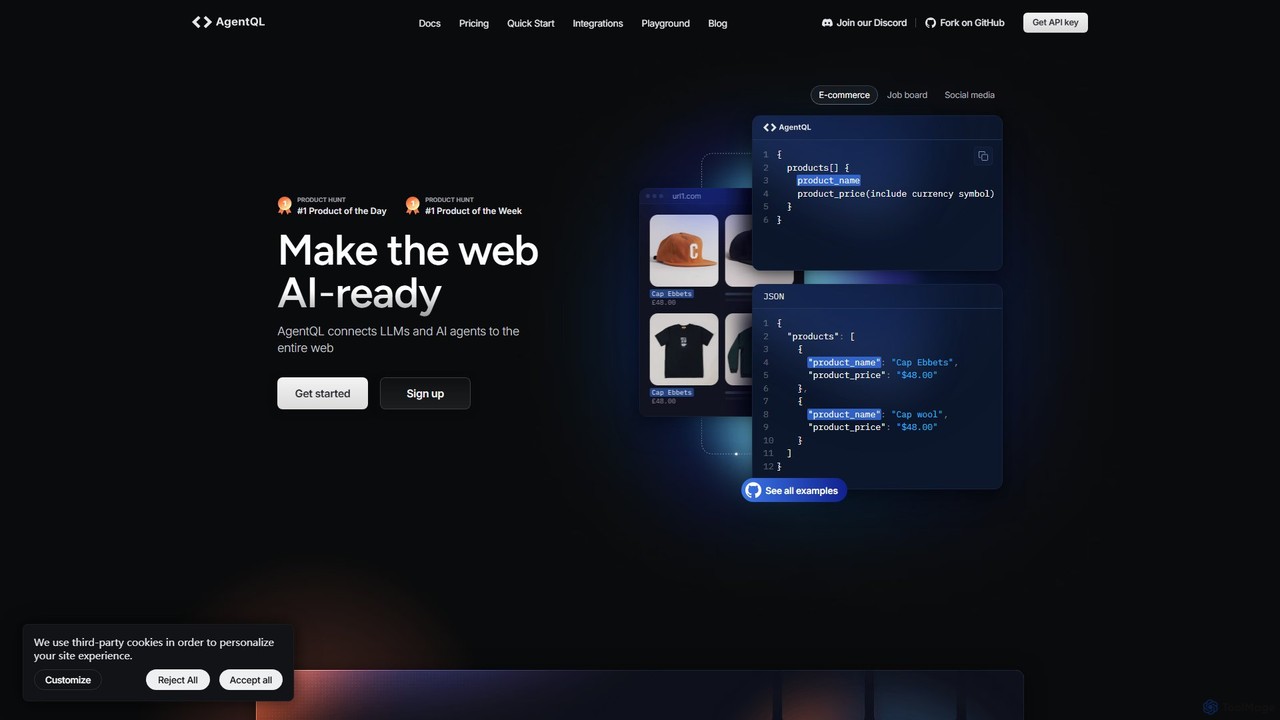
AgentQL Product overview

AgentQL is a developer toolset that connects LLMs and AI agents to the web. It uses an AI-powered query language to robustly extract structured data and automate web interactions, serving as a powerful, self-healing alternative to fragile XPath and CSS selectors.

Preview

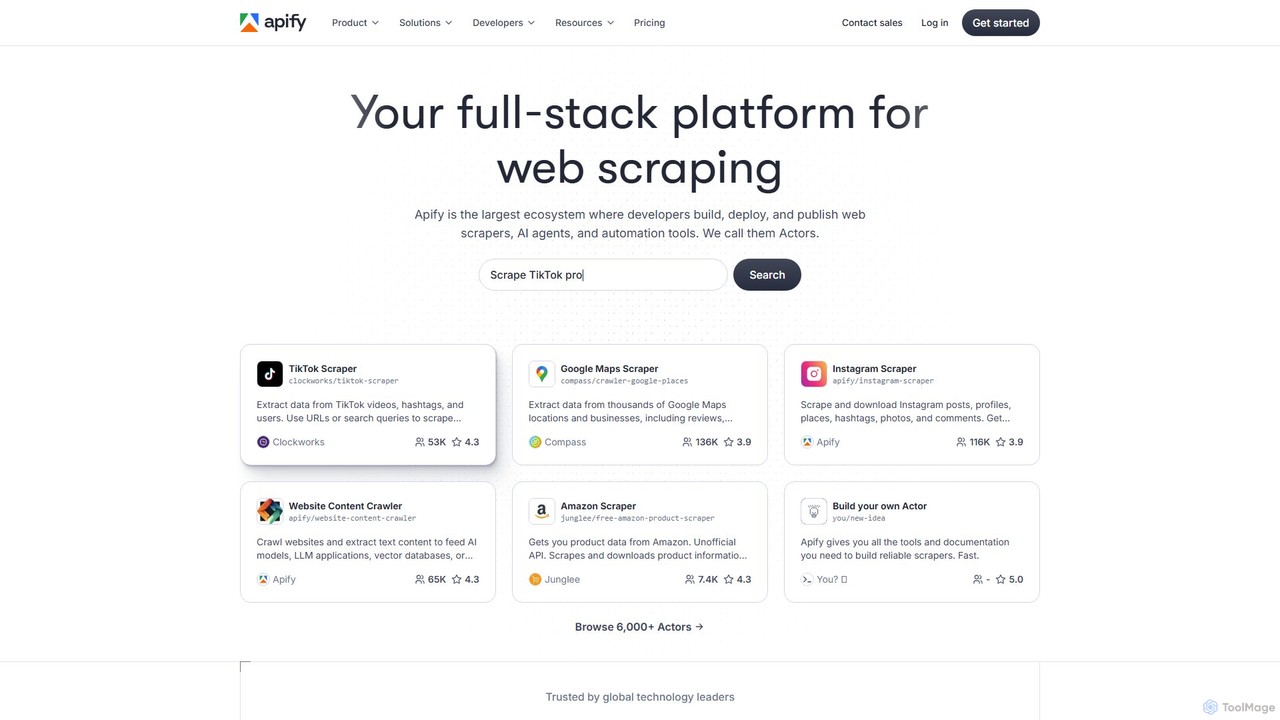
Apify Product overview

Apify is a full-stack web scraping and automation platform that enables developers to build, deploy, and publish data extraction tools, known as 'Actors'. It offers a vast marketplace of pre-built scrapers for popular websites like Google Maps, Instagram, and TikTok, alongside a robust cloud infrastructure for creating custom solutions. With support for Python and JavaScript, open-source libraries, and seamless integrations, Apify simplifies collecting web data at any scale.

Preview

Quick facts

Compare product focus, pricing models and audiences. Highlighted rows indicate different listed information; unknown pricing does not mean free.

AgentQL VS Apify — Quick facts
Quick factsAgentQLApify
Pricing modelFreemiumFreemium
Product typeWebWeb
Primary focusLlmData Collection
Audience and rolesNo data availableNo data available
CategoriesLlm · Data Extraction · Web Scraping · AutomationData Collection · Data Extraction · Web Scraping · Automation
AddedAug 2, 2025Aug 16, 2025
UpdatedNov 19, 2026Nov 19, 2026

Features, usage and use cases

Explore the listed product descriptions, features and workflows. Taxonomy labels alone are not feature evaluations.

AgentQL

AgentQL is a comprehensive suite of tools designed to make the entire web AI-ready, enabling Large Language Models (LLMs) and AI agents to seamlessly interact with web pages, extract structured data, and perform complex automation tasks. It fundamentally changes how developers approach web data extraction by replacing traditional, brittle methods like XPath and DOM/CSS selectors with a robust, AI-driven query language. This language understands the semantic structure of a webpage, allowing it to locate the desired information consistently, even when the site's layout or underlying code changes.

The core of AgentQL is its unique query language, which allows you to define the exact shape of the data you need in a simple, declarative syntax. For example, you can request a list of products with their names and prices, and AgentQL will intelligently parse the page to find and structure this information into a clean JSON output. This eliminates the tedious process of writing complex parsing scripts and manually sifting through raw HTML.

How to use AgentQL

Using AgentQL involves a straightforward workflow that integrates easily into existing development processes:

  1. Define Your Data Structure: Start by writing an AgentQL query that describes the data you want to extract. For instance, to get product details, your query might look like: { products[] { product_name, product_price(include currency symbol) } }.
  2. Choose Your Integration Method: AgentQL offers multiple ways to execute your queries. You can use the versatile Python and JavaScript SDKs, which integrate with Playwright for powerful browser automation and interaction on both public and private (behind authentication) sites. Alternatively, for public-facing data, you can use the browserless REST API to retrieve data from any URL without managing a browser instance.
  3. Debug and Refine: Utilize the browser-based debugging extension to build, test, and optimize your queries in real-time on any live webpage. This interactive tool significantly speeds up the development process.
  4. Execute and Automate: Run your queries through the SDK or API to receive structured JSON data. The SDKs also allow you to programmatically interact with web elements, such as clicking buttons, filling forms, and navigating pages, enabling full-scale web automation.
  5. Integrate with AI Frameworks: Connect AgentQL with popular agentic frameworks like LangChain and LlamaIndex, or low-code platforms like Langflow, to feed real-time, structured web data into your AI applications and RAG models.

Core Features of AgentQL

  • AI-Powered Query Language: A semantic and robust language for selecting elements and extracting data, resilient to changes in page layout and HTML structure.
  • Structured Data Output: Automatically converts unstructured web content into clean, predictable JSON format based on your query.
  • Versatile SDKs (Python & JavaScript): Provides deep integration with your applications using Playwright for advanced browser control and automation.
  • Browserless REST API: Enables high-volume data extraction from public URLs without the overhead of running a browser.
  • Browser Debugging Extension: An interactive tool for real-time query creation, testing, and optimization directly on web pages.
  • Self-Healing Queries: Queries are not tied to specific HTML tags, making them adaptable to dynamic content and website updates, ensuring long-term reliability.
  • PDF Parsing: Capable of extracting complex information, including tables, from PDF documents.
  • Broad Integrations: Plays well with major AI and automation frameworks like LangChain, LlamaIndex, and Langflow.

Use Cases for AgentQL

AgentQL is ideal for a wide range of applications where interaction with web data is crucial:

  • AI Agent Development: Empowering AI agents to browse the web, gather real-time information for decision-making, and execute tasks on behalf of users.
  • Robust Web Scraping: Building scalable and maintainable data extraction pipelines for market research, competitor analysis, price monitoring, and lead generation.
  • Retrieval-Augmented Generation (RAG): Grounding LLM responses with accurate, real-time, structured data from the web to reduce hallucinations and improve answer quality.
  • Workflow Automation: Automating repetitive tasks such as filling out forms, data entry from websites into internal systems, and testing web applications.
  • No-Code/Low-Code Solutions: Enabling users of platforms like Langflow to create visual workflows that pull and process live web data without writing code.

Advantages of AgentQL

The primary advantage of AgentQL is its robustness and efficiency. By using AI to understand page structure, it saves countless hours of developer time that would otherwise be spent writing and maintaining fragile parsing scripts. Its queries are reusable across similar pages, and its self-healing nature means less maintenance and more reliable data pipelines. It provides structured data out-of-the-box, simplifying downstream processing and integration with other systems.

Pricing and Plans

AgentQL offers a flexible pricing structure to suit different needs, from individual hobbyists to large enterprises.

  • Starter Plan: $0/month. This plan is perfect for enthusiasts and small projects, offering 50 free API calls per month, 10 hours of remote browser time, and community support. Additional usage is billed on a pay-as-you-go basis.
  • Professional Plan: $99/month. Aimed at teams with regular scraping and automation needs, this plan includes 10,000 API calls per month, 500 hours of remote browser time, a higher rate limit, and priority email support.
  • Enterprise Plan: Custom pricing. For businesses requiring fully managed solutions, this plan offers ready-to-use datasets, dedicated cloud or on-premise deployment, 24/7 premium support, and a dedicated account manager.
  • A free trial is also available, providing 300 API calls and 1 hour of remote browser access without requiring a credit card.

Apify

Apify is a comprehensive cloud platform designed for web scraping, data extraction, and process automation. It provides a complete ecosystem where developers and businesses can build, deploy, manage, and publish web scrapers and automation tools, which are called 'Actors'. Apify caters to a wide range of users, from individual developers needing to extract data for a small project to large enterprises requiring reliable, scalable data pipelines for business intelligence and AI applications.

The platform's core is the Apify Store, a marketplace featuring over 6,000 pre-built Actors for scraping popular websites like Google, Instagram, TikTok, and Amazon. This allows users to get structured data instantly without writing any code. For more specific needs, Apify provides a powerful development environment with all the necessary tools to build custom Actors from scratch using popular programming languages and libraries.

How to use Apify

Using Apify involves a straightforward workflow that can be adapted to your technical skill level:

  1. Choose Your Method: You can either select a ready-made 'Actor' from the Apify Store for a specific task (e.g., 'Google Maps Scraper') or decide to build your own custom scraper.
  2. Configure the Actor: If using a pre-built Actor, you simply provide the necessary inputs, such as URLs, search keywords, or location data, through a user-friendly interface.
  3. Build a Custom Actor (Optional): For custom needs, developers can use the Apify SDK with Python or JavaScript (Node.js). The platform supports popular libraries like Crawlee, Playwright, Puppeteer, and Scrapy. You can write your code locally and deploy it to the Apify cloud.
  4. Run and Monitor: Execute your Actor on Apify's cloud infrastructure. The platform handles proxies, scaling, and compute resources automatically. You can monitor the progress of your scraping jobs in real-time through the dashboard.
  5. Access and Export Data: Once the run is complete, the extracted data is stored and can be viewed in various formats like JSON, CSV, or Excel. You can download the data directly or access it via the Apify API.
  6. Integrate and Automate: Schedule your Actors to run at regular intervals for continuous data monitoring. Integrate the data flow with other applications and services like Zapier, Google Sheets, Pinecone, LangChain, or your own database.

Core Features of Apify

  • Apify Store: A vast marketplace of over 6,000 pre-built web scrapers and automation tools (Actors) for immediate use.
  • Developer Platform: A full-stack environment to build, test, and deploy custom scrapers with robust cloud infrastructure, supporting Python and JavaScript.
  • Open-Source Libraries: Deep integration with powerful open-source libraries like Crawlee (Apify's own), Playwright, Puppeteer, Selenium, and Scrapy.
  • Integrated Proxies: Access to a large pool of datacenter and residential proxies to manage IP rotation, bypass blocking, and ensure successful data extraction.
  • Scalable Cloud Infrastructure: Automatically scales resources based on demand. Users don't need to manage servers, storage, or compute.
  • Scheduling and Monitoring: Built-in tools to schedule scraping jobs to run periodically and monitor their status, performance, and resource consumption.
  • Data Integration & API: A powerful API to run Actors and access data programmatically, plus seamless integrations with tools like Zapier, Airbyte, LangChain, and LlamaIndex.
  • AI Data Solutions: Specialized Actors like the 'Website Content Crawler' are designed to extract and clean text content to feed AI models, vector databases, and RAG pipelines.

Use Cases for Apify

Apify is versatile and can be used for a wide array of data-driven tasks:

  • Lead Generation: Extracting contact information and business details from Google Maps, LinkedIn, or industry directories.
  • Market & Competitor Analysis: Scraping product prices, reviews, and descriptions from e-commerce sites like Amazon to monitor market trends.
  • Social Media Intelligence: Gathering data from platforms like TikTok, Instagram, and Twitter for sentiment analysis, influencer tracking, and campaign monitoring.
  • AI and Machine Learning: Crawling websites to collect large datasets of text and images for training AI models and powering RAG (Retrieval-Augmented Generation) systems.
  • Brand Monitoring: Tracking mentions of a brand, product, or service across news sites, blogs, and forums.
  • Financial and Real Estate Data Aggregation: Collecting stock market data, property listings, and pricing information from various sources.

Advantages of Apify

Apify stands out with several key advantages:

  • All-in-One Solution: It combines a marketplace of ready-to-use tools with a powerful development platform and managed cloud infrastructure.
  • Efficiency and Speed: Pre-built Actors save hundreds of development hours, allowing users to get data in minutes.
  • Developer-Centric: It supports the languages and tools developers already know and love, backed by extensive documentation, code templates, and a strong community.
  • Reliability and Scalability: Built for performance at scale, offering enterprise-grade reliability with 99.95% uptime and SOC2 compliance.
  • Monetization for Developers: Developers can publish their Actors on the Apify Store and earn a recurring income, while Apify handles billing, infrastructure, and marketing.

Pricing and Plans

Apify operates on a freemium, usage-based pricing model, making it accessible for projects of all sizes.

  • Free Plan: Includes a generous amount of free monthly platform credits ($5/month), which is sufficient for small projects, testing, and learning. New creators also get a significant credit bonus to start.
  • Personal Plan ($49/month): Designed for individuals and freelancers, offering a larger pool of platform credits and access to more features.
  • Team Plan ($499/month): Aimed at small to medium-sized businesses, this plan includes even more credits, collaborative features, longer data retention, and priority support.
  • Enterprise Plan (Custom Pricing): Tailored for large organizations with specific needs, offering custom credit amounts, premium security features (SOC2), dedicated support, and custom service level agreements (SLAs).

All plans operate on a pay-as-you-go basis for usage beyond the included credits, covering compute units, proxy usage, and data storage.

Positioning

Their taxonomy shows where the products overlap and where each one has a more distinct focus. Unknown fields are shown explicitly and are never filled with assumptions.

Categories

Shared
Data ExtractionWeb ScrapingAutomation
Only AgentQL
Llm
Only Apify
Data Collection

Tags

Shared
APIautomationdata extractionweb scraping
Only AgentQL
AI agentdeveloper toolLangChainllmPDF parsingPlaywrightstructured data
Only Apify
AI datadata miningdeveloper toolsjavascriptlead generationpythonRAGweb crawler

Audience and roles

Shared
No listed items
Only AgentQL
No listed items
Only Apify
No listed items

Traffic comparison

Traffic is shown on the same scale so differences in market visibility are not visually understated.

How to interpret the traffic data

Both charts share the same months and vertical scale. Each tool identifies its latest reporting month; missing months are left blank, not counted as zero. Regional and source visit counts are estimates calculated from the reported shares.

AgentQL monthly traffic:

Latest traffic · 2026-05

Monthly visits
19.7K
Avg. visit duration
0:43
Pages per visit
1.98
Bounce rate
40.71%
Data updated 2026-06-15

Monthly traffic trend

  • 2025-09: 31K
  • 2026-01: 23.6K
  • 2026-02: 19.9K
  • 2026-03: 24K
  • 2026-04: 19.3K
  • 2026-05: 19.7K

Top regions

Top 5 countries/regions
Country/regionPercentageEstimated visits
🇺🇸United States49.81%9.8K
🇮🇳India20.61%4.1K
🇬🇧United Kingdom17.65%3.5K
🇩🇪Germany6.43%1.3K
🇻🇳Vietnam5.5%1.1K

Traffic sources

Source typePercentageEstimated visits
Direct81.96%16.2K
Referral18.04%3.6K

Search keywords

agent qlagentqlcensus data scrappercomposio cli,nested job scraping with agentql

Apify monthly traffic:

Latest traffic · 2026-05

Monthly visits
4.4M
Avg. visit duration
4:48
Pages per visit
7.65
Bounce rate
36.29%
Data updated 2026-06-15

Monthly traffic trend

  • 2025-09: 1.9M
  • 2026-01: 2.5M
  • 2026-02: 2.5M
  • 2026-03: 3.8M
  • 2026-04: 4.1M
  • 2026-05: 4.4M

Top regions

Top 5 countries/regions
Country/regionPercentageEstimated visits
🇺🇸United States40.31%1.8M
🇮🇳India31.99%1.4M
🇧🇷Brazil10.35%457.4K
🇬🇧United Kingdom8.77%387.5K
🇩🇪Germany8.58%379.1K

Traffic sources

Source typePercentageEstimated visits
Direct84.73%3.7M
Referral11.9%525.9K
Email3.37%148.9K

Search keywords

apifyepornerfacebookthisvidxvideos

Community signals

Ratings, comments, favorites, and likes are community signals—not a substitute for product fit.

AgentQL

Rating
No data available
Comments
0
Favorites
176
Likes
184

Apify

Rating
No data available
Comments
0
Favorites
156
Likes
173

AgentQL vs Apify · Comparison FAQ

What do AgentQL and Apify have in common?
Both tools are listed under Data Extraction、Web Scraping、Automation. These categories indicate overlapping use cases; compare their detailed descriptions for workflows, capabilities and limitations.
Are AgentQL and Apify free?
Listed pricing models: AgentQL — Freemium; Apify — Freemium. Missing pricing is not proof of a free plan, and freemium does not mean every feature is free. Check official sites for current plans, limits and trials.
How should I choose between AgentQL and Apify?
The primary listed category is Llm for AgentQL, and Data Collection for Apify. Compare features, steps and use cases, then verify pricing, data permissions and deployment needs. This page does not include hands-on testing and does not declare a winner from traffic or tags.

Sources and comparison methodology

This page is assembled from ToolMage product listings, taxonomy, traffic statistics and on-site user feedback. It is not a hands-on test or an independent review.
  • Feature and plan descriptions reflect information in the listings, not real-time guarantees. Verify pricing, quotas, availability and privacy terms on the official sites.
  • Traffic uses the reporting months shown. Missing statistics do not mean zero visits, and different periods do not establish growth or superiority. Regional and source visit counts are estimates based on shares.
  • Different tags indicate differences in the listings, not proof that the other product lacks a capability. Ratings, favorites and visits are not used to declare a winner.

Related comparisons