
ToolMage
Sign in

AI TOOL COMPARISON

appaca vs CodeFlying

What is the difference, and which fits your workflow? Compare features, usage, pricing models and traffic side by side.

Jump to key differences

Product overview

appaca Product overview

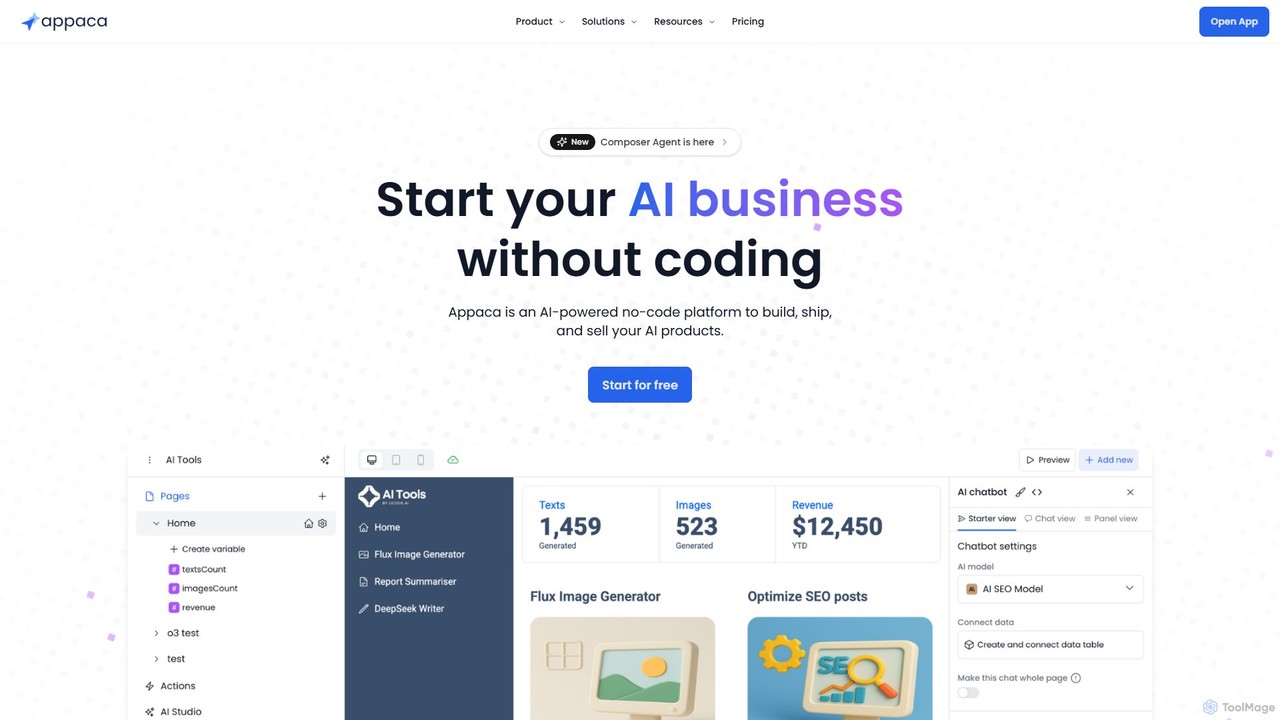
Appaca is an AI-powered, no-code platform that enables users to build, ship, and sell full-stack AI applications. It provides an all-in-one solution with a visual UI builder, agentic workflow creation, integrated databases, user authentication, and Stripe-powered monetization. Users can leverage top AI models like GPT-4o, Claude 3.5, and Gemini to create everything from SaaS products to internal tools without writing any code.

Preview

CodeFlying Product overview

CodeFlying is an AI-powered development platform that automatically generates software, mini-programs, and web applications from a single sentence. It empowers innovators and non-technical users to build and deploy functional apps using natural language, drastically reducing development time and complexity.

Preview

Quick facts

Compare product focus, pricing models and audiences. Highlighted rows indicate different listed information; unknown pricing does not mean free.

appaca VS CodeFlying — Quick facts
Quick factsappacaCodeFlying
Pricing modelFreemiumFreemium
Product typeWebWeb
Primary focusSaasApp Builder
Audience and rolesNo data availableNo data available
CategoriesSaas · No Code · AutomationApp Builder · No Code · Automation
AddedAug 10, 2025Aug 15, 2025
UpdatedNov 19, 2026Nov 19, 2026

Features, usage and use cases

Explore the listed product descriptions, features and workflows. Taxonomy labels alone are not feature evaluations.

appaca

Appaca is a comprehensive, no-code platform designed to democratize the creation of AI-powered applications. It empowers entrepreneurs, businesses, and agencies to build, deploy, and monetize sophisticated, full-stack AI solutions without needing extensive technical expertise or a development team. The platform serves as an all-in-one ecosystem, integrating everything from front-end user interface design to complex backend workflows, user management, and payment processing.

At its core, Appaca allows you to bring your AI ideas to life in minutes. You can power your applications with a wide array of leading Large Language Models (LLMs), including OpenAI's GPT-4o, Anthropic's Claude 3.5 Sonnet, Google's Gemini, and models from Meta and Mistral. This flexibility ensures you can choose the best model for your specific use case, whether it's text generation, image creation, or voice transcription.

How to use appaca

Getting started with Appaca is a straightforward, step-by-step process designed for speed and efficiency:

  1. Sign Up & Create a Project: Begin by signing up for a free account. Once in the dashboard, create a new app project.
  2. Design the User Interface (UI): Use the intuitive, drag-and-drop UI builder. Select from a variety of pre-built components like input fields, buttons, and data displays to design a user-facing interface that matches your brand. You can customize the look and feel without writing any CSS.
  3. Build the Backend Workflow: This is where the magic happens. Use the visual agentic workflow builder to define the app's logic. You can chain prompts, connect to different AI models, integrate third-party tools, and manipulate data from the built-in database.
  4. Integrate AI Models: Choose from the extensive list of supported text, image, and voice AI models. Configure the model settings and prompts directly within the workflow builder.
  5. Set Up User Management & Monetization: Enable the pre-built user authentication system for login and registration pages. If you plan to sell your app, integrate Stripe to charge for subscriptions or AI credit usage.
  6. Publish and Launch: Once your app is ready, you can publish it instantly to a unique appaca.io subdomain. On paid plans, you can connect a custom domain for a fully white-labeled experience.

Core Features of appaca

  • No-Code App Builder: Visually construct full-stack AI applications with a drag-and-drop interface.
  • Agentic Workflow Engine: Design complex, multi-step backend logic to power your app's core functionality.
  • Extensive LLM Integration: Access to top-tier AI models from OpenAI (GPT-4o, DALL-E 3), Anthropic (Claude 3.5), Google (Gemini), Meta (Llama), and more.
  • Built-in Database: Store and manage application data seamlessly within the platform.
  • User Authentication: Pre-built login, registration, and account management pages for your end-users.
  • Stripe Monetization: Easily integrate Stripe to sell subscriptions and AI credits, turning your app into a business.
  • Customizable UI Components: A rich library of UI elements to create a professional and branded user experience.
  • Custom Domain & White-Labeling: Connect your own domain and remove Appaca branding on paid plans.
  • Custom Code Support: Go beyond no-code with custom scripting for workflows and CSS for styling when needed.

Use Cases for appaca

Appaca is versatile enough for a wide range of applications:

  • SaaS Startups: Quickly build and launch a Minimum Viable Product (MVP) for a niche market, such as a Poem Analyzer, a Gen Z slang translator, or a specialized content generator.
  • Internal Business Tools: Create custom AI tools for your team to enhance productivity. Examples include an internal knowledge base search powered by your company's documents or an automated report summarizer.
  • Agencies and Freelancers: Deliver custom AI solutions for clients in a fraction of the time and cost of traditional development, from custom chatbots to data analysis tools.
  • Marketing and Sales: Build tools for lead generation, personalized email creation, or social media post generation.

Advantages of appaca

The primary advantage of Appaca is its ability to drastically reduce the time and cost of AI app development. It provides a unified platform that eliminates the need to piece together separate services for hosting, databases, authentication, and AI model APIs. This accelerates the go-to-market timeline, allowing creators to validate ideas and generate revenue faster. Its scalability and flexibility, from a generous free plan to powerful pro features, make it suitable for projects of all sizes.

Pricing and Plans

Appaca offers a freemium model with plans to suit different needs:

  • Free Plan ($0/month): Perfect for starting out. Includes 1 app, 100 AI credits/month, 1GB storage, 500 database rows, and access to basic AI models.
  • Pro Plan ($49/month billed yearly or $59/month): Ideal for launching a business. Includes 5 apps, 10,000 AI credits/month, 25GB storage, 5 editors, custom domain support, monetization features, and access to advanced text, image, and voice models.
  • Ultra Plan ($249/month billed yearly or $299/month): For scaling businesses. Includes unlimited apps, 20,000 AI credits/month, 100GB storage, 10 editors, and all Pro features.

Additional AI credits and storage can be purchased as add-ons.

CodeFlying

CodeFlying, also known as 码上飞, is a revolutionary AI application development platform designed to transform ideas into functional software with unprecedented speed and simplicity. By leveraging advanced large language models for code generation, CodeFlying allows users to create mini-programs, native APPs, and H5 web applications simply by describing their needs in natural language. This no-code/low-code approach democratizes software development, making it accessible to entrepreneurs, designers, business managers, and anyone with an innovative idea, without requiring any programming knowledge.

The platform is built on the core principle of "Speak in your language, create an application." It interprets user prompts to design, code, and deploy applications, handling everything from the user interface (UI) to the backend logic and database structure. This enables rapid prototyping and the creation of Minimum Viable Products (MVPs) in a fraction of the time and cost of traditional development methods.

How to use CodeFlying

Using CodeFlying is an intuitive, conversational process. The platform guides users from concept to a fully functional application in a few simple steps:

  1. Describe Your Idea: Start by typing a clear, concise sentence or paragraph describing the application you want to build. For example, "Create a Pomodoro timer app to help users focus" or "Build an online store for selling handmade snacks with a shopping cart and user reviews."
  2. AI Generation: CodeFlying's AI engine analyzes your request. It understands the core features, required data, and user flows, then automatically generates the necessary frontend and backend code, database schema, and APIs.
  3. Review and Refine: The platform presents an initial version of your application. You can test its functionality and appearance. If you need changes or additional features, you can provide further instructions in natural language, such as "Add a user rating system" or "Change the color scheme to blue and white."
  4. Deploy and Share: Once you are satisfied with the application, you can deploy it with a single click. CodeFlying provides you with a shareable link for your H5 web app or instructions for publishing your mini-program or native APP.

Core Features of CodeFlying

  • Natural Language to App Generation: The primary feature allowing users to create complex applications from simple text prompts.
  • Multi-Platform Output: Simultaneously generates code for H5 web pages, mini-programs (like WeChat), and mobile APPs.
  • AI-Powered Full-Stack Development: The AI handles both the visual frontend and the complex backend logic, including databases and server-side operations.
  • Rapid Prototyping and Iteration: Go from idea to a testable MVP in minutes, and easily iterate on the design and functionality with conversational feedback.
  • Template and Example Gallery: Offers a wide range of pre-built application examples (like e-commerce stores, productivity tools, learning platforms) that can be used as a starting point.
  • No-Code/Low-Code Environment: Eliminates the need for manual coding, making app development accessible to everyone, regardless of technical skill.

Use Cases for CodeFlying

CodeFlying is versatile and can be used to build a wide variety of applications across different industries:

  • E-commerce: Quickly launch online stores, such as an "Online Snack Shop" or a "Shopping Assistant" to recommend products.
  • Productivity Tools: Create personal or team tools like a "Pomodoro Timer," "Task Management Platform," or an "Attendance Management System."
  • Educational Apps: Develop learning aids like a "Vocabulary Quiz App," a "Knowledge Subscription Platform," or a dedicated "Learning Platform."
  • Business & Utilities: Build internal tools like a "Smart Recruitment Platform," a "Vehicle Document Check" tool, or a "City Services Platform."
  • Entertainment & Lifestyle: Create fun apps like a "Fantasy Novel Generator," a "Cyber Fortune Teller," or an "AI Wardrobe Stylist."

Advantages of CodeFlying

CodeFlying offers significant advantages over traditional development approaches:

  • Unmatched Speed: Reduce development cycles from months to mere hours or even minutes.
  • Cost Efficiency: Drastically lowers the cost of software development, making it affordable for startups and individuals.
  • Democratization of Technology: Empowers non-technical founders and creators to bring their digital products to life without hiring a large development team.
  • Fosters Innovation: Allows for quick testing and validation of business ideas, reducing risk and encouraging experimentation.
  • Simplicity and Ease of Use: The natural language interface is the most intuitive way to interact with a computer, removing technical barriers.

Pricing and Plans

CodeFlying likely operates on a freemium model. This typically includes a free plan that allows users to experience the core features and build basic applications, possibly with CodeFlying branding and certain limitations. Paid plans would offer advanced features, more resources (e.g., more apps, higher usage limits), custom domains, no branding, and priority support. For the most accurate and up-to-date pricing information, it is recommended to visit the official CodeFlying website.

Positioning

Their taxonomy shows where the products overlap and where each one has a more distinct focus. Unknown fields are shown explicitly and are never filled with assumptions.

Categories

Shared
No CodeAutomation
Only appaca
Saas
Only CodeFlying
App Builder

Tags

Shared
app builderno-code
Only appaca
agentic workflowAI applicationClaudegeminigpt-4ointernal toolsmonetizationSaaS builderstartup toolwhite-label
Only CodeFlying
AI developmentcode generationH5 generatorlow-codemini-program generatornatural language processingrapid prototypingsoftware development

Audience and roles

Shared
No listed items
Only appaca
No listed items
Only CodeFlying
No listed items

Traffic comparison

Traffic is shown on the same scale so differences in market visibility are not visually understated.

How to interpret the traffic data

Both charts share the same months and vertical scale. Each tool identifies its latest reporting month; missing months are left blank, not counted as zero. Regional and source visit counts are estimates calculated from the reported shares.

appaca monthly traffic:

Latest traffic · 2026-05

Monthly visits
56.9K
Avg. visit duration
0:11
Pages per visit
1.62
Bounce rate
40.26%
Data updated 2026-06-15

Monthly traffic trend

  • 2025-09: 11.2K
  • 2026-01: 63.3K
  • 2026-02: 48.3K
  • 2026-03: 37.8K
  • 2026-04: 35.1K
  • 2026-05: 56.9K

Top regions

Top 5 countries/regions
Country/regionPercentageEstimated visits
🇺🇸United States29.92%17K
🇻🇳Vietnam22.78%13K
🇳🇬Nigeria19.84%11.3K
🇧🇷Brazil14.47%8.2K
🇫🇷France12.99%7.4K

Search keywords

for writing gpt 5.5 or 5.4?gemini 1.5 pro vs 3 progpt 5.5 instantgpt-oss 120b vs gpt-5 miniqwen3 omni alternative

CodeFlying monthly traffic:

Latest traffic · 2026-05

Monthly visits
33.9K
Avg. visit duration
0:37
Pages per visit
1.79
Bounce rate
67.33%
Data updated 2026-06-15

Monthly traffic trend

  • 2025-09: 115.9K
  • 2026-01: 58.6K
  • 2026-02: 60.2K
  • 2026-03: 58.6K
  • 2026-04: 43.5K
  • 2026-05: 33.9K

Top regions

Top 5 countries/regions
Country/regionPercentageEstimated visits
🇨🇳China94.84%32.1K
🇮🇳India1.73%586
🇵🇰Pakistan1.52%515
🇺🇸United States1.1%373
🇧🇩Bangladesh0.81%274

Traffic sources

Source typePercentageEstimated visits
Direct74.65%25.3K
Referral25.35%8.6K

Search keywords

codeflyingcodeflying ai码上飞码上飞codeflying码上飞 营销 专家

Community signals

Ratings, comments, favorites, and likes are community signals—not a substitute for product fit.

appaca

Rating
No data available
Comments
0
Favorites
187
Likes
170

CodeFlying

Rating
No data available
Comments
0
Favorites
147
Likes
132

appaca vs CodeFlying · Comparison FAQ

What do appaca and CodeFlying have in common?
Both tools are listed under No Code、Automation. These categories indicate overlapping use cases; compare their detailed descriptions for workflows, capabilities and limitations.
Are appaca and CodeFlying free?
Listed pricing models: appaca — Freemium; CodeFlying — Freemium. Missing pricing is not proof of a free plan, and freemium does not mean every feature is free. Check official sites for current plans, limits and trials.
How should I choose between appaca and CodeFlying?
The primary listed category is Saas for appaca, and App Builder for CodeFlying. Compare features, steps and use cases, then verify pricing, data permissions and deployment needs. This page does not include hands-on testing and does not declare a winner from traffic or tags.

Sources and comparison methodology

This page is assembled from ToolMage product listings, taxonomy, traffic statistics and on-site user feedback. It is not a hands-on test or an independent review.

  • Feature and plan descriptions reflect information in the listings, not real-time guarantees. Verify pricing, quotas, availability and privacy terms on the official sites.
  • Traffic uses the reporting months shown. Missing statistics do not mean zero visits, and different periods do not establish growth or superiority. Regional and source visit counts are estimates based on shares.
  • Different tags indicate differences in the listings, not proof that the other product lacks a capability. Ratings, favorites and visits are not used to declare a winner.

Related comparisons