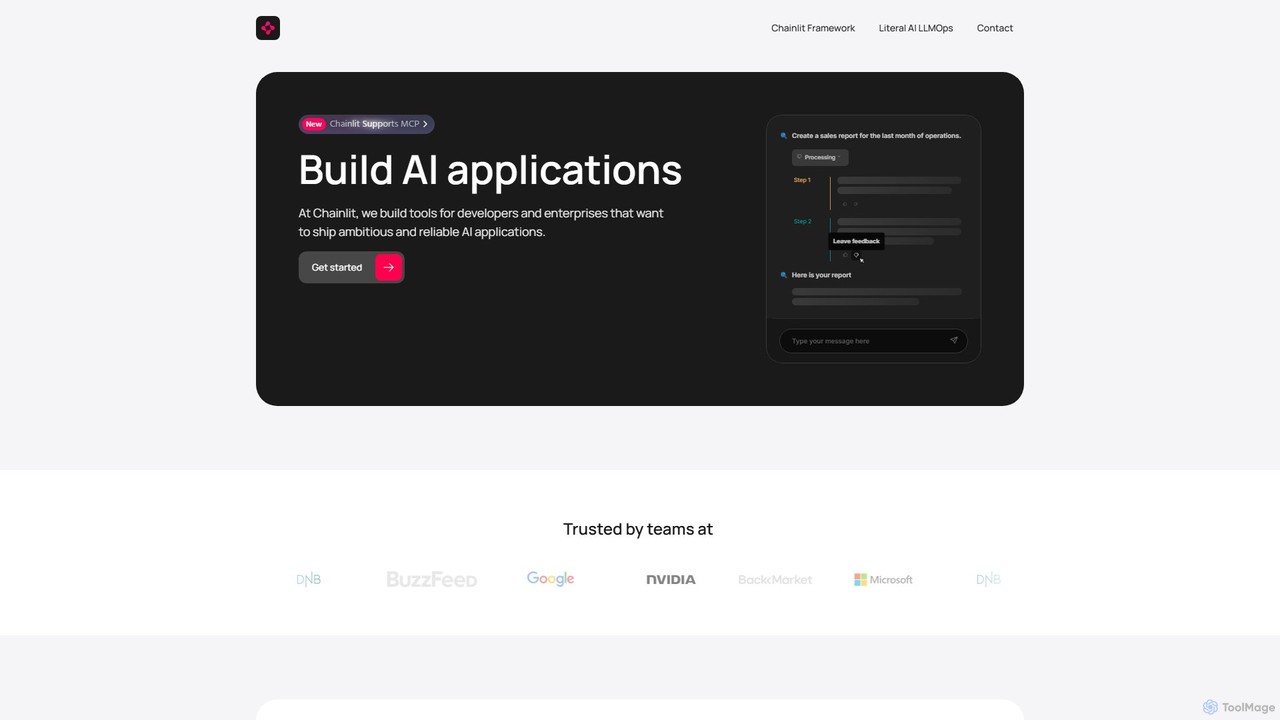

Chainlit
Framework
AI TOOL COMPARISON
What is the difference, and which fits your workflow? Compare features, usage, pricing models and traffic side by side.
Chainlit is an open-source Python framework for developers to rapidly build and deploy production-ready conversational AI applications. It provides an instant, customizable chat interface, allowing you to focus on your backend logic and LLM interactions. With deep integrations for LangChain, LlamaIndex, and major LLM providers, Chainlit simplifies the creation of everything from simple chatbots to complex, data-driven copilots.
Comet is a family of high-performance, open-source large language models (LLMs) developed by Perplexity AI. Designed for exceptional speed and accuracy, Comet powers fast conversational AI applications and is available for developers via API and direct download.
Compare product focus, pricing models and audiences. Highlighted rows indicate different listed information; unknown pricing does not mean free.
| Quick facts | Chainlit | Comet |
|---|---|---|
| Pricing model | Freemium | Freemium |
| Product type | Web | Web |
| Primary focus | Framework | Natural Language Processing |
| Audience and roles | No data available | No data available |
| Categories | Framework · Low Code No Code · Chatbot | Natural Language Processing · Language Models · Chatbot |
| Added | Aug 15, 2025 | Aug 8, 2025 |
| Updated | Nov 19, 2026 | Nov 19, 2026 |
Explore the listed product descriptions, features and workflows. Taxonomy labels alone are not feature evaluations.
Chainlit is a powerful open-source Python framework designed to accelerate the development and deployment of AI applications powered by Large Language Models (LLMs). It serves as a bridge between complex backend logic and a user-friendly, interactive frontend, enabling developers and enterprises to build and share sophisticated conversational AI tools in minutes, not weeks. By handling the user interface layer, Chainlit allows developers to concentrate entirely on the core application logic, data processing, and LLM interactions.
The framework is built with simplicity and speed in mind. It provides an intuitive way to visualize the reasoning steps of an LLM or agent, offering unparalleled transparency for both developers during debugging and end-users seeking to understand the AI's conclusions. This 'thought' process visualization is a key feature that sets Chainlit apart, making complex AI interactions transparent and trustworthy.
Getting started with Chainlit is remarkably straightforward, requiring only basic Python knowledge. The typical workflow is as follows:
$ pip install chainlit.app.py). You use Chainlit's intuitive decorators, such as @cl.on_chat_start to define setup actions and @cl.on_message to handle incoming user messages. This is where you integrate your chosen LLM provider (like OpenAI or Mistral) and frameworks (like LangChain or LlamaIndex).$ chainlit run app.py -w. The -w flag enables a 'watch' mode that automatically reloads the app whenever you save changes to the file, streamlining the development process.Chainlit's versatility makes it suitable for a wide range of applications:
The primary advantage of Chainlit is its ability to dramatically reduce development time. By abstracting away the frontend, it allows developers to focus on what matters: the AI logic. Its open-source nature fosters a strong community, continuous improvement, and complete transparency. The built-in explainability features are a significant benefit for creating trustworthy AI. Finally, with enterprise-grade features like authentication and flexible deployment, Chainlit scales from simple personal projects to robust, mission-critical business applications.
Chainlit is an open-source framework and is completely free to use. You can install and deploy it on your own infrastructure without any licensing fees. While the core framework is free, the team may offer paid enterprise solutions, dedicated support, or a managed cloud hosting platform for businesses that require additional services and infrastructure management. The associated observability platform, Literal AI, may have its own separate pricing structure.
Comet is a state-of-the-art family of open-source large language models (LLMs) created by the team at Perplexity AI. Engineered to deliver an optimal balance of speed, accuracy, and efficiency, Comet is designed to power the next generation of conversational AI and search applications. These models are not only the engine behind Perplexity's own acclaimed answer engine but are also made available to the global developer and researcher community to foster innovation.
The core philosophy behind Comet is to provide blazingly fast inference speeds without compromising on the quality of the output. This makes it an ideal choice for real-time applications where low latency is critical, such as interactive chatbots, live translation services, and dynamic content generation. By being open-source, Comet empowers developers to fine-tune the models for specific tasks, conduct research, and deploy them on their own infrastructure, offering unparalleled flexibility and control.
There are two primary ways to leverage the power of Comet:
Comet's unique combination of speed and quality makes it suitable for a wide array of applications:
The primary advantage of Comet is its industry-leading performance-to-cost ratio. It provides a speed and responsiveness that is often associated with much smaller, less capable models, while delivering the accuracy of larger, more expensive ones. Its open-source nature fosters transparency, community collaboration, and customization, setting it apart from closed, proprietary models. Being developed by Perplexity AI, a leader in the AI search space, ensures that the model is built on a foundation of expertise and is continuously improved.
Comet's pricing is structured to be accessible for everyone from individual hobbyists to large enterprises.
Their taxonomy shows where the products overlap and where each one has a more distinct focus. Unknown fields are shown explicitly and are never filled with assumptions.
Traffic is shown on the same scale so differences in market visibility are not visually understated.
Both charts share the same months and vertical scale. Each tool identifies its latest reporting month; missing months are left blank, not counted as zero. Regional and source visit counts are estimates calculated from the reported shares.
| Country/region | Percentage | Estimated visits |
|---|---|---|
| 🇺🇸United States | 30.97% | 16.3K |
| 🇧🇷Brazil | 21.66% | 11.4K |
| 🇮🇳India | 16.26% | 8.6K |
| 🇹🇷Turkey | 15.87% | 8.4K |
| 🇮🇹Italy | 15.24% | 8K |
| Source type | Percentage | Estimated visits |
|---|---|---|
| Direct | 53.12% | 28K |
| Referral | 46.88% | 24.7K |
| Country/region | Percentage | Estimated visits |
|---|---|---|
| 🇺🇸United States | 45.88% | 63.4M |
| 🇮🇳India | 22.86% | 31.6M |
| 🇩🇪Germany | 11.9% | 16.4M |
| 🇷🇺Russia | 10.05% | 13.9M |
| 🇫🇷France | 9.31% | 12.9M |
| Source type | Percentage | Estimated visits |
|---|---|---|
| Direct | 94.18% | 130.1M |
| Referral | 3.71% | 5.1M |
| 2.11% | 2.9M |
Ratings, comments, favorites, and likes are community signals—not a substitute for product fit.
This page is assembled from ToolMage product listings, taxonomy, traffic statistics and on-site user feedback. It is not a hands-on test or an independent review.