DataCamp
Data Science
AI TOOL COMPARISON
What is the difference, and which fits your workflow? Compare features, usage, pricing models and traffic side by side.
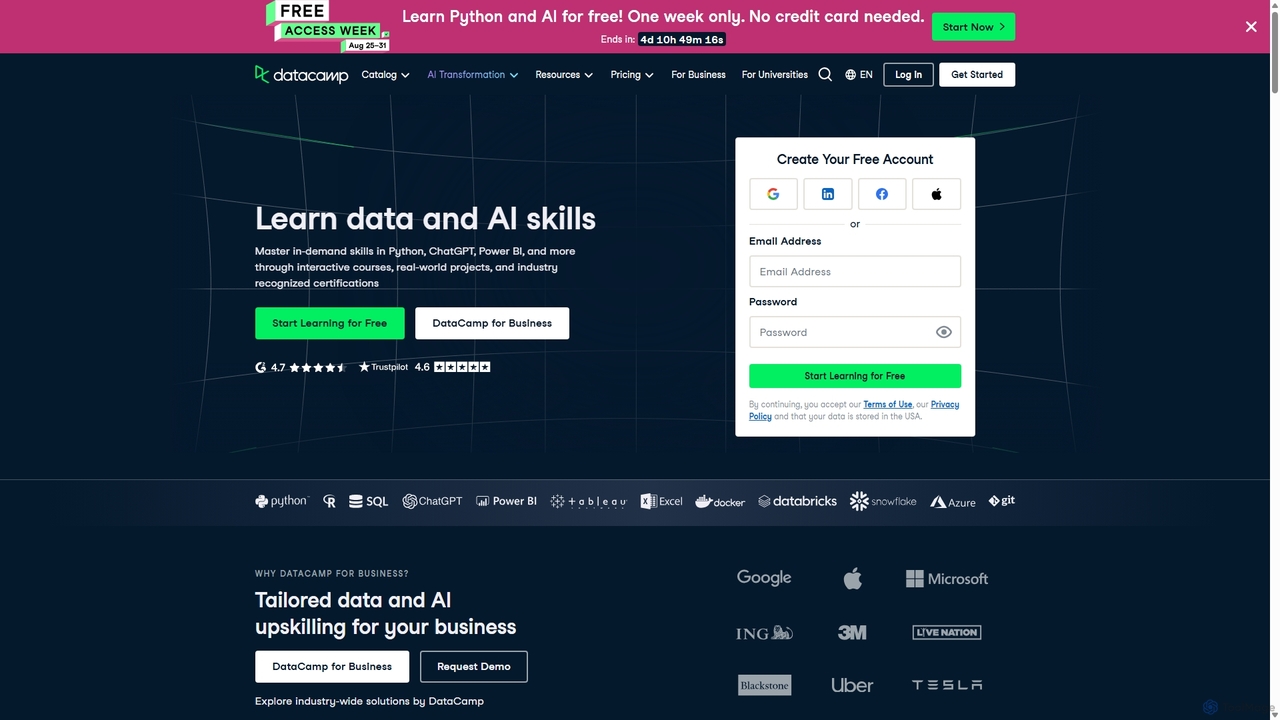
DataCamp is an interactive online learning platform for data science and AI. It offers hands-on courses in Python, R, SQL, Power BI, and more. Through a 'learn-by-doing' approach with in-browser coding, real-world projects, and career tracks, it empowers individuals and businesses to build job-ready data skills, from beginner to expert level.
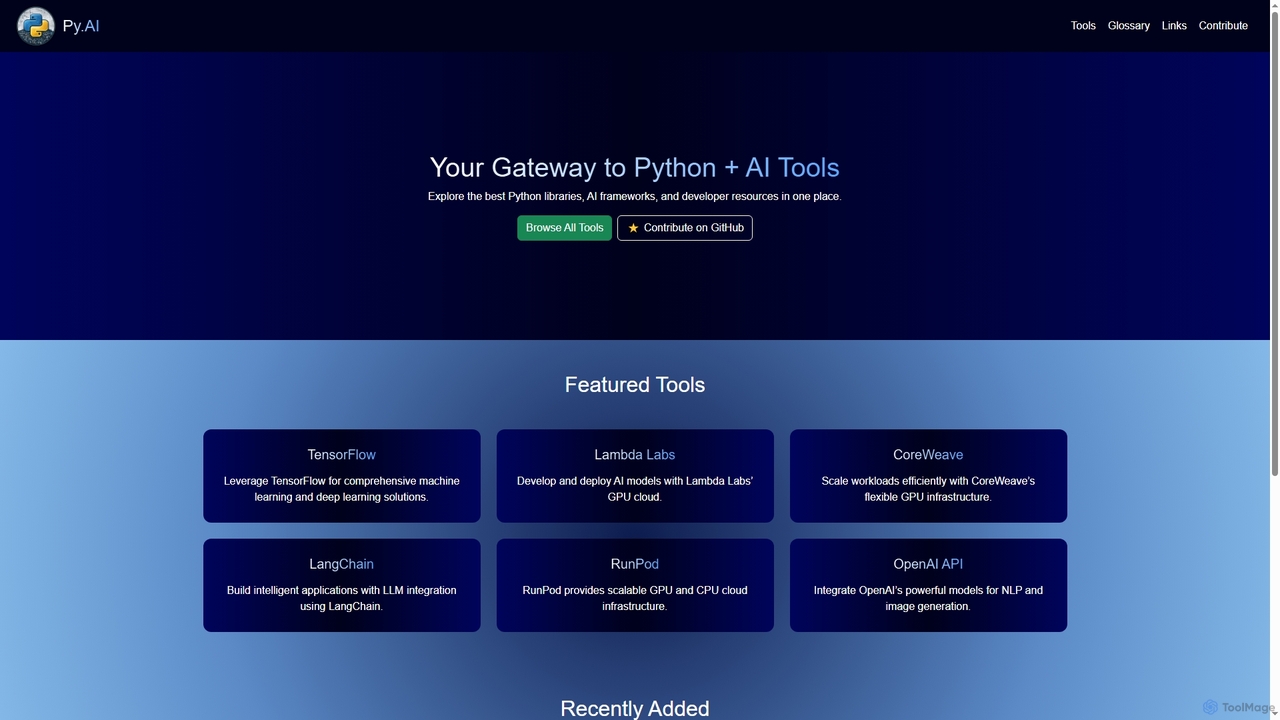
Py is a curated online directory serving as a comprehensive gateway to the best Python libraries, AI frameworks, and developer resources. It helps users explore, discover, and find tools to enhance their machine learning and AI projects.
Compare product focus, pricing models and audiences. Highlighted rows indicate different listed information; unknown pricing does not mean free.
| Quick facts | DataCamp | Py |
|---|---|---|
| Pricing model | Freemium | Free |
| Product type | Web | Web |
| Primary focus | Data Science | Tool Discovery |
| Audience and roles | AI Engineer · Business Analyst · Data Analyst · Data Scientist · Educator · Machine Learning Engineer · Marketing Manager · Product Manager · Software Developer · Student | AI Researcher · Data Scientist · Educator · Machine Learning Engineer · Python Developer · Software Developer · Student |
| Categories | Data Science · E Learning · Career Development | Tool Discovery · Resource Directory · Learning Resources |
| Added | Sep 13, 2025 | Nov 18, 2025 |
| Updated | Nov 19, 2026 | Nov 19, 2026 |
Explore the listed product descriptions, features and workflows. Taxonomy labels alone are not feature evaluations.
DataCamp is a leading online learning platform designed to democratize data skills for everyone, from individuals to entire organizations. It provides a comprehensive and interactive environment for mastering data science, artificial intelligence, and analytics. With a community of over 17 million learners and trusted by more than 5,000 companies, including 80% of the Fortune 1000, DataCamp has established itself as a premier destination for data and AI education.
The platform's curriculum covers a vast array of in-demand technologies, including Python, R, SQL, ChatGPT, Power BI, Tableau, Excel, Docker, and more. It caters to all skill levels, offering foundational courses for absolute beginners and advanced tracks for seasoned professionals. The learning model is built on a hands-on, interactive philosophy where short instructional videos are immediately followed by practical, in-browser coding exercises. This ensures that learners can apply new concepts instantly, which significantly enhances knowledge retention and practical skill development.
Getting started with DataCamp is a straightforward process designed to get you learning quickly:
DataCamp is versatile and serves a wide range of learners and organizations:
The platform stands out for its effective and engaging learning model. The 'learn-by-doing' approach ensures practical skill acquisition rather than just theoretical knowledge. Its curriculum is constantly updated to reflect the latest industry trends, including courses on Generative AI, LLMs, and prompt engineering. The flexibility of self-paced learning, combined with desktop and mobile access, allows users to learn whenever and wherever they want. Furthermore, the focus on career outcomes, with certifications and job-search support, provides a clear return on investment for learners.
DataCamp operates on a freemium model, allowing users to start learning for free. The free plan typically includes access to the first chapter of all courses, providing a solid introduction to the platform and various topics. For full access to the entire course library, projects, and certifications, users can upgrade to a paid subscription. The main plans are:
Py (Py.AI) is a dedicated online platform designed to be your central hub for all things Python and Artificial Intelligence. It meticulously curates and organizes a vast collection of Python libraries, AI frameworks, and essential developer resources, making it easier for professionals, researchers, and enthusiasts to navigate the rapidly evolving AI landscape. The platform aims to simplify the discovery process, allowing users to quickly find relevant tools, understand their features, and integrate them into their projects.
To use Py, simply visit the website (py.ai). You can browse all available tools by navigating to the 'Browse All Tools' section. The directory allows you to filter tools by various categories such as AI Agents / Automation, APIs & Integration Tools, Computer Vision, Core AI/ML Libraries, Data Handling / Analysis, Generative AI, MLOps, NLP, and more. You can also search for specific tools by name or description. Additionally, Py offers a comprehensive glossary of Python AI terms and a collection of interesting links to external educational and inspirational resources. Users can subscribe to receive early access and updates as new tools are added.
Py is ideal for anyone involved in Python-based AI development. Data scientists can use it to discover new machine learning libraries for data analysis or model optimization. Software developers can find AI frameworks for integrating natural language processing or computer vision into their applications. Researchers can explore cutting-edge tools for deep learning or reinforcement learning. Educators and students can leverage the glossary and external links to deepen their understanding of AI concepts and find practical project resources. It serves as a central reference point for staying updated with the Python AI ecosystem.
The primary advantages of Py include its highly curated nature, ensuring quality and relevance of listed tools. It acts as a centralized gateway, saving users time by consolidating diverse resources in one place. The categorization and search features enhance discoverability, while the glossary and external links provide valuable educational support. Being under active development, Py promises continuous updates and expansion, ensuring users have access to the latest and most relevant tools in the Python AI domain. Its focus on Python makes it a specialized and highly effective resource for that specific ecosystem.
Their taxonomy shows where the products overlap and where each one has a more distinct focus. Unknown fields are shown explicitly and are never filled with assumptions.
Traffic is shown on the same scale so differences in market visibility are not visually understated.
Both charts share the same months and vertical scale. Each tool identifies its latest reporting month; missing months are left blank, not counted as zero. Regional and source visit counts are estimates calculated from the reported shares.
| Country/region | Percentage | Estimated visits |
|---|---|---|
| 🇺🇸United States | 42.23% | 2.3M |
| 🇮🇳India | 24.51% | 1.4M |
| 🇬🇧United Kingdom | 12.51% | 695.6K |
| 🇩🇪Germany | 12.28% | 682.8K |
| 🇫🇷France | 8.47% | 471K |
| Source type | Percentage | Estimated visits |
|---|---|---|
| Direct | 78.91% | 4.4M |
| Referral | 14.51% | 806.8K |
| 6.58% | 365.9K |
Ratings, comments, favorites, and likes are community signals—not a substitute for product fit.
Py.AI is a curated directory of Python AI tools and resources, serving as a gateway to explore the best Python libraries, AI frameworks, and developer resources in one place, as stated on its homepage.
On Py.AI, you can find a curated collection of Python libraries, AI frameworks, and developer tools. This includes categories like AI Agents / Automation, APIs & Integration Tools, Computer Vision, Core AI/ML Libraries, Data Handling / Analysis, Generative AI, MLOps, NLP, and more, as listed in the 'Browse All Python AI Tools' section.
You can contribute to Py.AI by suggesting new tools or glossary terms. The homepage also mentions an option to 'Contribute on GitHub', indicating a collaborative development approach.
Yes, Py.AI is explicitly stated as being 'under active development' on its homepage. Users are encouraged to subscribe for early access and updates.
You can stay updated by subscribing to Py.AI. The homepage offers a 'Notify me' option to 'get early access and updates whenever new Python and AI tools are added.'
This page is assembled from ToolMage product listings, taxonomy, traffic statistics and on-site user feedback. It is not a hands-on test or an independent review.