explain.dev
Code Assistant
AI TOOL COMPARISON
What is the difference, and which fits your workflow? Compare features, usage, pricing models and traffic side by side.
Code Assistant
Code Assistant
explain.dev is an AI-powered tool for developers that instantly generates clear, natural-language explanations for any code snippet. It helps demystify complex algorithms, legacy code, and unfamiliar libraries, boosting productivity and accelerating the learning process.
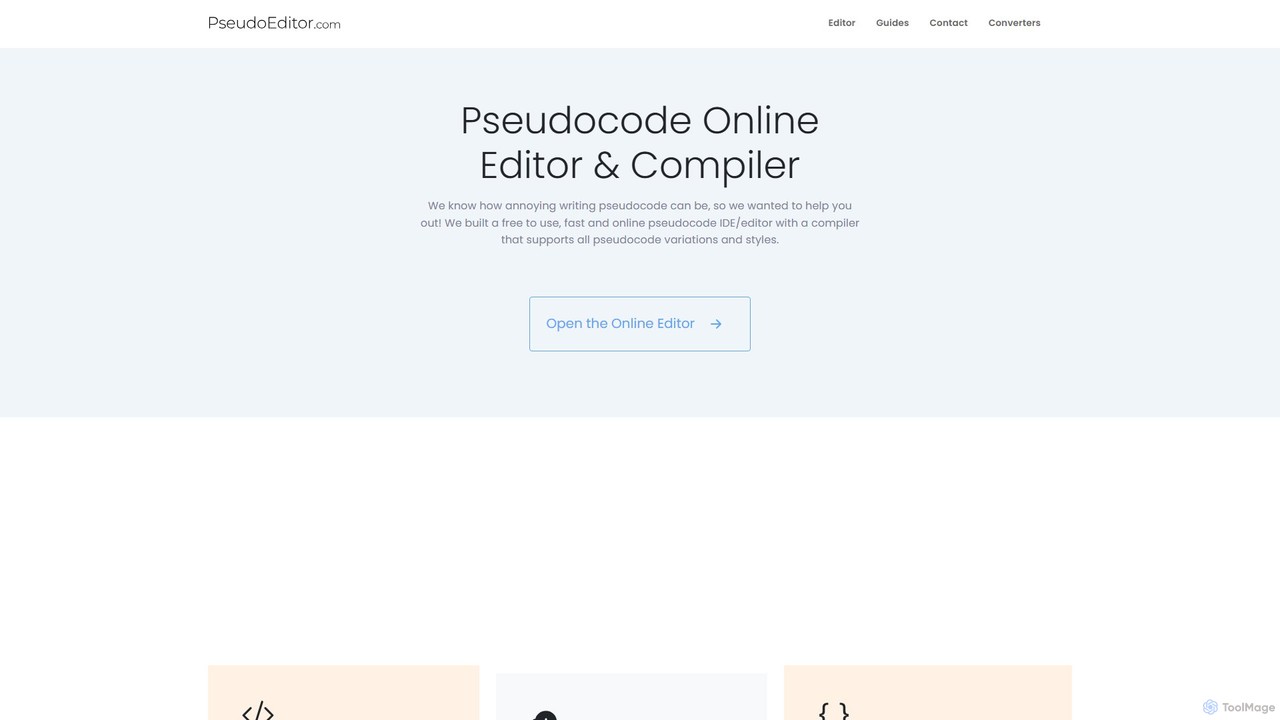
An online pseudocode editor, compiler, and AI-powered converter. Write, test, and debug algorithms, then convert your pseudocode into Python, Java, C++, and JavaScript. Ideal for students, educators, and developers.
Compare product focus, pricing models and audiences. Highlighted rows indicate different listed information; unknown pricing does not mean free.
| Quick facts | explain.dev | PseudoEditor |
|---|---|---|
| Pricing model | Freemium | Freemium |
| Product type | Web | Web |
| Primary focus | Code Assistant | Code Assistant |
| Audience and roles | No data available | No data available |
| Categories | Code Assistant · Learning · Automation | Code Assistant · Learning · Automation |
| Added | Aug 7, 2025 | Aug 4, 2025 |
| Updated | Nov 19, 2026 | Nov 19, 2026 |
Explore the listed product descriptions, features and workflows. Taxonomy labels alone are not feature evaluations.
explain.dev is an advanced AI-driven platform designed to serve the developer community by providing instant, clear, and concise explanations for code snippets across a wide range of programming languages. In the fast-paced world of software development, engineers often encounter complex algorithms, unfamiliar third-party library functions, or dense legacy code that can be time-consuming to decipher. explain.dev addresses this challenge head-on, acting as an intelligent assistant that translates code into human-readable language, significantly reducing comprehension time and improving workflow efficiency.
The tool is built on sophisticated language models trained specifically on vast datasets of code and technical documentation. This allows it to understand the context, logic, and purpose of the code, providing explanations that are not only accurate but also insightful. It aims to be an indispensable resource for both junior developers learning the ropes and senior engineers navigating complex systems.
Using explain.dev is designed to be a straightforward and intuitive process, allowing developers to get answers without disrupting their workflow:
explain.dev is versatile and can be applied in various scenarios:
The primary advantage of explain.dev is its ability to dramatically boost developer productivity. By removing the mental overhead of deciphering code, it allows engineers to focus on higher-level problem-solving. It democratizes knowledge by making complex code accessible to developers of all skill levels. Furthermore, it promotes better coding practices by offering insights into complexity and potential improvements, ultimately leading to higher-quality software.
While the official website is currently under development, explain.dev is expected to follow a freemium model common for developer tools:
Specific pricing details will be announced upon the official launch.
PseudoEditor is a comprehensive, web-based platform designed to streamline the process of writing, testing, and converting pseudocode. It serves as an all-in-one toolkit for students, educators, and developers who need to design and understand algorithms before implementation. The platform offers a user-friendly online editor with dynamic syntax highlighting, an integrated compiler to run and debug pseudocode, and powerful AI-driven tools to convert pseudocode into multiple programming languages.
At its core, PseudoEditor aims to bridge the gap between algorithmic logic and actual code. It provides a standardized environment, following the AQA computer science exam board standards from the UK, which makes it an invaluable resource for students preparing for exams. The ability to save projects in the cloud allows users to work on their algorithms from any device, at any time, ensuring their work is never lost.
Using PseudoEditor is straightforward and intuitive. First, navigate to the website and open the online editor. You can immediately start writing your algorithm in pseudocode. The editor features dynamic syntax highlighting for keywords, functions, data types, and conditionals, which helps in writing clean and error-free logic. Once your pseudocode is ready, you can click the 'Run' button to use the built-in compiler. The output of your program will be displayed in the console, allowing you to test and debug your logic on the spot. To save your work, you can create a free account, which enables you to store your projects and access them later from any device. For more advanced functionality, users can upgrade to PseudoEditor Pro. With a Pro account, you can access the AI-powered 'Code Converter' page. Simply paste your pseudocode into the input box, select the target language (like Python, Java, or C++), and the tool will automatically generate the corresponding code. Similarly, the AI Code Generator and Flowchart tools are available to Pro users to further accelerate their workflow.
PseudoEditor is versatile and beneficial for various users. For computer science students, it's an essential tool for learning algorithmic thinking, completing assignments, and preparing for exams. Educators can use it to teach programming concepts in a language-agnostic way and provide students with a hands-on learning platform. For software developers and engineers, it serves as a rapid prototyping tool to sketch out and validate algorithm logic before committing to writing complex code in a specific language. The AI converter saves significant time by automating the translation from a high-level plan to executable code.
The main advantage of PseudoEditor is its ability to centralize the entire algorithm design workflow. Instead of using separate tools for writing, testing, and converting, users get everything in one place. This improves efficiency and reduces context-switching. The educational focus, particularly its alignment with the AQA curriculum, makes it a highly relevant and practical tool for students. The freemium model ensures that core functionalities are accessible to everyone, while the Pro features provide significant value for serious users and professionals by automating complex tasks and saving valuable time.
PseudoEditor operates on a freemium model.
Free Plan: This plan includes access to the core online pseudocode editor, the compiler, and the ability to save projects. This version is ad-supported.
PseudoEditor Pro: This is a premium subscription plan that unlocks all advanced features. Pro users get unlimited access to the AI pseudocode converters (to Python, Java, etc.), the AI code generator, the flowchart generator, an ad-free experience, and priority 24/7 support. For the most current pricing and plan details, please visit the official PseudoEditor website.
Their taxonomy shows where the products overlap and where each one has a more distinct focus. Unknown fields are shown explicitly and are never filled with assumptions.
Traffic is shown on the same scale so differences in market visibility are not visually understated.
Both charts share the same months and vertical scale. Each tool identifies its latest reporting month; missing months are left blank, not counted as zero. Regional and source visit counts are estimates calculated from the reported shares.
| Country/region | Percentage | Estimated visits |
|---|---|---|
| 🇺🇸United States | 46.92% | 21.8K |
| 🇮🇳India | 18.94% | 8.8K |
| 🇳🇬Nigeria | 18.48% | 8.6K |
| 🇬🇧United Kingdom | 8.03% | 3.7K |
| 🇻🇳Vietnam | 7.63% | 3.5K |
| Source type | Percentage | Estimated visits |
|---|---|---|
| Direct | 72.17% | 33.5K |
| Referral | 24.71% | 11.5K |
| 3.12% | 1.4K |
| Country/region | Percentage | Estimated visits |
|---|---|---|
| 🇬🇧United Kingdom | 28.03% | 15.9K |
| 🇮🇳India | 20.01% | 11.3K |
| 🇺🇸United States | 19.85% | 11.3K |
| 🇵🇰Pakistan | 19.21% | 10.9K |
| 🇿🇦South Africa | 12.9% | 7.3K |
| Source type | Percentage | Estimated visits |
|---|---|---|
| Direct | 89.29% | 50.6K |
| Referral | 9.11% | 5.2K |
| 1.6% | 907 |
Ratings, comments, favorites, and likes are community signals—not a substitute for product fit.
This page is assembled from ToolMage product listings, taxonomy, traffic statistics and on-site user feedback. It is not a hands-on test or an independent review.