ToolMage
Sign in

AI TOOL COMPARISON

Fivetran vs Weld

What is the difference, and which fits your workflow? Compare features, usage, pricing models and traffic side by side.

Jump to key differences

Product overview

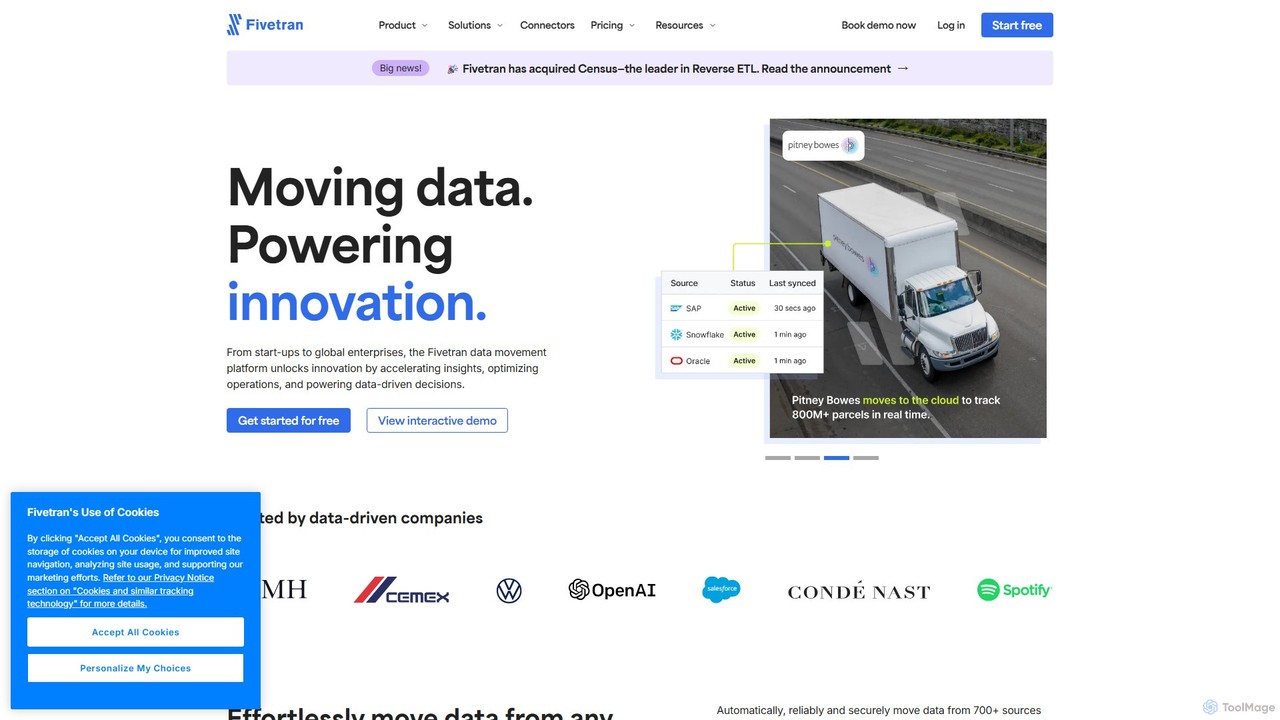
Fivetran Product overview

Fivetran is an automated data movement platform that centralizes data from hundreds of sources into cloud data warehouses, lakes, and databases. It simplifies and accelerates data integration with pre-built, zero-maintenance pipelines, enabling teams to focus on analytics, AI, and business intelligence rather than on engineering.

Preview

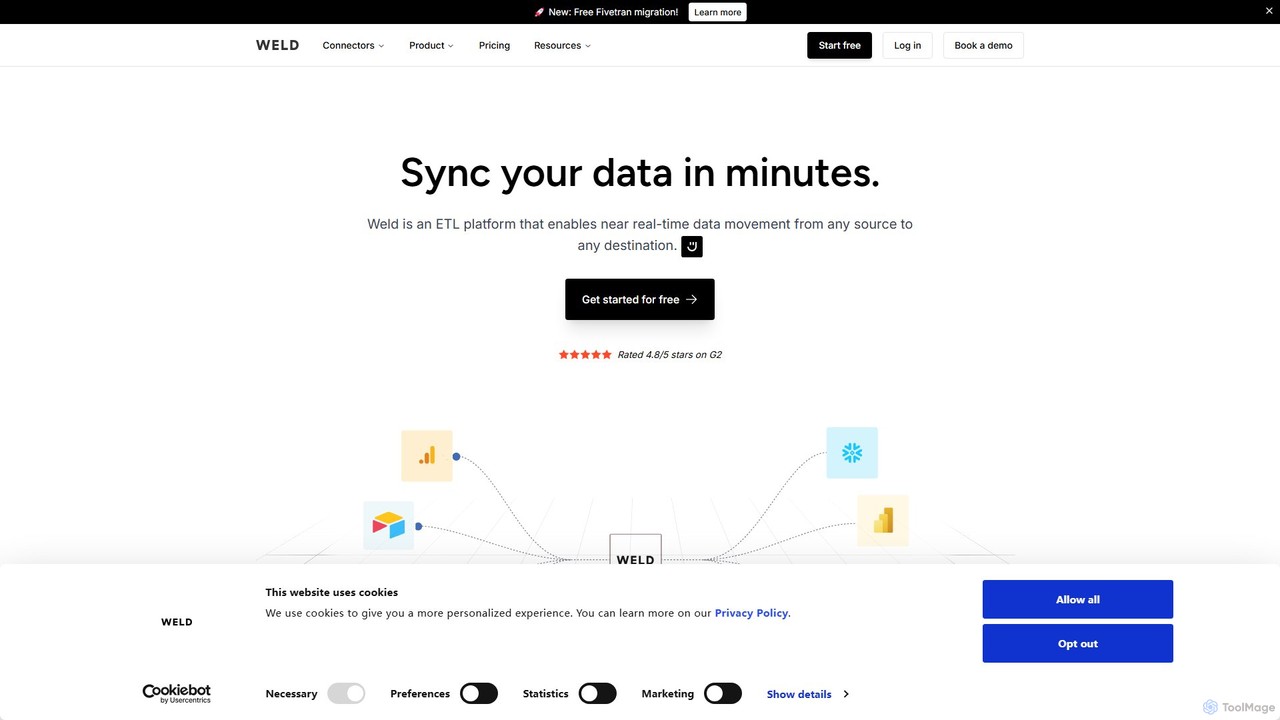
Weld Product overview

Weld is an AI-powered data platform that automates data integration and transformation. It centralizes data from all your SaaS tools and databases into a cloud warehouse like Snowflake or BigQuery. With its AI assistant, Ed, teams can easily clean, model, and prepare data for analytics, business intelligence, and AI applications, breaking down data silos and unlocking real-time insights.

Preview

Quick facts

Compare product focus, pricing models and audiences. Highlighted rows indicate different listed information; unknown pricing does not mean free.

Fivetran VS Weld — Quick facts
Quick factsFivetranWeld
Pricing modelFreemiumFreemium
Product typeWebWeb
Primary focusEtlAnalytics
Audience and rolesNo data availableNo data available
CategoriesEtl · Api Management · AutomationAnalytics · Etl · Database
AddedAug 14, 2025Aug 8, 2025
UpdatedNov 19, 2026Nov 19, 2026

Features, usage and use cases

Explore the listed product descriptions, features and workflows. Taxonomy labels alone are not feature evaluations.

Fivetran

Fivetran is a leading automated data movement platform designed to make access to data as simple and reliable as electricity. It empowers organizations of all sizes, from startups to global enterprises, to centralize their data, modernize their infrastructure, and power innovation. By automating the most time-consuming parts of the ELT (Extract, Load, Transform) process, Fivetran allows data teams to accelerate insights, optimize operations, and drive data-driven decisions. The platform has recently expanded its capabilities by acquiring Census, the leader in Reverse ETL, creating a comprehensive solution for the entire data movement lifecycle.

How to use Fivetran

Using Fivetran is designed to be a straightforward, low-code experience. The process typically involves these steps:
1. Sign Up and Connect: Start with a free trial. In the Fivetran dashboard, you begin by selecting a destination, such as a cloud data warehouse (e.g., Snowflake, BigQuery, Redshift) or a data lake.
2. Choose Your Sources: Browse Fivetran's extensive library of over 700 pre-built connectors. Select the sources you want to sync, which can include SaaS applications (like Salesforce, Google Ads), databases (like PostgreSQL, MongoDB), ERPs (like SAP), and file systems.
3. Authorize and Configure: Follow the simple, step-by-step setup guides to authorize Fivetran to access your data sources. Configuration is minimal; Fivetran handles API changes, schema drift, and idempotency automatically.
4. Start Syncing: Once configured, Fivetran begins the initial historical sync, moving all your historical data to the destination. After that, it automatically performs incremental updates to keep your data fresh and in real-time.
5. Transform and Analyze: With raw data loaded into your warehouse, you can use Fivetran's integrated transformation tools (including dbt Core™) or other solutions to model the data for analytics, AI model training, or business intelligence dashboards.

Core Features of Fivetran

  • Automated Data Pipelines: Zero-maintenance, self-healing pipelines that automatically adapt to schema and API changes from sources, ensuring data flows without interruption.
  • 700+ Pre-built Connectors: An extensive library of fully managed connectors for databases, SaaS apps, ERPs, events, files, and more, eliminating the need for custom coding.
  • Enterprise-Grade Security: Robust security features including SOC 2, ISO 27001, HIPAA, and GDPR compliance, column hashing, role-based access control (RBAC), and private networking options to keep data secure in transit and at rest.
  • Scalability and Performance: Built to handle massive data volumes, syncing petabytes of data and trillions of rows per month with high throughput and reliability.
  • Integrated Transformations: Seamlessly orchestrate data transformations post-load using SQL-based tools like dbt Core™, allowing for analytics-ready data models.
  • Reverse ETL with Census: Move enriched, modeled data from the warehouse back into operational applications (like CRMs and marketing platforms) to power business teams with actionable insights.
  • Developer-Friendly REST API: A comprehensive REST API allows for programmatic management of connectors, users, and permissions, enabling seamless integration into existing data workflows and CI/CD processes.
  • Connector SDK: For niche or in-house data sources, the Connector SDK allows developers to build their own fully managed connectors on the Fivetran platform.

Use Cases for Fivetran

Fivetran serves as the foundational data infrastructure for a wide range of applications across various industries.
• Powering AI and GenAI: Companies like HubSpot use Fivetran to centralize data from disparate systems, creating a reliable foundation for training AI/ML models on employee performance and other business metrics.
• Building Customer 360 Profiles: Retail and CPG companies like Nando's leverage Fivetran to consolidate customer data from sales, marketing, and support systems into a single view, enabling personalized marketing and improved customer service.
• Accelerating Business Intelligence: Organizations like Dropbox have cut data ingestion and reporting time from weeks to minutes, allowing analysts to deliver insights to stakeholders much faster.
• Saving Engineering Resources: By automating data integration, companies like Okta have saved thousands of engineering hours, freeing up their technical teams to focus on core product development instead of building and maintaining brittle data pipelines.
• Database Replication: Reliably and efficiently replicate data from production databases to a data warehouse for analytics without impacting the performance of the source systems.

Advantages of Fivetran

The primary advantage of Fivetran is its ability to radically simplify and automate data integration. It saves immense amounts of time and engineering resources that would otherwise be spent on building and maintaining custom pipelines. Its reliability and ability to automatically handle schema changes mean that data is always available and accurate for decision-making. The platform's security and compliance features make it a trusted choice for enterprises in regulated industries. With the addition of Reverse ETL, Fivetran now offers a complete, end-to-end data movement solution, from source ingestion to operational activation.

Pricing and Plans

Fivetran operates on a freemium and usage-based pricing model, designed to scale with your needs. There is a Free Plan that allows you to get started and sync a limited volume of data at no cost. For larger needs, paid plans are based on consumption, specifically the number of 'monthly active rows' (MARs) – the number of unique primary keys moved from source to destination each month. This model means you only pay for the data you actively use. The price per row decreases as your data volume increases, making it cost-effective at scale. For detailed pricing information and to estimate costs, it is recommended to visit the official Fivetran pricing page.

Weld

Weld is a modern, AI-enhanced data platform designed to help businesses centralize, transform, and activate their data. In today's digital landscape, companies rely on a multitude of SaaS applications, leading to fragmented data silos. Weld addresses this challenge by providing a unified ELT (Extract, Load, Transform) solution that seamlessly syncs data from various sources into a central cloud data warehouse like Google BigQuery or Snowflake. This creates a single source of truth, empowering teams to derive fresh, reliable insights in near real-time.

The platform stands out with its integrated AI assistant, "Ed". This intelligent co-pilot assists data teams by simplifying complex tasks such as cleaning, combining, and modeling data. Ed can help generate SQL queries, debug code, and suggest best practices for data transformation, making the entire process faster and more accessible even for less technical users. By building a solid, clean data foundation, Weld not only streamlines current business intelligence efforts but also prepares companies for a future driven by advanced AI and machine learning applications.

How to use Weld

Using Weld involves a straightforward, multi-step process to build and manage your data pipelines:

  1. Connect Your Data Sources: Begin by connecting your various SaaS tools (e.g., HubSpot, Salesforce, Google Ads), databases, and other data sources to the Weld platform. Weld offers a wide range of pre-built, in-house connectors for reliable integration.
  2. Set Up Your Destination: Choose and connect your cloud data warehouse, such as Snowflake, Google BigQuery, or another supported destination. This will serve as the central repository for all your integrated data.
  3. Load and Sync Data: Configure your data syncs. Weld extracts the data from your chosen sources and loads it into your warehouse. You can schedule these syncs to run at your desired frequency, from near real-time to daily, ensuring your data is always up-to-date.
  4. Transform and Model Data: Once the data is in your warehouse, use Weld's transformation layer to make it analysis-ready. Write SQL models to clean, join, and aggregate data into meaningful business metrics. Leverage the AI assistant, Ed, to accelerate this process by generating code and providing suggestions.
  5. Activate Your Data: The clean, transformed data is now ready for use. Connect it to your favorite Business Intelligence (BI) tools for visualization and reporting, or use Weld's Reverse ETL capabilities to send enriched data back into your operational SaaS tools to power sales and marketing teams.

Core Features of Weld

  • Automated Data Syncing (ELT): Effortlessly extract and load data from over 100+ sources into your data warehouse with reliable, in-house built connectors.
  • AI Assistant "Ed": An intelligent co-pilot that helps write, debug, and optimize SQL for data transformation, significantly boosting productivity and lowering the technical barrier.
  • In-Warehouse Transformation: A powerful, SQL-based modeling layer that allows you to transform raw data into clean, analysis-ready datasets directly within your warehouse.
  • Reverse ETL (Data Activation): Sync your modeled data from the warehouse back to your operational tools (like CRM, marketing automation platforms) to empower business teams with actionable insights.
  • High Reliability and Scalability: Engineered for performance with a 99.9% uptime guarantee, capable of handling massive data volumes and over 150,000 daily syncs.
  • Centralized Management: Provides a single platform to manage your entire data stack, from integration and transformation to activation and monitoring.

Use Cases for Weld

Weld is versatile and can be applied across various business functions:

  • Unified Business Intelligence: Consolidate data from finance, marketing, sales, and product departments to create a single source of truth for comprehensive company-wide dashboards and reporting.
  • Marketing Performance Analysis: Combine ad spend data from platforms like Google Ads and Facebook Ads with conversion data from your CRM to accurately calculate Return on Ad Spend (ROAS) and Customer Acquisition Cost (CAC).
  • 360-Degree Customer View: Merge data from your CRM (e.g., Salesforce), support desk (e.g., Zendesk), and product analytics to build a complete profile of your customers, enabling personalized marketing and improved customer service.
  • Sales Operations Efficiency: Enrich lead data in your CRM with product usage information from your warehouse, allowing sales teams to identify product-qualified leads (PQLs) and prioritize their outreach.
  • AI and Machine Learning Foundation: Prepare and structure large, clean datasets that are essential for training predictive models, such as customer churn prediction or lead scoring algorithms.

Advantages of Weld

Weld offers significant advantages for data-driven organizations:

  • Eliminate Data Silos: Provides a unified view of all business operations by centralizing scattered data.
  • Accelerate Time to Insight: Automates manual data processes, allowing teams to spend less time on data management and more time on analysis.
  • Democratize Data: The AI assistant and user-friendly interface make it easier for more team members to work with data, not just highly specialized data engineers.
  • Future-Ready Data Stack: Builds a robust and scalable data foundation that can adapt to rapid technological changes and support future AI initiatives.
  • Cost-Effective: By combining ELT, transformation, and Reverse ETL into one platform, Weld can simplify your data stack and potentially reduce costs compared to using multiple disparate tools.

Pricing and Plans

Weld operates on a freemium model, making it accessible for teams of all sizes.

  • Free Plan: Ideal for small projects or for teams just getting started. This plan typically includes a limited number of connectors and data volume to allow users to test the platform's core functionalities.
  • Growth/Paid Plans: As your data needs grow, you can upgrade to paid plans that offer more connectors, higher data volumes, advanced features, and priority support. Pricing is often based on usage or the number of active connectors.
  • Enterprise Plan: A custom-tailored plan for large organizations with specific requirements for security, compliance (e.g., SOC 2), dedicated support, and unlimited scalability. Contact the Weld sales team for a custom quote.

The "Get started for free" option on their website allows you to explore the platform's capabilities firsthand.

Positioning

Their taxonomy shows where the products overlap and where each one has a more distinct focus. Unknown fields are shown explicitly and are never filled with assumptions.

Categories

Shared
Etl
Only Fivetran
Api ManagementAutomation
Only Weld
AnalyticsDatabase

Tags

Shared
automationbusiness intelligencedata integrationdata pipelinedata warehouseELT
Only Fivetran
analyticsAPIdata lakeETLreverse ETL
Only Weld
AI assistantbigquerydata transformationsnowflakeSQL

Audience and roles

Shared
No listed items
Only Fivetran
No listed items
Only Weld
No listed items

Traffic comparison

Traffic is shown on the same scale so differences in market visibility are not visually understated.

How to interpret the traffic data

Both charts share the same months and vertical scale. Each tool identifies its latest reporting month; missing months are left blank, not counted as zero. Regional and source visit counts are estimates calculated from the reported shares.

Fivetran monthly traffic:

Latest traffic · 2026-05

Monthly visits
381.6K
Avg. visit duration
2:40
Pages per visit
6.2
Bounce rate
41.3%
Data updated 2026-06-15

Monthly traffic trend

  • 2025-09: 403.6K
  • 2026-01: 346K
  • 2026-02: 394.6K
  • 2026-03: 459.4K
  • 2026-04: 420.9K
  • 2026-05: 381.6K

Top regions

Top 5 countries/regions
Country/regionPercentageEstimated visits
🇺🇸United States58.2%222.1K
🇮🇳India16.92%64.6K
🇦🇺Australia12.87%49.1K
🇨🇦Canada7.04%26.9K
🇬🇧United Kingdom4.97%19K

Traffic sources

Source typePercentageEstimated visits
Direct77.61%296.2K
Referral14.55%55.5K
Email7.84%29.9K

Search keywords

fivetranfivetran careersfivetran pricinginstant data scraperoutscraper

Weld monthly traffic:

Latest traffic · 2026-05

Monthly visits
31.4K
Avg. visit duration
1:43
Pages per visit
3.36
Bounce rate
35.55%
Data updated 2026-06-15

Monthly traffic trend

  • 2025-09: 36.2K
  • 2026-01: 44.7K
  • 2026-02: 31.8K
  • 2026-03: 26.5K
  • 2026-04: 29.1K
  • 2026-05: 31.4K

Top regions

Top 5 countries/regions
Country/regionPercentageEstimated visits
🇺🇸United States39.08%12.3K
🇮🇳India20.43%6.4K
🇬🇧United Kingdom19.91%6.3K
🇻🇳Vietnam11.28%3.5K
🇫🇷France9.3%2.9K

Search keywords

dlt data load toolsync gohighlevel contacts with hubspotsystem user tokenweldweldapp

Community signals

Ratings, comments, favorites, and likes are community signals—not a substitute for product fit.

Fivetran

Rating
No data available
Comments
0
Favorites
218
Likes
227

Weld

Rating
No data available
Comments
0
Favorites
181
Likes
189

Fivetran vs Weld · Comparison FAQ

What do Fivetran and Weld have in common?
Both tools are listed under Etl. These categories indicate overlapping use cases; compare their detailed descriptions for workflows, capabilities and limitations.
Are Fivetran and Weld free?
Listed pricing models: Fivetran — Freemium; Weld — Freemium. Missing pricing is not proof of a free plan, and freemium does not mean every feature is free. Check official sites for current plans, limits and trials.
How should I choose between Fivetran and Weld?
The primary listed category is Etl for Fivetran, and Analytics for Weld. Compare features, steps and use cases, then verify pricing, data permissions and deployment needs. This page does not include hands-on testing and does not declare a winner from traffic or tags.

Sources and comparison methodology

This page is assembled from ToolMage product listings, taxonomy, traffic statistics and on-site user feedback. It is not a hands-on test or an independent review.

  • Feature and plan descriptions reflect information in the listings, not real-time guarantees. Verify pricing, quotas, availability and privacy terms on the official sites.
  • Traffic uses the reporting months shown. Missing statistics do not mean zero visits, and different periods do not establish growth or superiority. Regional and source visit counts are estimates based on shares.
  • Different tags indicate differences in the listings, not proof that the other product lacks a capability. Ratings, favorites and visits are not used to declare a winner.

Related comparisons