ToolMage
Sign in

AI TOOL COMPARISON

Gradientj vs UBOS

What is the difference, and which fits your workflow? Compare features, usage, pricing models and traffic side by side.

Jump to key differences

Product overview

Gradientj Product overview

Gradientj is a powerful platform for developers and businesses to build, test, and deploy autonomous AI agents. It provides a comprehensive suite of tools, including a reasoning engine, pre-built components, and seamless integrations, to transform complex workflows into intelligent, automated processes from prompt to production.

Preview

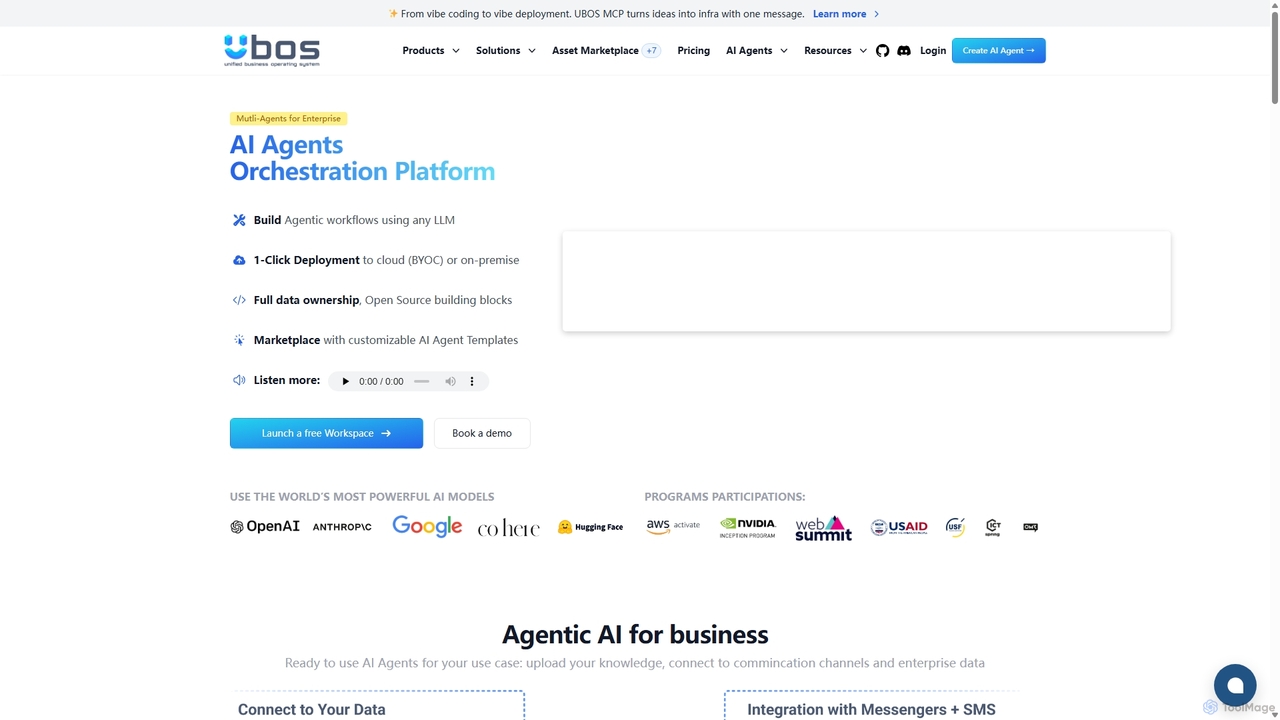
UBOS Product overview

UBOS is a low-code AI orchestration platform for enterprises to build, deploy, and scale multi-agent AI workflows. It offers a marketplace of customizable templates, supports any LLM, and enables one-click deployment to cloud or on-premise. UBOS simplifies creating complex AI solutions like chatbots and data analysis tools, empowering businesses to become AI-first organizations with full data ownership.

Preview

Quick facts

Compare product focus, pricing models and audiences. Highlighted rows indicate different listed information; unknown pricing does not mean free.

Gradientj VS UBOS — Quick facts
Quick factsGradientjUBOS
Pricing modelFreemiumFreemium
Product typeWebWeb
Primary focusIntelligenceOrchestration
Audience and rolesAI Engineer · Automation Specialist · Business Analyst · CTO · Data Analyst · Machine Learning Engineer · Operations Manager · Product Manager · Software DeveloperAI Engineer · Business Analyst · CTO · Data Analyst · Enterprise Architect · IT Professional · Operations Manager · Product Manager · Software Developer · Startup Founder
CategoriesIntelligence · Ai Agent Development · Platform · Workflow AutomationOrchestration · Enterprise Solutions · Low Code No Code · Workflow Automation
AddedSep 17, 2025Sep 9, 2025
UpdatedNov 19, 2026Nov 19, 2026

Features, usage and use cases

Explore the listed product descriptions, features and workflows. Taxonomy labels alone are not feature evaluations.

Gradientj

Gradientj is an end-to-end platform designed to simplify and accelerate the creation of sophisticated, autonomous AI agents. It empowers developers, product teams, and businesses to move beyond simple chatbots and build intelligent agents capable of complex reasoning, decision-making, and task execution. By providing a structured, low-code environment with powerful underlying technology, Gradientj bridges the gap between a conceptual prompt and a production-ready, scalable AI solution.

The platform is built around a core reasoning engine that enables agents to understand goals, break them down into smaller steps, utilize various tools, and adapt to unexpected outcomes. This allows for the automation of nuanced and dynamic workflows that traditional rule-based automation tools struggle with. Whether it's automating back-office operations, creating dynamic data analysis tools, or building next-generation customer support, Gradientj provides the necessary infrastructure to do so reliably and at scale.

How to use Gradientj

Building and deploying an agent with Gradientj follows a streamlined, intuitive process:

  1. Define the Agent's Goal: Start by clearly articulating the agent's objective in natural language. This could be anything from "Qualify new sales leads from our CRM" to "Analyze weekly performance data and generate a summary report."
  2. Assemble the Agent: Use the platform's visual builder or SDK to construct your agent. This involves selecting a Large Language Model (LLM), configuring its memory (short-term and long-term), and assigning it a set of tools.
  3. Integrate Tools and Data: Connect your agent to the necessary resources. Gradientj offers seamless integrations with thousands of APIs, databases, and internal knowledge bases. You can grant it access to tools like Google Search, your company's CRM, or custom internal APIs.
  4. Test and Debug: Leverage the advanced observability suite to test your agent in a safe environment. You can trace every step of its reasoning process, inspect API calls, and identify any points of failure or inefficiency. This iterative debugging process is crucial for building reliable agents.
  5. Deploy with a Single Click: Once you are satisfied with the agent's performance, deploy it with a single click. Gradientj automatically generates a secure API endpoint, allowing you to integrate your new AI agent into any application, website, or existing workflow.
  6. Monitor and Improve: After deployment, continuously monitor the agent's performance through the platform's analytics dashboard. Gather feedback, identify areas for improvement, and easily update the agent's logic to enhance its capabilities over time.

Core Features of Gradientj

  • Intelligent Reasoning Engine: A sophisticated engine that allows agents to plan, execute multi-step tasks, and self-correct based on outcomes.
  • Modular Building Blocks: A library of pre-built components, including connections to various LLMs, memory modules, and tool integrations, to speed up development.
  • Extensive Tool & API Integration: Easily connect agents to external data sources, third-party applications (like Salesforce, Slack, Google Workspace), and custom internal APIs.
  • One-Click Deployment & Scalability: Deploy agents as production-ready API endpoints instantly. The platform is built to handle enterprise-level workloads and scale automatically.
  • Advanced Observability and Debugging: A comprehensive suite of tools for tracing agent behavior, logging interactions, and visualizing the decision-making process for rapid troubleshooting.
  • Human-in-the-Loop Collaboration: Set up workflows where agents can flag exceptions or request human approval for specific tasks, ensuring a perfect balance between automation and control.
  • Secure and Isolated Environments: Each customer's instance and data are kept fully isolated, with robust security protocols to ensure data privacy and compliance.

Use Cases for Gradientj

Gradientj is versatile and can be applied across various industries and functions:

  • Automated Customer Support: Build agents that can understand complex user queries, access knowledge bases, perform actions (like processing a refund), and intelligently escalate to human support when necessary.
  • Dynamic Data Analysis & Reporting: Create agents that connect to databases or analytics platforms, interpret natural language queries, perform data analysis, and automatically generate and distribute reports.
  • Business Process Automation (BPA): Automate intricate internal processes such as lead qualification, employee onboarding, insurance claim processing, and supply chain logistics.
  • Personalized Research Assistants: Deploy agents to conduct in-depth research on any topic, synthesize information from multiple sources, and deliver structured summaries or reports.

Advantages of Gradientj

Using Gradientj offers significant competitive advantages:

  • Accelerated Development Cycle: Drastically reduces the time and complexity required to build and deploy functional AI agents, moving from concept to production in days instead of months.
  • Increased Reliability and Predictability: The platform's structured environment and powerful debugging tools result in more robust and dependable agents compared to building from scratch.
  • Scalability on Demand: The cloud-native architecture ensures that your AI agents can handle fluctuating workloads without manual intervention.
  • Democratized AI Development: The low-code interface makes agent development accessible to a wider range of users, not just specialized AI engineers.
  • Cost-Effectiveness: Automating complex, manual tasks reduces operational costs, frees up employee time for higher-value work, and minimizes human error.

Pricing and Plans

Gradientj offers a flexible pricing structure to suit different needs, from individual developers to large enterprises. While you should consult the official website for the most current details, the plans generally follow this model:

  • Free Tier: Ideal for individuals and developers looking to experiment and build personal projects. It typically includes a limited number of agent runs, basic features, and community support.
  • Pro Tier: Designed for startups and small teams. This plan offers a higher volume of agent runs, access to premium features, collaboration tools, and standard customer support.
  • Enterprise Tier: A custom solution for large organizations with specific requirements. It includes unlimited capacity, custom integrations, dedicated infrastructure, advanced security and compliance features, and a dedicated support manager.

UBOS

UBOS, which stands for Unified Business Operating System, is a pioneering low-code/no-code platform designed to democratize AI engineering. It serves as a comprehensive orchestration platform for AI agents, enabling businesses, from startups to large enterprises, to build, manage, and scale sophisticated AI-powered solutions with unprecedented ease. The core mission of UBOS is to transform companies into autonomous, AI-first organizations by simplifying the complex world of AI into manageable, interconnected building blocks.

The platform is built on a multi-agent architecture, treating AI agents as microservices. This allows users to start with a single agent for a specific task and seamlessly scale to an entire ecosystem of collaborating agents. By supporting any Large Language Model (LLM), UBOS provides ultimate flexibility, allowing developers and business users to leverage the world's most powerful AI models for their specific needs. It bridges the gap between business logic and advanced technology, making AI accessible to everyone.

How to use UBOS

Getting started with UBOS is a straightforward process designed for rapid development and deployment:

  1. Select a Template: Begin by exploring the UBOS Marketplace, which offers a variety of open-source, customizable AI agent templates for common use cases like CRM, data analysis, or customer service chatbots.
  2. Customize Your Workflow: Utilize the intuitive low-code/no-code visual editor to design your agentic workflow. Connect different AI services, integrate with your existing APIs, and link to any datastore.
  3. Integrate Your Knowledge: Upload your company's knowledge base, documents, and data to provide the AI agents with the context they need to perform tasks accurately and effectively.
  4. Choose Your LLM: Select from a wide range of powerful LLMs (like Claude 3, GPT series, etc.) that best suit your application's requirements for reasoning, language, or analysis.
  5. Deploy with One Click: Deploy your application effortlessly to your own cloud environment (BYOC - Bring Your Own Cloud) or on-premise infrastructure. UBOS manages the deployment via Kubernetes, automatically generating Docker Images and Helm charts for easy management.
  6. Scale and Iterate: Monitor your AI agents' performance and scale your operations as needed. The microservice architecture allows for easy updates and the addition of new agents to your system.

Core Features of UBOS

  • Multi-Agent Orchestration: Design and manage complex systems where multiple AI agents collaborate as microservices to achieve business goals.
  • Low-Code/No-Code Platform: An accessible, visual development environment that empowers both developers and non-technical business users to build AI applications.
  • Marketplace of AI Templates: A rich library of pre-built, customizable templates that accelerate the development of solutions for CRM, data analysis, chatbots, and more.
  • LLM Agnostic: Freedom to integrate and switch between any leading Large Language Model, ensuring your applications are always powered by the best technology.
  • 1-Click Deployment: Streamlined deployment process to any cloud or on-premise server, with built-in support for Kubernetes, Docker, and Helm.
  • Full Data Ownership: Deploy on your own infrastructure to maintain complete control and security over your sensitive business data.
  • High Scalability: The platform is architected to scale seamlessly from a single agent to an army of agents across multiple CPUs and GPUs.
  • Custom Internal Tool Builder: Create a variety of solutions including internal tools, admin panels, database GUIs, dashboards, and operational apps.

Use Cases for UBOS

UBOS is versatile and can be applied across various business functions:

  • Customer Service Automation: Build intelligent AI chatbots and virtual assistants that integrate with your CRM to provide 24/7 support and manage customer relationships.
  • Business Intelligence and Data Analysis: Deploy AI agents that connect to multiple data sources, perform complex analyses, and generate real-time insights and reports on custom dashboards.
  • Internal Operations: Develop custom internal tools, such as employee portals, admin panels for IT management, or automated workflow systems to enhance operational efficiency.
  • Enterprise-Specific Solutions: Craft bespoke AI applications for industries like healthcare (e.g., pharmacy admin panels) or finance, tailored to specific regulatory and operational needs.
  • Rapid Prototyping: Quickly create and test functional AI prototypes to validate ideas and secure stakeholder buy-in before committing to full-scale development.

Advantages of UBOS

UBOS offers a significant competitive edge by making advanced AI development accessible, fast, and secure. It accelerates the software development lifecycle, allowing teams to build and deploy solutions in a fraction of the time it would traditionally take. The platform's flexibility in LLM choice and deployment options (cloud or on-prem) provides unparalleled control and helps future-proof business technology stacks. By empowering non-technical users, it fosters innovation across the entire organization, not just within the IT department.

Pricing and Plans

UBOS operates on a usage-based pricing model. The platform offers a free workspace to get started, allowing users to explore its capabilities. For paid plans, billing is calculated based on the total monthly compute usage, determined by the number of services running in your workspaces. This pay-as-you-go approach ensures that costs scale with your usage. Charges are processed at the end of each month, and payments can be made via all major credit and debit cards through Stripe. For detailed enterprise pricing or a personalized demo, users are encouraged to contact the sales team.

Positioning

Their taxonomy shows where the products overlap and where each one has a more distinct focus. Unknown fields are shown explicitly and are never filled with assumptions.

Categories

Shared
Workflow Automation
Only Gradientj
IntelligenceAi Agent DevelopmentPlatform
Only UBOS
OrchestrationEnterprise SolutionsLow Code No Code

Tags

Shared
AI agentlow-codeno-codeworkflow automation
Only Gradientj
AI developmentAPI integrationautonomous agentbusiness process automationdeveloper toolslarge language modelsllmreasoning engine
Only UBOS
business operating systemBYOCchatbot buildercustom applicationsdata analysisenterprise AIinternal toolskubernetesmulti-agent systemorchestration

Audience and roles

Shared
AI EngineerBusiness AnalystCTOData AnalystOperations ManagerProduct ManagerSoftware Developer
Only Gradientj
Automation SpecialistMachine Learning Engineer
Only UBOS
Enterprise ArchitectIT ProfessionalStartup Founder

Traffic comparison

Traffic is shown on the same scale so differences in market visibility are not visually understated.

How to interpret the traffic data

Both charts share the same months and vertical scale. Each tool identifies its latest reporting month; missing months are left blank, not counted as zero. Regional and source visit counts are estimates calculated from the reported shares.

Gradientj monthly traffic:

Latest traffic · 2026-05

Monthly visits
921
Avg. visit duration
0:37
Pages per visit
1.84
Bounce rate
35.97%
Data updated 2026-06-15

Monthly traffic trend

  • 2025-09: 374
  • 2026-01: No data available
  • 2026-02: 0
  • 2026-03: 0
  • 2026-04: 104
  • 2026-05: 921

Top regions

Top 5 countries/regions
Country/regionPercentageEstimated visits
🇺🇸United States100%921

Search keywords

gradientj

UBOS monthly traffic:

Latest traffic · 2026-05

Monthly visits
48K
Avg. visit duration
1:14
Pages per visit
1.92
Bounce rate
9.57%
Data updated 2026-06-15

Monthly traffic trend

  • 2025-09: 38K
  • 2026-01: 20.8K
  • 2026-02: 38K
  • 2026-03: 53.9K
  • 2026-04: 46.6K
  • 2026-05: 48K

Top regions

Top 5 countries/regions
Country/regionPercentageEstimated visits
🇺🇸United States43.2%20.7K
🇻🇳Vietnam15.17%7.3K
🇮🇳India14.93%7.2K
🇹🇷Turkey14.19%6.8K
🇩🇪Germany12.51%6K

Traffic sources

Source typePercentageEstimated visits
Direct48.95%23.5K
Referral48.36%23.2K
Email2.69%1.3K

Search keywords

baostockcreepy linkcreepylinkfedora derivat für raspberry pi 5fedora für raspberry pi 5

Community signals

Ratings, comments, favorites, and likes are community signals—not a substitute for product fit.

Gradientj

Rating
No data available
Comments
0
Favorites
180
Likes
197

UBOS

Rating
No data available
Comments
0
Favorites
171
Likes
179

Gradientj vs UBOS · Comparison FAQ

What do Gradientj and UBOS have in common?
Both tools are listed under Workflow Automation. These categories indicate overlapping use cases; compare their detailed descriptions for workflows, capabilities and limitations.
Are Gradientj and UBOS free?
Listed pricing models: Gradientj — Freemium; UBOS — Freemium. Missing pricing is not proof of a free plan, and freemium does not mean every feature is free. Check official sites for current plans, limits and trials.
How should I choose between Gradientj and UBOS?
The primary listed category is Intelligence for Gradientj, and Orchestration for UBOS. Compare features, steps and use cases, then verify pricing, data permissions and deployment needs. This page does not include hands-on testing and does not declare a winner from traffic or tags.

Sources and comparison methodology

This page is assembled from ToolMage product listings, taxonomy, traffic statistics and on-site user feedback. It is not a hands-on test or an independent review.

  • Feature and plan descriptions reflect information in the listings, not real-time guarantees. Verify pricing, quotas, availability and privacy terms on the official sites.
  • Traffic uses the reporting months shown. Missing statistics do not mean zero visits, and different periods do not establish growth or superiority. Regional and source visit counts are estimates based on shares.
  • Different tags indicate differences in the listings, not proof that the other product lacks a capability. Ratings, favorites and visits are not used to declare a winner.

Related comparisons