
ToolMage
Sign in

AI TOOL COMPARISON

Metaflow vs Modelbit

What is the difference, and which fits your workflow? Compare features, usage, pricing models and traffic side by side.

Jump to key differences

Product overview

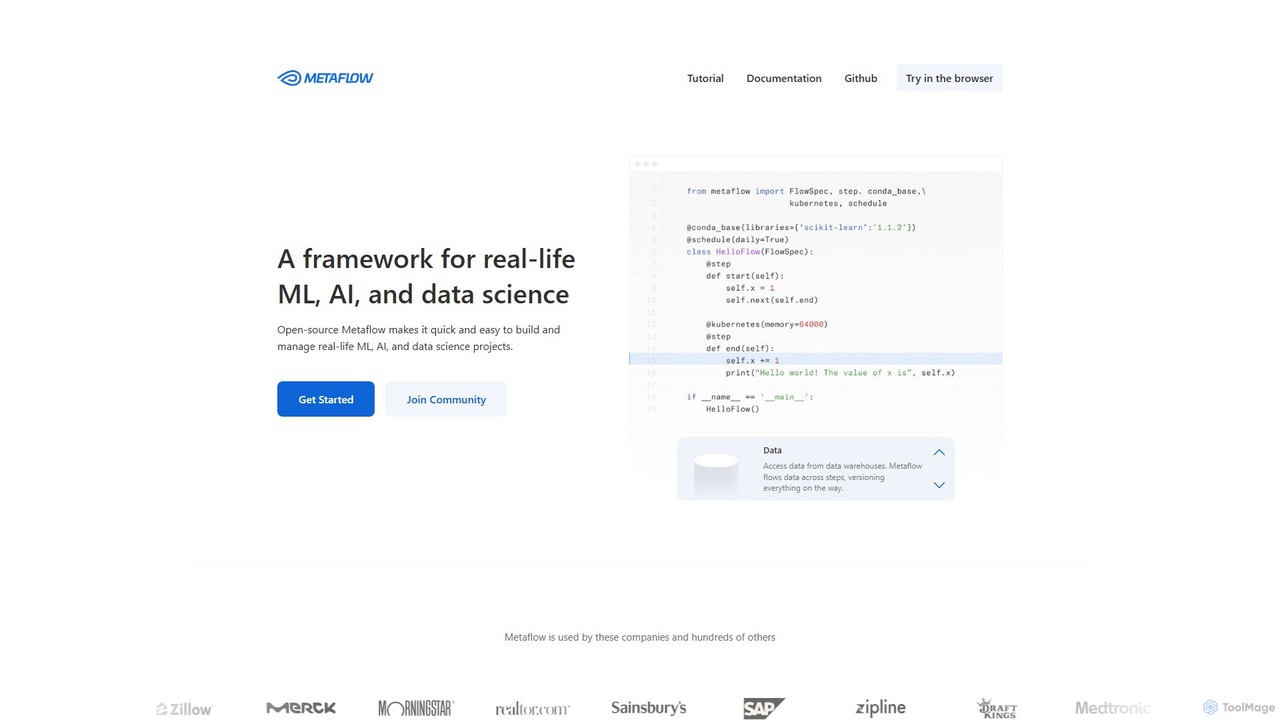
Metaflow Product overview

A human-centric Python framework, originally from Netflix, for building and managing real-life data science, ML, and AI projects. It simplifies workflow orchestration, data management, and model deployment, enabling rapid prototyping and scalable production pipelines.

Preview

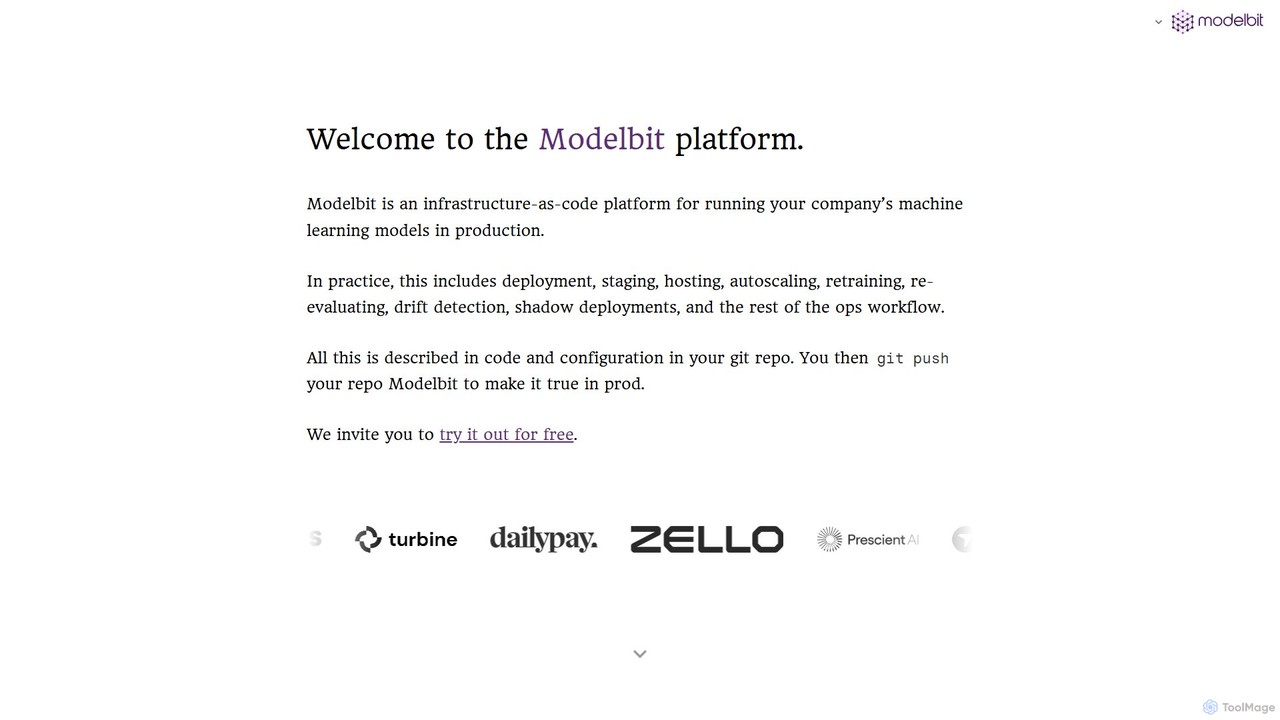
Modelbit Product overview

Modelbit is an MLOps platform for deploying machine learning models directly from Python notebooks to production. It provides an infrastructure-as-code workflow, enabling data scientists to deploy, host, scale, and manage models with a single line of code and a git push.

Preview

Quick facts

Compare product focus, pricing models and audiences. Highlighted rows indicate different listed information; unknown pricing does not mean free.

Metaflow VS Modelbit — Quick facts
Quick factsMetaflowModelbit
Pricing modelFreeFreemium
Product typeWebWeb
Primary focusMlopsMlops
Audience and rolesNo data availableNo data available
CategoriesMlops · Workflow AutomationMlops · Automation
AddedAug 12, 2025Aug 2, 2025
UpdatedNov 19, 2026Nov 19, 2026

Features, usage and use cases

Explore the listed product descriptions, features and workflows. Taxonomy labels alone are not feature evaluations.

Metaflow

Metaflow is a powerful, human-centric Python framework designed to boost the productivity of data scientists and machine learning engineers. Originally developed and battle-hardened at Netflix to handle their massive-scale machine learning needs, it was open-sourced in 2019. Today, it is trusted by hundreds of companies, from startups to large enterprises like 23andMe, CNN, and Realtor.com, for a wide range of projects including cutting-edge Generative AI, computer vision, business analytics, and operations research.

The core philosophy of Metaflow is to allow data scientists to focus on their models and logic, written in standard Python, while the framework handles the heavy lifting of engineering infrastructure. It provides a unified API to structure workflows, manage data, handle dependencies, and scale computations from a laptop to the cloud seamlessly.

How to use Metaflow

Using Metaflow involves structuring your machine learning code as a 'flow,' which is a Directed Acyclic Graph (DAG) of steps. The process is straightforward and Pythonic:

  1. Installation: Install Metaflow with a simple pip command: pip install metaflow.
  2. Structure your code: Define a Python class that inherits from FlowSpec. Each method within the class decorated with @step becomes a node in your workflow graph. The flow typically starts with a start step and ends with an end step.
  3. Write your logic: Implement your data loading, preprocessing, model training, and evaluation logic within these steps. You can pass artifacts (data, models, variables) between steps by assigning them to self.
  4. Run locally: Execute your workflow from the command line: python my_flow.py run. Metaflow automatically snapshots your code, data, and dependencies for each run.
  5. Scale to the cloud: To run a step on a larger cloud instance (e.g., AWS Batch), simply add a decorator like @batch(cpu=8, memory=16000) to the step. No other code changes are needed.
  6. Deploy and schedule: Once your flow is ready, you can deploy it to a production scheduler like AWS Step Functions, Argo Workflows, or Airflow with a single command.
  7. Inspect results: Use the Metaflow Client API to programmatically access and analyze the results of any past run.

Core Features of Metaflow

  • Workflow Orchestration: Easily define complex ML workflows as Pythonic Directed Acyclic Graphs (DAGs).
  • Automatic State Management: Metaflow automatically versions and tracks all your code, data, and external dependencies for every execution, ensuring full reproducibility.
  • Seamless Scalability: Transition from local development on a laptop to distributed computation on the cloud (AWS, Azure, GCP) with simple decorators, requiring no changes to your core logic.
  • Efficient Data Handling: Provides a fast, built-in data transport layer to move objects of any size between steps and to/from data stores like Amazon S3.
  • Isolated Dependency Management: Manage library dependencies for each step independently using Conda, preventing conflicts and ensuring consistent environments.
  • Rich Integrations: Natively integrates with a wide ecosystem of tools, including cloud providers (AWS Batch, Kubernetes), schedulers (AWS Step Functions, Airflow, Argo), and ML libraries (PyTorch, TensorFlow, Scikit-learn).
  • Monitoring GUI: Comes with a built-in GUI to visualize, monitor, and debug your workflow executions in real-time.

Use Cases for Metaflow

Metaflow is versatile and used across various domains:

  • Rapid Prototyping: Data scientists can quickly build and iterate on ML models on their local machines without worrying about infrastructure.
  • Production ML Pipelines: Deploy robust, scalable, and maintainable pipelines for recommendation engines, fraud detection systems, demand forecasting, and NLP applications.
  • Generative AI & LLMs: Manage complex, multi-stage workflows for training, fine-tuning, and deploying large language models and other generative AI systems.
  • Business Analytics & Operations Research: Automate data processing, statistical modeling, and optimization tasks to derive business insights.
  • Reproducible Scientific Research: Ensure that scientific experiments are fully reproducible by capturing the entire computational environment and lineage.

Advantages of Metaflow

  • Human-Centric Design: Empowers data scientists by letting them use idiomatic Python, abstracting away complex infrastructure concerns.
  • Laptop to Cloud: Offers a uniquely smooth path to scale projects from a single laptop to thousands of cores in the cloud.
  • Battle-Tested Reliability: Proven at Netflix scale, ensuring it is robust, performant, and reliable for mission-critical applications.
  • Reproducibility by Default: Every run is automatically versioned and inspectable, making it easy to debug issues and reproduce results.
  • Vibrant Open-Source Community: Actively maintained and supported by a strong community and the original creators at Outerbounds.

Pricing and Plans

Metaflow is a completely free and open-source framework, distributed under the permissive Apache 2.0 License. You can download, install, and use it without any cost. Users are only responsible for the costs of the underlying cloud infrastructure (e.g., compute and storage on AWS, GCP, or Azure) that their workflows consume. For enterprises seeking additional features, dedicated support, and a fully managed cloud platform, commercial offerings are available through Outerbounds, the company founded by Metaflow's creators.

Modelbit

Modelbit is a comprehensive infrastructure-as-code platform designed to streamline the deployment and management of machine learning models in production environments. It specifically targets teams with serious ML infrastructure needs, bridging the gap between model development in Python notebooks and robust, scalable production systems. The platform handles the entire operational lifecycle, including deployment, staging, hosting, autoscaling, retraining, drift detection, and shadow deployments, all managed through code and configuration within a Git repository.

With Modelbit, data scientists are empowered to take their models from a Jupyter or Colab notebook to a live, scalable API endpoint in minutes. The core philosophy is to let data scientists work in their preferred environment while providing a seamless, automated path to production, eliminating the traditional friction and long lead times associated with ML deployment.

How to use Modelbit

The workflow is designed for simplicity and integration with existing data science and engineering practices:

  1. Develop in a Notebook: Train and finalize your machine learning model in your preferred Python environment, such as a Jupyter notebook or Google Colab.
  2. Import and Deploy: Import the Modelbit library into your notebook. With your trained model and any necessary data processing functions ready, call the `modelbit.deploy()` function. This single command initiates the deployment process.
  3. Automated Packaging: Modelbit automatically captures your model, its code dependencies, and the specific Python environment (including package versions), ensuring perfect replication in production.
  4. Git-Based Management: Connect your Modelbit account to a GitHub repository. Deployments are managed through Git. For instance, pushing code to a 'staging' branch deploys the model to a staging environment, while merging to the 'main' branch promotes it to production.
  5. Access and Scale: Once deployed, Modelbit automatically generates a unique REST API and a Snowflake API for your model. You can then use the web interface or CLI to monitor performance, view logs, manage different versions, set up A/B tests, or roll back to a previous version if needed. The system automatically scales resources, including GPUs, based on traffic.

Core Features of Modelbit

  • Direct Notebook Deployment: Go from a model in a notebook to a production API with the `modelbit.deploy()` command, eliminating complex manual steps.
  • Git-Based MLOps (Infrastructure-as-Code): Manage your entire ML deployment lifecycle through Git. Every `git push` creates a new, versioned, and idempotent deployment.
  • Automatic API Generation: Each model version gets its own containerized environment with a unique REST API and Snowflake API, ready for integration.
  • Auto-Scaling and GPU Support: Deployments are containerized and isolated, with automatic scaling to handle variable loads. Full support for GPU-intensive models like large vision transformers.
  • Advanced Deployment Strategies: Natively supports shadow deployments to test new models on production traffic without impacting users, A/B testing between versions, and instant rollbacks.
  • Hybrid Cloud Flexibility: Run models in Modelbit's secure, multi-tenant cloud or deploy them within your own cloud environment (VPC) for maximum control and privacy.
  • Environment Parity: Automatically captures and recreates the exact Python environment, preventing the common "it works on my machine" problem.

Use Cases for Modelbit

Modelbit is trusted by companies for demanding, real-time applications:

  • Real-time Threat Detection: Companies like Ambient AI use Modelbit to deploy large, multi-modal computer vision models that analyze security footage in real-time to detect threats, leveraging its GPU support and rapid iteration capabilities.
  • Fintech and Risk Assessment: Used for deploying models for fraud detection and loan underwriting, where high availability (99.99% uptime) and low latency are critical.
  • Logistics and E-commerce: Teams at companies like Inventa deploy models to reduce predicted shipping times and forecast order volumes, directly optimizing business operations.
  • Healthcare and Life Sciences: OM1 uses Modelbit to power ML applications that help detect rare diseases, demonstrating its capability to handle complex and sensitive workloads.

Advantages of Modelbit

The platform offers significant advantages for ML teams:

  • Speed and Agility: Reduces deployment cycles from months or weeks to just minutes, allowing for faster experimentation and delivery of new features.
  • Empowers Data Scientists: Gives data scientists the autonomy to deploy and manage their own models, freeing up DevOps and ML engineering resources.
  • Production-Grade Reliability: Built for mission-critical systems with features like container isolation, idempotent deployments, and a proven 99.99% uptime.
  • Seamless Integration: Fits perfectly into modern data science (Python, notebooks) and software engineering (Git, CI/CD) workflows.
  • Cost-Effective: The autoscaling feature ensures that you only use and pay for the compute resources required at any given moment.

Pricing and Plans

Modelbit operates on a freemium model. It offers a free tier that allows individual developers and small teams to try out the platform and deploy models. For larger teams and enterprise use cases with requirements such as hybrid cloud deployments, advanced security features, and dedicated support, custom-priced plans are available. For the most accurate and up-to-date pricing information, it is recommended to visit the official Modelbit website.

Positioning

Their taxonomy shows where the products overlap and where each one has a more distinct focus. Unknown fields are shown explicitly and are never filled with assumptions.

Categories

Shared
Mlops
Only Metaflow
Workflow Automation
Only Modelbit
Automation

Tags

Shared
data sciencemachine learningMLOpspython
Only Metaflow
awsdata pipelinenetflixopen sourcereproducibilityworkflow orchestration
Only Modelbit
AI developer toolsautoscalingCI/CD for MLinfrastructure as codemodel deploymentmodel hosting

Audience and roles

Shared
No listed items
Only Metaflow
No listed items
Only Modelbit
No listed items

Traffic comparison

Traffic is shown on the same scale so differences in market visibility are not visually understated.

How to interpret the traffic data

Both charts share the same months and vertical scale. Each tool identifies its latest reporting month; missing months are left blank, not counted as zero. Regional and source visit counts are estimates calculated from the reported shares.

Metaflow monthly traffic:

Latest traffic · 2026-05

Monthly visits
20.3K
Avg. visit duration
0:46
Pages per visit
2.02
Bounce rate
41.56%
Data updated 2026-06-15

Monthly traffic trend

  • 2025-09: 31K
  • 2026-01: 21K
  • 2026-02: 38.7K
  • 2026-03: 41.1K
  • 2026-04: 17.6K
  • 2026-05: 20.3K

Top regions

Top 5 countries/regions
Country/regionPercentageEstimated visits
🇺🇸United States32.93%6.7K
🇮🇳India29.12%5.9K
🇩🇪Germany17.53%3.6K
🇧🇷Brazil14.04%2.8K
🇻🇳Vietnam6.38%1.3K

Traffic sources

Source typePercentageEstimated visits
Direct65.85%13.4K
Referral34.15%6.9K

Search keywords

metaflowmetaflow aimetaflow.commetaflow with kubernetesself.merge_artifacts metaflow

Modelbit monthly traffic:

Latest traffic · 2026-05

Monthly visits
438
Avg. visit duration
0:25
Pages per visit
1.62
Bounce rate
34.27%
Data updated 2026-06-15

Monthly traffic trend

  • 2025-09: 8.1K
  • 2026-01: 2.5K
  • 2026-02: 1.6K
  • 2026-03: 2.4K
  • 2026-04: 3K
  • 2026-05: 438

Top regions

Top 5 countries/regions
Country/regionPercentageEstimated visits
🇮🇳India100%438

Search keywords

dbt incremental modelssam segment anything checkpoint bsam_vit_b_01ec64sam_vit_b_01ec64.pthsam_vit_b_01ec64.pth (1)

Community signals

Ratings, comments, favorites, and likes are community signals—not a substitute for product fit.

Metaflow

Rating
No data available
Comments
0
Favorites
148
Likes
146

Modelbit

Rating
No data available
Comments
0
Favorites
176
Likes
178

Metaflow vs Modelbit · Comparison FAQ

What do Metaflow and Modelbit have in common?
Both tools are listed under Mlops. These categories indicate overlapping use cases; compare their detailed descriptions for workflows, capabilities and limitations.
Are Metaflow and Modelbit free?
Listed pricing models: Metaflow — Free; Modelbit — Freemium. Missing pricing is not proof of a free plan, and freemium does not mean every feature is free. Check official sites for current plans, limits and trials.
How should I choose between Metaflow and Modelbit?
The primary listed category is Mlops for Metaflow, and Mlops for Modelbit. Compare features, steps and use cases, then verify pricing, data permissions and deployment needs. This page does not include hands-on testing and does not declare a winner from traffic or tags.

Sources and comparison methodology

This page is assembled from ToolMage product listings, taxonomy, traffic statistics and on-site user feedback. It is not a hands-on test or an independent review.

  • Feature and plan descriptions reflect information in the listings, not real-time guarantees. Verify pricing, quotas, availability and privacy terms on the official sites.
  • Traffic uses the reporting months shown. Missing statistics do not mean zero visits, and different periods do not establish growth or superiority. Regional and source visit counts are estimates based on shares.
  • Different tags indicate differences in the listings, not proof that the other product lacks a capability. Ratings, favorites and visits are not used to declare a winner.

Related comparisons