ToolMage
Sign in

AI TOOL COMPARISON

Morph vs Zencoder

What is the difference, and which fits your workflow? Compare features, usage, pricing models and traffic side by side.

Jump to key differences

Product overview

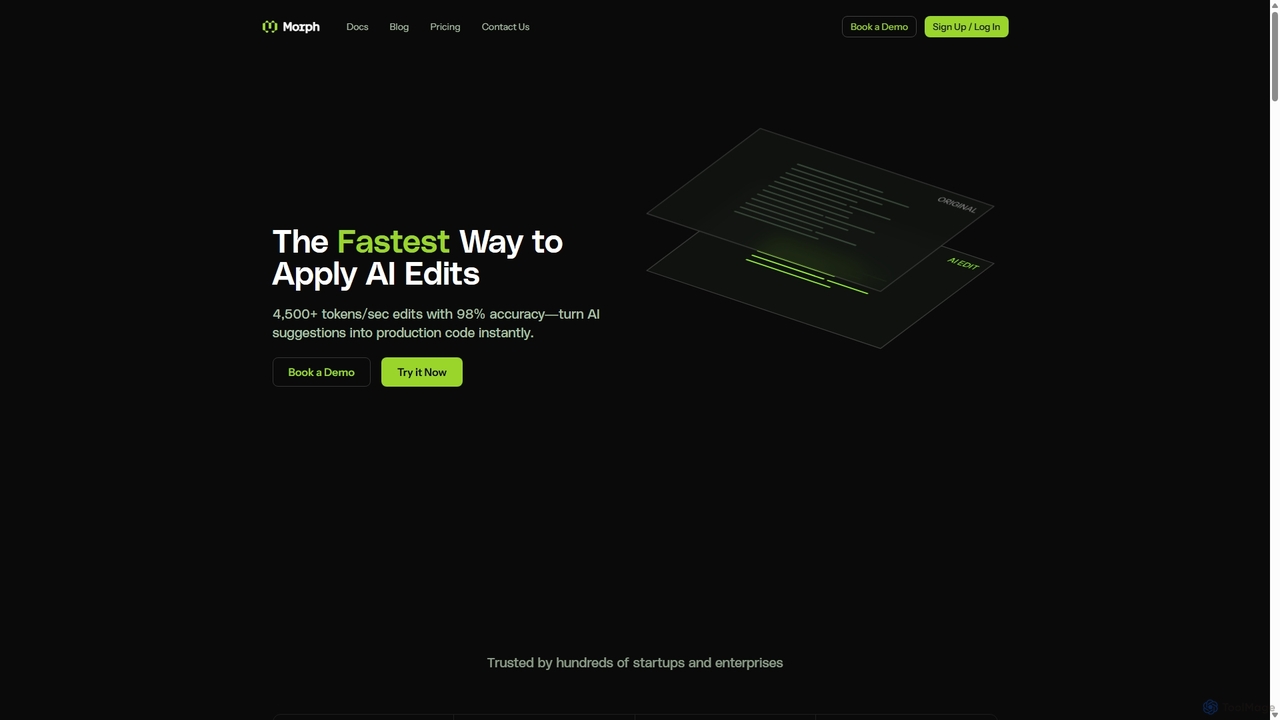
Morph Product overview

Morph is an API-first platform for developers, providing the fastest and most accurate way to apply AI-generated edits to code and files. With speeds of 4,500+ tokens/sec and 98% accuracy, it empowers AI agents to perform reliable, semantic modifications, bridging the gap between AI suggestions and production-ready implementation.

Preview

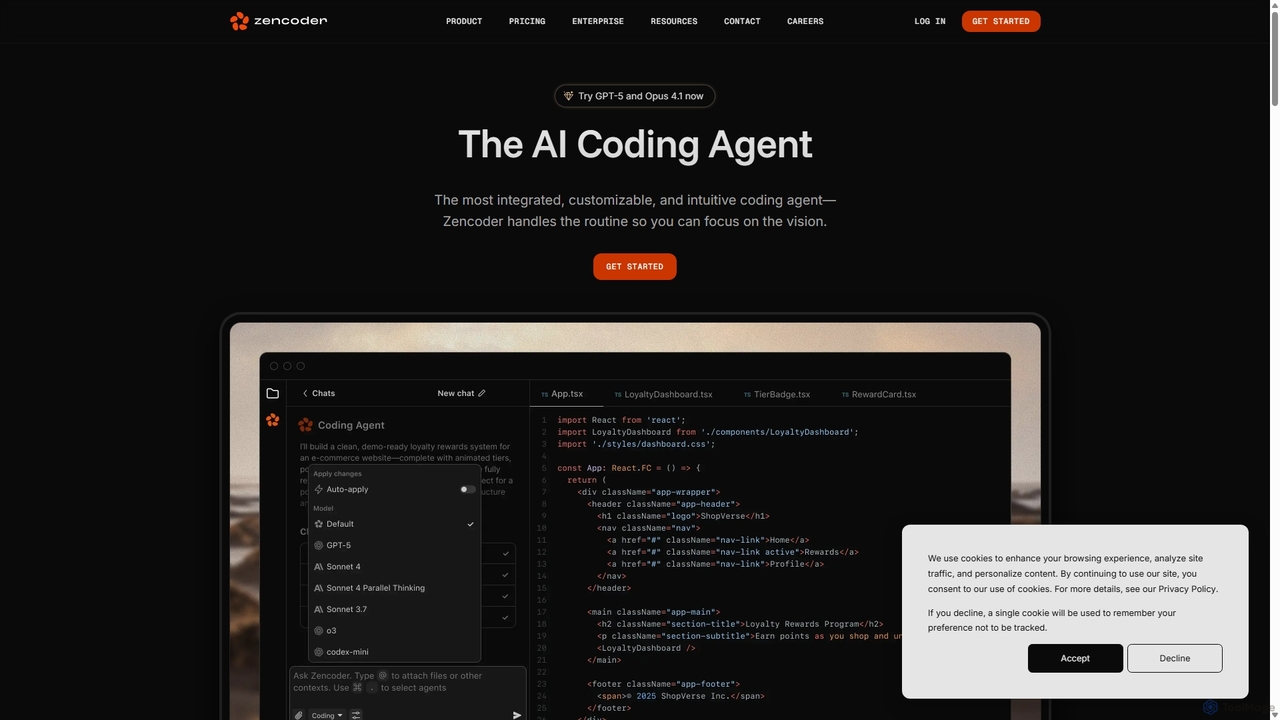
Zencoder Product overview

Zencoder is an advanced AI coding agent designed to automate routine development tasks. It deeply integrates into your workflow, understanding your entire codebase to implement features, write tests, fix bugs, and refactor code autonomously. With customizable 'Zen Agents' and seamless integration with VS Code, JetBrains, and over 100 developer tools, Zencoder empowers engineering teams to focus on innovation and ship products faster.

Preview

Quick facts

Compare product focus, pricing models and audiences. Highlighted rows indicate different listed information; unknown pricing does not mean free.

Morph VS Zencoder — Quick facts
Quick factsMorphZencoder
Pricing modelFreemiumFreemium
Product typeWebWeb
Primary focusInfrastructureCode Assistant
Audience and rolesAI Engineer · DevOps Engineer · Product Manager · Software Developer · Technical WriterDevOps Engineer · Engineering Manager · Machine Learning Engineer · Product Manager · Quality Assurance Engineer · Software Developer
CategoriesInfrastructure · Code Assistant · AutomationCode Assistant · Debugging · Testing · Automation
AddedSep 13, 2025Sep 9, 2025
UpdatedNov 19, 2026Nov 19, 2026

Features, usage and use cases

Explore the listed product descriptions, features and workflows. Taxonomy labels alone are not feature evaluations.

Morph

Morph is a specialized AI infrastructure designed for developers building the next generation of AI agents and coding tools. It addresses a critical bottleneck in AI-driven development: while large language models (LLMs) are excellent at suggesting changes, they often struggle to apply them accurately and efficiently to existing files. Morph solves this with a suite of powerful, purpose-built models that function as a high-performance 'edit_file' tool for any AI agent.

At its core, Morph provides an OpenAI-compatible API that allows agents to merge suggested changes into codebases and documents with unparalleled speed and precision. Instead of relying on fragile methods like string replacement or traditional diffs, Morph performs a semantic merge. It understands the underlying structure and intent of the code, allowing it to handle variable renames, style preservation, and complex refactoring tasks that would otherwise fail. This results in an enterprise-grade 98% accuracy rate, ensuring that AI-driven modifications are reliable and production-ready.

How to use Morph

Integrating Morph is designed to be simple and intuitive for developers. It functions as a specialized tool that you add to your existing AI agent's capabilities. The process typically involves these steps:

  1. Sign Up for an API Key: Get your credentials from the Morph website to access the service.
  2. Add the 'edit_file' Tool: Define a function or tool within your agent's framework (like LangChain or a custom implementation) that calls the Morph API. This tool takes parameters such as the file path, the original code, and the AI's suggested update or instruction.
  3. Make the API Call: Use the OpenAI-compatible endpoint. Your agent sends the original code and the desired update to the Morph API. For example, using Python or TypeScript, you can make a `client.chat.completions.create` request pointing to Morph's API base URL.
  4. Receive the Updated File: Morph processes the request at over 4,500 tokens per second and returns the complete, updated file content. Your agent can then write this content back to the file system or proceed with the next step in its workflow.

This API-first approach means Morph can be integrated into any environment, from custom IDE extensions and CI/CD pipelines to automated code review bots and AI application builders.

Core Features of Morph

  • Fast Apply Engine: The core technology that merges AI edits at a lightning-fast 4,500+ tokens/second, making real-time agentic workflows possible.
  • High Accuracy Semantic Merging: Achieves 98% accuracy by understanding code context, structure, and intent, far surpassing traditional diff/patch methods.
  • Specialized Code Models: Includes a high-precision Code Embedding model for accurate code retrieval and a Code Reranking model to optimize context for LLM prompts.
  • OpenAI-Compatible API: Ensures seamless integration into existing projects and workflows that already use OpenAI's SDKs.
  • Enterprise-Ready Deployment: Offers a self-hosting option for on-premise or private cloud deployment, ensuring data privacy and security with SOC2 compliance.
  • Format Versatility: Capable of editing not just code but also complex structured documents like DOCX, XML, HTML, Markdown, and even TipTap's JSON format.

Use Cases for Morph

Morph is a foundational tool for a wide range of AI-powered applications:

  • AI Coding Agents: Build custom coding assistants that can reliably refactor code, add features, and fix bugs across multiple files.
  • Automated Code Refactoring: Perform large-scale codebase transformations, such as migrating to a new framework or updating dependencies, automatically.
  • CI/CD Automation: Integrate agents into your build and deployment pipelines to automatically fix linting errors, apply security patches, or optimize code.
  • AI Application Builders: Power no-code/low-code platforms where users can describe application changes in natural language and have Morph apply them to the underlying code.
  • Intelligent Document Editors: Create AI agents for editing technical documentation, legal contracts, or collaborative documents while preserving complex formatting and structure.
  • Game Development: Automate the generation and modification of game assets, scripts, and configuration files in engines like Unity and Unreal.

Advantages of Morph

Morph offers a distinct competitive edge for developers building with AI:

  • Unmatched Speed: Over 10x faster than alternative methods like full-file rewrites from general-purpose LLMs, enabling responsive and interactive experiences.
  • Superior Reliability: The 98% success rate drastically reduces the need for manual intervention and debugging of AI-generated changes.
  • Developer-First Design: The simple, API-centric approach makes it easy to integrate powerful editing capabilities without a steep learning curve.
  • Scalability: Built to handle enterprise workloads with high rate limits, concurrent processing, and the ability to manage large files (2000+ lines).
  • Cost-Efficiency: By using specialized models for the merging task, it avoids the high cost of using large, general-purpose models for entire file rewrites.

Pricing and Plans

Morph offers a flexible, usage-based pricing model with a free tier to get started.

  • Free Tier: Includes 100 requests per month for developers to experiment and build prototypes.
  • Pay-as-you-go API:
    • Morph-v3-fast: The fastest model (4500+ tok/sec). Input: $0.8/1M tokens, Output: $1.2/1M tokens.
    • Morph-v3-large: The most capable model (2500+ tok/sec). Input: $0.9/1M tokens, Output: $1.9/1M tokens.
    • Morph-embedding-v3: For code search. $0.18/1M tokens.
    • Morph-rerank-v3: For context-aware results. $0.80/1M tokens.
  • Teams & Enterprise: Custom plans are available for teams needing larger context lengths, self-hosting, high rate limits, and dedicated support.

Zencoder

Zencoder is a sophisticated AI Coding Agent built to revolutionize the software development lifecycle. It goes beyond simple code completion by acting as an autonomous partner for engineering teams. By deeply understanding the entire codebase, including complex architectures and cross-repository dependencies, Zencoder handles the mundane and repetitive tasks, allowing developers to concentrate on high-level design and innovation. It is trusted by engineers from startups to Fortune 500 companies and is designed for enterprise-scale development, prioritizing security, compliance, and scalability.

The core of Zencoder's power lies in its 'Zen Agents'—customizable AI agents that can be tailored to your team's specific workflows and best practices. These agents can be created, configured, and deployed to automate everything from generating unit tests to fixing production bugs overnight. This transforms team knowledge into scalable, automated processes, ensuring consistency and quality across all projects.

How to use Zencoder

Getting started with Zencoder is designed to be seamless and intuitive, integrating directly into existing developer environments. First, install the Zencoder extension for your preferred IDE, such as VS Code or any JetBrains IDE (like IntelliJ IDEA, PyCharm). Once installed, connect Zencoder to your development stack. It offers native integrations with over 100 tools including GitHub, GitLab, Jira, Linear, Sentry, and Datadog. You can authorize access to your repositories to give the agent full context of your codebase. For specific tasks, you can interact with Zencoder through its 'Agentic Chat' interface, where you can issue commands in natural language, ask technical questions, or request code generation. For example, you can ask it to 'implement the feature described in JIRA-123' or 'write unit tests for the new checkout service'. To automate workflows, you can configure Zen Agents to trigger on specific events, such as a new Jira ticket or a failing CI/CD build, enabling a 24/7 autonomous engineering workforce.

Core Features of Zencoder

  • Autonomous Zen Agents: Create, customize, and deploy AI agents that understand your code, automate workflows, and scale team knowledge. These agents can operate 24/7 to fix bugs, update dependencies, and clean up tech debt.
  • Deep Codebase Understanding: Zencoder analyzes your entire codebase, including large monorepos and multi-repo architectures, to understand structure, conventions, and dependencies, ensuring context-aware and accurate code generation.
  • Zentester: An AI-powered testing agent that generates comprehensive end-to-end and unit tests, following your existing patterns to ensure high test coverage and code quality.
  • Seamless IDE Integration: Native extensions for VS Code and JetBrains IDEs, allowing developers to use Zencoder without leaving their familiar coding environment.
  • Extensive Stack Integration: Connects with over 100 developer tools like GitHub, Jira, Sentry, and CircleCI, enabling powerful workflow automation across your entire toolchain.
  • Agentic Chat: An intelligent chat assistant with full codebase context that can answer technical questions, provide guidance, and act as an AI pair programmer.
  • Enterprise-Ready Security: The only AI coding agent with SOC 2 Type II, ISO 27001, and ISO 42001 certifications. It offers SSO, audit logs, role-based access, and flexible deployment options (cloud, on-premise).
  • High Performance: Achieved a 70% success rate on the SWE-Bench benchmark, demonstrating industry-leading performance on real-world engineering tasks.

Use Cases for Zencoder

Zencoder is versatile and can be applied across the development process. Teams use it for automated feature implementation, where an agent takes a Jira ticket description and generates the necessary code across multiple files. For quality assurance, it's used for autonomous testing, with Zentester creating complete test suites for new features. Another key use case is 24/7 bug fixing; an agent can be triggered by a Sentry alert, identify the root cause, write a fix, and open a pull request for review by the time the team starts their day. It also excels at large-scale code refactoring, a task that can take a human developer hours or days. Furthermore, by creating custom Zen Agents, teams can codify and enforce best practices, ensuring standardized code quality and architectural consistency across the organization.

Advantages of Zencoder

The primary advantage of Zencoder is its ability to act as a force multiplier for engineering teams, significantly boosting productivity and accelerating development cycles. It automates tedious, time-consuming tasks, freeing developers to focus on creative problem-solving. Its deep codebase understanding leads to higher quality, contextually-aware code suggestions compared to simple autocomplete tools. The platform's customizability through Zen Agents allows teams to build a bespoke AI workforce tailored to their unique needs. Finally, its strong emphasis on enterprise-grade security, compliance, and privacy ensures that it can be safely adopted in organizations of any size, protecting sensitive code and data.

Pricing and Plans

Zencoder offers a tiered pricing model to suit individuals, teams, and large enterprises. All plans include core features like the Coding Agent, 100+ integrations, and Zen Agents.

  • Free Plan: A 7-day trial plan perfect for testing and experimentation, offering 25 Premium LLM Calls per day.
  • Starter Plan ($19/user/month): Designed for light personal use and side projects, providing 200 Premium LLM Calls per day.
  • Core Plan ($49/user/month): Ideal for professional developers and teams, with 550 Premium LLM Calls per day, multi-repository indexing, SSO, and audit logs.
  • Advanced Plan ($119/user/month): For automation-heavy workflows, this plan includes access to premium models like Claude Opus 4.1.
  • Max Plan ($250/user/month): Built for high-performing developers with maximum usage limits.

After daily limits are reached on paid plans, service continues in a 'slow mode'. Users can also use their own API keys (BYOK) to bypass daily limits. A 'Premium LLM Call' is counted each time the agent interacts with a large language model to complete a task.

Positioning

Their taxonomy shows where the products overlap and where each one has a more distinct focus. Unknown fields are shown explicitly and are never filled with assumptions.

Categories

Shared
Code AssistantAutomation
Only Morph
Infrastructure
Only Zencoder
DebuggingTesting

Tags

Shared
automationCI/CDcode generationrefactoring
Only Morph
AI agentAPIcode editingdeveloper toolfile editinginfrastructurellmsemantic search
Only Zencoder
ai coding assistantautonomous agentscode reviewdebuggingdeveloper toolsjetbrainsunit testingVS Code

Audience and roles

Shared
DevOps EngineerProduct ManagerSoftware Developer
Only Morph
AI EngineerTechnical Writer
Only Zencoder
Engineering ManagerMachine Learning EngineerQuality Assurance Engineer

Traffic comparison

Traffic is shown on the same scale so differences in market visibility are not visually understated.

How to interpret the traffic data

Both charts share the same months and vertical scale. Each tool identifies its latest reporting month; missing months are left blank, not counted as zero. Regional and source visit counts are estimates calculated from the reported shares.

Morph monthly traffic:

Latest traffic · 2026-05

Monthly visits
338.5K
Avg. visit duration
0:37
Pages per visit
1.84
Bounce rate
52.54%
Data updated 2026-06-15

Monthly traffic trend

  • 2025-09: 29.9K
  • 2026-01: 50.4K
  • 2026-02: 106.4K
  • 2026-03: 225.9K
  • 2026-04: 273.4K
  • 2026-05: 338.5K

Top regions

Top 5 countries/regions
Country/regionPercentageEstimated visits
🇺🇸United States44.38%150.2K
🇮🇳India17.99%60.9K
🇩🇪Germany14.9%50.4K
🇨🇳China11.62%39.3K
🇻🇳Vietnam11.11%37.6K

Traffic sources

Source typePercentageEstimated visits
Direct82.2%278.3K
Referral17.01%57.6K
Email0.79%2.7K

Search keywords

chatgpt vs claudeclaude code installclaude vs chatgptcodex vs claude codecursor alternatives

Zencoder monthly traffic:

Latest traffic · 2026-05

Monthly visits
217.9K
Avg. visit duration
1:52
Pages per visit
3.76
Bounce rate
40.98%
Data updated 2026-06-15

Monthly traffic trend

  • 2025-09: 297.6K
  • 2026-01: 475.8K
  • 2026-02: 344.7K
  • 2026-03: 258.4K
  • 2026-04: 227.2K
  • 2026-05: 217.9K

Top regions

Top 5 countries/regions
Country/regionPercentageEstimated visits
🇺🇸United States41.97%91.5K
🇮🇳India25%54.5K
🇮🇹Italy16.16%35.2K
🇨🇱Chile9.94%21.7K
🇩🇪Germany6.93%15.1K

Traffic sources

Source typePercentageEstimated visits
Direct83.12%181.1K
Referral13.94%30.4K
Email2.94%6.4K

Search keywords

cursor aigithub copilotwindsurf aizencoderzenflow

Community signals

Ratings, comments, favorites, and likes are community signals—not a substitute for product fit.

Morph

Rating
No data available
Comments
0
Favorites
179
Likes
161

Zencoder

Rating
No data available
Comments
0
Favorites
166
Likes
160

Morph vs Zencoder · Comparison FAQ

What do Morph and Zencoder have in common?
Both tools are listed under Code Assistant、Automation. These categories indicate overlapping use cases; compare their detailed descriptions for workflows, capabilities and limitations.
Are Morph and Zencoder free?
Listed pricing models: Morph — Freemium; Zencoder — Freemium. Missing pricing is not proof of a free plan, and freemium does not mean every feature is free. Check official sites for current plans, limits and trials.
How should I choose between Morph and Zencoder?
The primary listed category is Infrastructure for Morph, and Code Assistant for Zencoder. Compare features, steps and use cases, then verify pricing, data permissions and deployment needs. This page does not include hands-on testing and does not declare a winner from traffic or tags.

Sources and comparison methodology

This page is assembled from ToolMage product listings, taxonomy, traffic statistics and on-site user feedback. It is not a hands-on test or an independent review.

  • Feature and plan descriptions reflect information in the listings, not real-time guarantees. Verify pricing, quotas, availability and privacy terms on the official sites.
  • Traffic uses the reporting months shown. Missing statistics do not mean zero visits, and different periods do not establish growth or superiority. Regional and source visit counts are estimates based on shares.
  • Different tags indicate differences in the listings, not proof that the other product lacks a capability. Ratings, favorites and visits are not used to declare a winner.

Related comparisons