ToolMage
Sign in

AI TOOL COMPARISON

nao vs SQL Genius

What is the difference, and which fits your workflow? Compare features, usage, pricing models and traffic side by side.

Jump to key differences

Product overview

nao Product overview

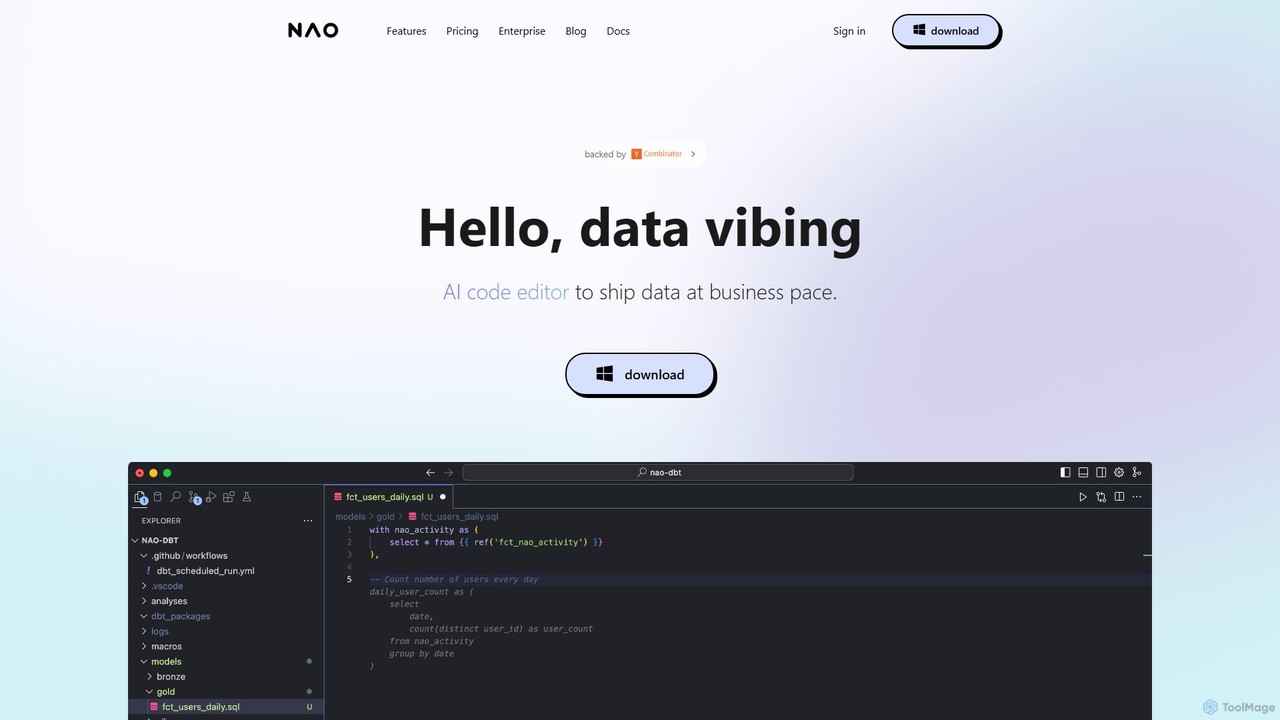
nao is an AI-powered code editor designed for data teams. It streamlines SQL and Python data pipeline creation, dbt workflows, and analytics by natively connecting to your data warehouse. Its intelligent agent provides data-aware code suggestions, quality checks, and instant diff previews to help you ship data faster and more safely.

Preview

SQL Genius Product overview

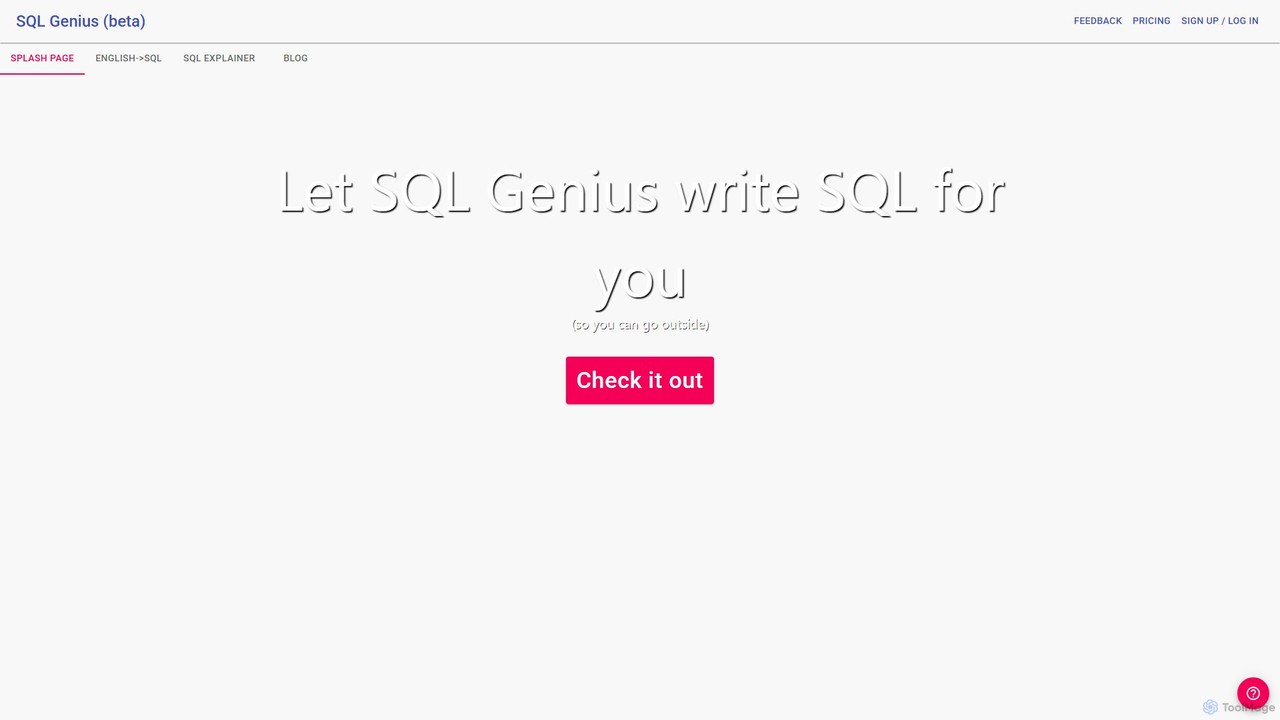
SQL Genius is an AI-powered tool that simplifies database interaction by converting plain English into SQL queries and explaining complex SQL code in simple terms. It's designed for developers, data analysts, and students to boost productivity and reduce the learning curve for SQL.

Preview

Quick facts

Compare product focus, pricing models and audiences. Highlighted rows indicate different listed information; unknown pricing does not mean free.

nao VS SQL Genius — Quick facts
Quick factsnaoSQL Genius
Pricing modelFreemiumFreemium
Product typeAppWeb
Primary focusAnalyticsAnalytics
Audience and rolesNo data availableNo data available
CategoriesAnalytics · Database · Code AssistantAnalytics · Database · Learning · Code Assistant
AddedAug 5, 2025Aug 10, 2025
UpdatedNov 19, 2026Nov 19, 2026

Features, usage and use cases

Explore the listed product descriptions, features and workflows. Taxonomy labels alone are not feature evaluations.

nao

nao is a revolutionary AI code editor built from the ground up for data professionals. It aims to accelerate the entire data workflow, from writing code to deploying pipelines, by integrating deeply with your data ecosystem. Designed for data analysts, analytics engineers, data scientists, and data engineers, nao acts as an intelligent partner, understanding the context of your data to help you write code that is not only syntactically correct but also semantically sound and safe for your production environment.

Unlike generic AI code assistants, nao connects directly to your data warehouse (supporting platforms like Databricks, DuckDB, and more). This native integration allows its AI to be 'data-aware,' providing suggestions based on your actual schema, table structures, and column names. This eliminates guesswork and significantly reduces errors. The core of nao is its powerful AI agent, which goes beyond simple code completion to become a guardian of your data quality.

How to use nao

Getting started with nao is a straightforward process designed to integrate seamlessly into your existing workflow:

  1. Download and Install: Begin by downloading the nao IDE for free from the official website. It's a standalone application that runs on your local machine.
  2. Connect Your Data Warehouse: The first crucial step is to connect nao to your data source. This secure connection allows the AI to access your schema metadata (not your actual data, which stays local) to provide context-aware assistance.
  3. Start Coding: Open a SQL worksheet or a Python script. As you type, nao's AI provides intelligent auto-completion for SQL queries and dbt models, aware of your specific tables and columns.
  4. Leverage the AI Agent: Use the dedicated AI tab to interact with the agent. You can ask it to generate complex queries, create dbt models, write documentation, or add tests. The agent understands your project's context, including dbt models and column-level lineage.
  5. Preview and Diff: Before committing any changes, use the 'Instant Diff Preview' feature. This shows you the direct impact your new code will have on the data, helping you catch potential issues and prevent breaking downstream dashboards or reports.
  6. Run Checks and Deploy: The agent can run data quality checks and your existing tests to validate your code. Once you're confident, you can ship your data pipelines faster and with greater confidence.

Core Features of nao

  • AI-Powered Code Editor: Optimized for SQL and Python with smart auto-completion, code generation, and conversational analytics capabilities.
  • Native Data Warehouse Integration: Connects directly to your data sources like Databricks and DuckDB for schema-aware AI suggestions.
  • Advanced AI Agent: A multifaceted agent that assists with data quality checks, instant data diffs, running tests, and understanding column-level lineage.
  • Deep dbt Integration: Preview dbt models directly in the IDE, get auto-complete for model columns, and visualize the lineage graph to understand dependencies.
  • Instant Diff Preview: See the impact of your code changes on the data in real-time, preventing unintended consequences.
  • Conversational Analytics & Charts: Interact with your data using natural language to generate insights and visualizations directly within the editor.
  • Enterprise-Grade Security: Your data and code remain local. Nothing is shared with an LLM without explicit permission, and enterprise plans offer options for self-hosted LLMs to keep everything within your infrastructure.
  • Unified Development Environment: Combines the tools you love—SQL editor, transformation tool (dbt), and BI lineage—into a single, cohesive IDE.

Use Cases for nao

nao is versatile and can be applied to numerous data-related tasks:

  • Accelerated Data Pipeline Development: Rapidly build and iterate on SQL and Python pipelines with AI-generated code and instant feedback.
  • Robust dbt Workflow Management: Create, test, and document dbt models more efficiently. Understand the impact of changes with column-level lineage and model previews.
  • Complex Data Analysis: Perform sophisticated analyses such as distribution, retention, conversion, and root cause analysis using conversational prompts and powerful querying tools.
  • Data Quality Assurance: Proactively identify and fix data quality issues before they affect production by using the agent's automated checks and data diffs.
  • Safe Code Refactoring: Confidently refactor complex SQL queries or dbt models, using the instant diff preview to ensure the output remains consistent.

Advantages of nao

nao offers significant advantages over traditional code editors and other AI assistants:

  • Data-Aware Intelligence: Unlike tools like Cursor, nao's suggestions are not generic; they are tailored to your specific data schema, resulting in code that works correctly the first time.
  • Enhanced Safety and Reliability: The focus on data quality checks, diffs, and lineage impact analysis helps prevent data breakages, protecting your BI dashboards and analytical reports.
  • Increased Productivity: By unifying multiple tools into one IDE and automating repetitive tasks, nao allows data teams to ship projects significantly faster.
  • Uncompromised Security: With a strong emphasis on data privacy, nao ensures your sensitive data and proprietary code are secure, offering enterprise-level controls for maximum protection.

Pricing and Plans

nao offers a flexible pricing structure to suit different needs:

  • Starter Plan: Free. This plan includes a 15-day trial of the Pro features, basic data warehouse connection, SQL auto-complete, and dbt previews & lineage.
  • Pro Plan: $30 per user/month. Includes everything in the Starter plan, plus the full AI tab on your data, the complete AI agent for data workflows, instant data diff, and direct support.
  • Enterprise Plan: Custom pricing. This plan includes all Pro features, plus enterprise-grade data security, the option for enterprise-hosted LLMs, an enterprise workspace, and a dedicated support team.

SQL Genius

SQL Genius is an intelligent AI assistant designed to streamline the process of writing and understanding SQL queries. It empowers users of all skill levels, from beginners to seasoned professionals, to interact with databases more efficiently. By leveraging advanced artificial intelligence, SQL Genius translates natural language instructions into ready-to-use, syntactically correct SQL code. This eliminates the need for manual coding, reduces the likelihood of errors, and significantly speeds up development and data analysis workflows.

The platform features a clean, intuitive interface that makes database querying accessible to everyone. Whether you're a developer building an application, a data analyst extracting insights, or a student learning the ropes of database management, SQL Genius acts as your personal database expert, available 24/7.

How to use SQL Genius

Using SQL Genius is a straightforward process designed for maximum efficiency:

  1. Define Your Database Schema: In the 'My Tables' section, you can add your database tables. For each table, specify the table name and its schema (column names and data types). This context is crucial for the AI to generate accurate and relevant queries. You can add multiple tables to represent your entire database structure.
  2. Write Your Query in English: Navigate to the 'English->SQL' feature. In the text box, describe the data you want to retrieve or the operation you want to perform in plain English. For example, you could write "Show me all patients over the age of 40 who were admitted in the last month" or "Find the doctor with the highest number of patients."
  3. Generate the SQL Code: Select the appropriate SQL dialect from the advanced options (e.g., PostgreSQL, MySQL) to ensure compatibility. Click the 'Write SQL' button, and the AI will instantly generate the corresponding SQL query.
  4. Explain an Existing SQL Query: If you have a complex SQL query that you need to understand, use the 'SQL Explainer' tab. Paste your code into the input field, and SQL Genius will provide a clear, step-by-step breakdown of what the query does, explaining each clause and function in simple terms.

Core Features of SQL Genius

  • Natural Language to SQL: Translates plain English prompts into high-quality, executable SQL queries.
  • SQL Explainer: Deconstructs and explains complex SQL code, making it easy to understand, debug, and learn from.
  • Custom Schema Awareness: Allows users to input their specific table schemas, enabling the AI to generate highly accurate, context-aware queries tailored to their database.
  • Multi-Dialect Support: Supports various SQL dialects (like PostgreSQL, MySQL, etc.), ensuring the generated code works seamlessly with your specific database system.
  • Intuitive User Interface: A simple and clean web-based interface that requires no installation and is easy to navigate for all users.

Use Cases for SQL Genius

SQL Genius is a versatile tool suitable for a wide range of users and scenarios:

  • Data Analysts & Scientists: Quickly generate complex queries for data exploration, reporting, and analysis without getting bogged down in syntax.
  • Software Developers: Accelerate backend development by rapidly creating SQL queries for application features, APIs, and database migrations.
  • Students & Educators: An excellent learning aid for understanding the logic behind SQL and the relationship between a request and the resulting code.
  • Product Managers & Business Analysts: Enables non-technical team members to perform their own data lookups and gain insights without needing to rely on engineering resources.
  • Database Administrators: Helps in quickly scripting maintenance tasks or understanding legacy queries within the system.

Advantages of SQL Genius

  • Productivity Boost: Automates the time-consuming task of writing SQL, freeing up valuable time for more critical tasks.
  • Error Reduction: AI-generated code minimizes the risk of syntax errors, typos, and logical flaws that are common in manually written queries.
  • Democratizes Data Access: Lowers the barrier to entry for database interaction, empowering more team members to work with data directly.
  • Accelerated Learning: Serves as an interactive tutor, helping users learn SQL faster by providing instant examples and explanations.

Pricing and Plans

SQL Genius appears to operate on a freemium model. This typically includes a free plan with a limited number of queries for users to try out the service. For more extensive usage, higher query limits, advanced features, and priority support, paid subscription plans are likely available. For the most current and detailed pricing information, please visit the official SQL Genius website.

Positioning

Their taxonomy shows where the products overlap and where each one has a more distinct focus. Unknown fields are shown explicitly and are never filled with assumptions.

Categories

Shared
AnalyticsDatabaseCode Assistant
Only nao
No listed items
Only SQL Genius
Learning

Tags

Shared
data analysisdatabasedeveloper tools
Only nao
AI assistantanalytics engineeringcode editordata pipelinedata qualitydbtpythonSQL
Only SQL Genius
code assistantno-codepostgresqlquery generatorsql explainersql generatortext to sql

Audience and roles

Shared
No listed items
Only nao
No listed items
Only SQL Genius
No listed items

Traffic comparison

Traffic is shown on the same scale so differences in market visibility are not visually understated.

How to interpret the traffic data

Both charts share the same months and vertical scale. Each tool identifies its latest reporting month; missing months are left blank, not counted as zero. Regional and source visit counts are estimates calculated from the reported shares.

nao monthly traffic:

Latest traffic · 2026-05

Monthly visits
19.1K
Avg. visit duration
0:22
Pages per visit
1.73
Bounce rate
40.34%
Data updated 2026-06-15

Monthly traffic trend

  • 2025-09: 4K
  • 2026-01: 17.9K
  • 2026-02: 24.2K
  • 2026-03: 22.6K
  • 2026-04: 17.3K
  • 2026-05: 19.1K

Top regions

Top 5 countries/regions
Country/regionPercentageEstimated visits
🇺🇸United States54.42%10.4K
🇮🇳India18.31%3.5K
🇫🇷France10.18%1.9K
🇩🇪Germany9.04%1.7K
🇧🇷Brazil8.05%1.5K

Traffic sources

Source typePercentageEstimated visits
Direct57.37%11K
Referral42.63%8.1K

Search keywords

naonao datanao idenao labnao labs

SQL Genius

No data available

Community signals

Ratings, comments, favorites, and likes are community signals—not a substitute for product fit.

nao

Rating
No data available
Comments
0
Favorites
169
Likes
148

SQL Genius

Rating
No data available
Comments
0
Favorites
134
Likes
141

nao vs SQL Genius · Comparison FAQ

What do nao and SQL Genius have in common?
Both tools are listed under Analytics、Database、Code Assistant. These categories indicate overlapping use cases; compare their detailed descriptions for workflows, capabilities and limitations.
Are nao and SQL Genius free?
Listed pricing models: nao — Freemium; SQL Genius — Freemium. Missing pricing is not proof of a free plan, and freemium does not mean every feature is free. Check official sites for current plans, limits and trials.
How should I choose between nao and SQL Genius?
The primary listed category is Analytics for nao, and Analytics for SQL Genius. Compare features, steps and use cases, then verify pricing, data permissions and deployment needs. This page does not include hands-on testing and does not declare a winner from traffic or tags.

Sources and comparison methodology

This page is assembled from ToolMage product listings, taxonomy, traffic statistics and on-site user feedback. It is not a hands-on test or an independent review.

  • Feature and plan descriptions reflect information in the listings, not real-time guarantees. Verify pricing, quotas, availability and privacy terms on the official sites.
  • Traffic uses the reporting months shown. Missing statistics do not mean zero visits, and different periods do not establish growth or superiority. Regional and source visit counts are estimates based on shares.
  • Different tags indicate differences in the listings, not proof that the other product lacks a capability. Ratings, favorites and visits are not used to declare a winner.

Related comparisons