ToolMage
Sign in

AI TOOL COMPARISON

QuickAppFlow vs Salesforce Platform

What is the difference, and which fits your workflow? Compare features, usage, pricing models and traffic side by side.

Jump to key differences

Product overview

QuickAppFlow Product overview

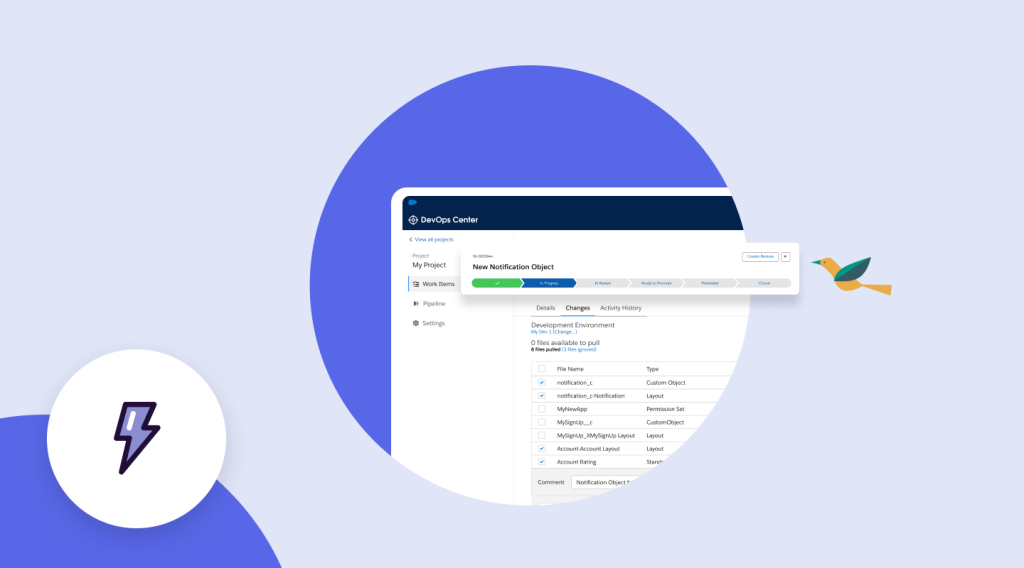
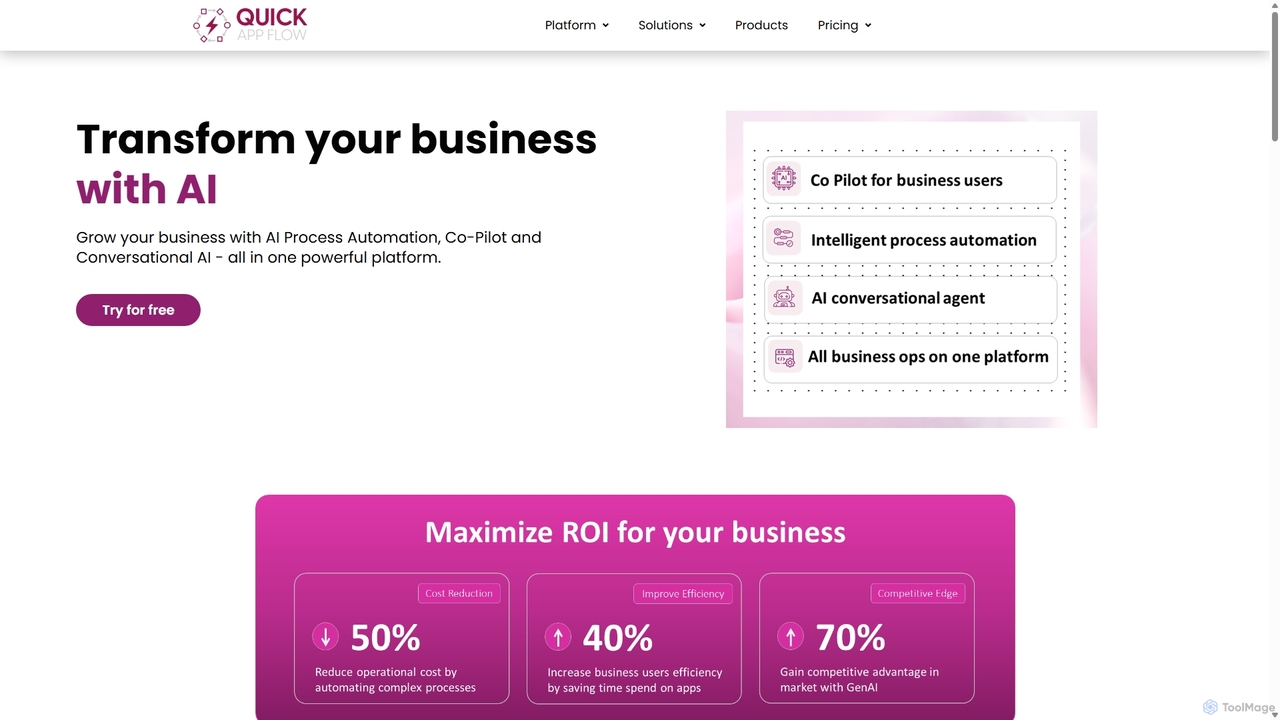
QuickAppFlow is an AI-powered low-code/no-code platform designed to build custom enterprise applications, automate complex workflows, and launch SaaS products. It integrates AI Process Automation, a conversational AI Co-Pilot, and visual development tools to accelerate digital transformation, enabling users to create powerful apps 10x faster and at a fraction of the cost without needing deep technical expertise.

Preview

Salesforce Platform Product overview

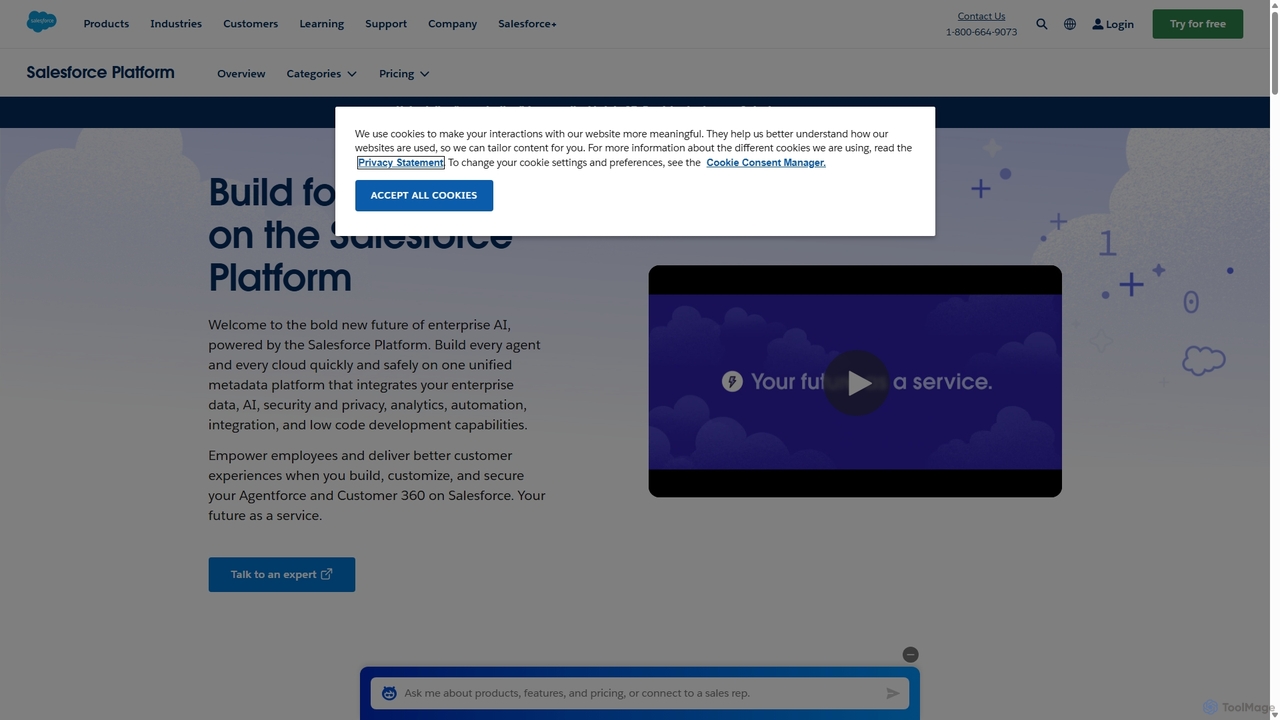
The Salesforce Platform is an enterprise-grade, low-code application development platform powered by AI. It enables businesses to build, deploy, and manage custom applications, automate complex workflows, and integrate systems seamlessly. Leveraging Einstein AI, Data Cloud, and robust security, it empowers teams to create intelligent, data-driven experiences for both customers and employees, accelerating innovation and reducing IT costs.

Preview

Quick facts

Compare product focus, pricing models and audiences. Highlighted rows indicate different listed information; unknown pricing does not mean free.

QuickAppFlow VS Salesforce Platform — Quick facts
Quick factsQuickAppFlowSalesforce Platform
Pricing modelFreemiumPaid
Product typeWebWeb
Primary focusCustom ChatbotsCrm
Audience and rolesBusiness Analyst · Customer Support · Entrepreneur · HR Manager · IT Manager · Operations Manager · Product Manager · Sales Representative · Software DeveloperBusiness Analyst · Customer Support · IT Manager · Marketing Manager · Operations Manager · Product Manager · Sales Representative · Software Developer · System Administrator
CategoriesCustom Chatbots · Enterprise Resource Planning · Low Code No Code · Workflow AutomationCrm · Analytics · Low Code No Code · Automation
AddedSep 23, 2025Sep 7, 2025
UpdatedNov 19, 2026Nov 19, 2026

Features, usage and use cases

Explore the listed product descriptions, features and workflows. Taxonomy labels alone are not feature evaluations.

QuickAppFlow

QuickAppFlow is a comprehensive, AI-driven low-code platform that empowers businesses and entrepreneurs to transform their ideas into powerful, scalable enterprise applications and SaaS products. It provides a unified environment for rapid application development, intelligent process automation, and seamless integration, significantly reducing development time and costs. The platform is designed for both business users (citizen developers) and IT professionals, enabling collaborative creation of solutions that meet unique business needs.

At its core, QuickAppFlow leverages artificial intelligence to streamline and enhance business operations. Its standout features include an AI Co-Pilot that allows users to manage business operations using natural language commands, eliminating the need to switch between multiple applications. Furthermore, its Intelligent Process Automation capability uses AI-powered decisioning to automate complex workflows and process unstructured data, making automation smarter and more efficient without requiring any AI expertise from the user.

How to use QuickAppFlow

Getting started with QuickAppFlow is a straightforward process designed for speed and efficiency:

  1. Choose a Starting Point: Users can begin by selecting one of over 16 ready-to-launch SaaS application templates (such as CRM, HRMS, Helpdesk) or start building a completely custom application from scratch.
  2. Visual Data Modeling: Utilize the visual, spreadsheet-like interface to define and structure your application's data model. What you see is what you get, making data management intuitive.
  3. Design Interfaces with Drag-and-Drop: Build user-friendly forms and interfaces for web and mobile using the drag-and-drop form builder. Pre-built controls and a mobile-friendly design ensure a seamless user experience across all devices.
  4. Automate Workflows: Design and automate business processes of any complexity with the no-code graphical workflow builder. Embed AI-decisioning directly into your workflows to handle dynamic scenarios.
  5. Integrate and Connect: Seamlessly connect your application with third-party systems using standard REST APIs. The platform also provides the capability to build custom connectors when needed.
  6. Deploy and Scale: Deploy your application in the cloud (AWS, Azure) or on-premise in any geographic location to comply with local data laws. The platform's multi-tenant architecture ensures scalability and security for your growing customer base.

Core Features of QuickAppFlow

  • AI Co-Pilot: A conversational AI assistant that understands natural language to perform multiple business operations, boosting efficiency by up to 30%.
  • Intelligent Process Automation: Supercharge workflows with AI-powered decisioning and unstructured data processing, enabling automation of complex tasks without coding.
  • Low-Code/No-Code Platform: A visual, drag-and-drop environment for building data models, user interfaces, and business logic, making app development accessible to everyone.
  • Ready-to-Launch SaaS Templates: A library of 16+ pre-built enterprise apps (CRM, HRMS, etc.) that can be customized and launched within weeks.
  • Mobile App Development: Efficiently build fully integrated and responsive mobile applications for various business needs like Field Sales and Field Services.
  • Enterprise-Grade Governance & Security: Centralized governance, granular permission management, and a scalable identity platform to ensure compliance and security.
  • Seamless Integrations: Open API with REST standards and low-code capabilities to build custom integrations with other enterprise systems.
  • Flexible Deployment: Host applications on major cloud providers like AWS and Azure or on-premise data centers, with support for multi-geography hosting.

Use Cases for QuickAppFlow

QuickAppFlow is versatile and can be applied across various industries and business functions:

  • Custom Enterprise App Development: Build bespoke applications for internal operations like project management, inventory control, or compliance tracking at 20x lower cost.
  • SaaS Product Launch: Entrepreneurs can launch multi-tenant SaaS products, such as a niche CRM for the construction industry or a specialized helpdesk for facility management, in a matter of weeks.
  • Workflow Automation: Automate complex business processes like employee onboarding, invoice processing, and customer support ticket routing.
  • Digital Transformation: Serve as an all-in-one platform to digitize manual processes, create intranet portals, and unify business operations.
  • Citizen Development: Empower business users and department heads to build their own solutions and automate processes using generative AI prompts, reducing reliance on IT departments.

Advantages of QuickAppFlow

The platform offers significant competitive advantages:

  • Speed and Cost-Effectiveness: Develop and launch applications 10x faster and at up to 20x lower cost compared to traditional development methods.
  • Increased Productivity: Achieve a 20% increase in employee productivity by managing all business operations on a single, unified platform.
  • Democratization of Development: The no-code/low-code approach empowers non-technical users (citizen developers) to build and automate, fostering innovation across the organization.
  • Flexibility and Customization: Offers a fully customizable and flexible platform that doesn't compromise on power, allowing for tailored solutions.
  • Scalability and Security: Built for enterprise needs with multi-tenancy, robust security features, and the ability to scale as your business grows.

Pricing and Plans

QuickAppFlow offers flexible pricing models tailored for entrepreneurs and businesses:

  • Starter Plan: $1800 for 6 months. Ideal for testing a product-market fit. Includes the choice of 1 from 16 SaaS products, the AI-powered low-code platform, AI Co-Pilot, 500 GB file storage, and 1 million records.
  • Launch Plan: $750 per month. Designed for launching a full-fledged SaaS product. Includes access to 15 SaaS products, the AI platform, AI Co-Pilot, 1 TB file storage, and 2 million records.
  • Build Plan: Pay-per-feature model for building a completely new SaaS product with customized features. Includes up to 45 man-days of free development.
  • White-Labeling: Users can white-label all 16 SaaS apps and the platform at no initial cost, paying only for hosting and support (starting from around $500/month). A free trial is also available.

Salesforce Platform

The Salesforce Platform is a comprehensive suite of tools and services designed to help businesses of all sizes build and deploy powerful, AI-driven applications. As the foundation of the world's #1 CRM, it provides an integrated environment where developers, IT managers, and business administrators can collaborate to create solutions that drive efficiency and customer success. The platform is built on key pillars including Einstein AI for intelligent predictions and generation, Data Cloud for unifying customer data, low-code tools for rapid development, and enterprise-grade trust and security.

By democratizing application development, the Salesforce Platform allows users to transform ideas into functional apps with minimal coding. It offers a spectrum of tools, from no-code builders for business users to pro-code environments for seasoned developers, ensuring that anyone can contribute to innovation. This flexibility, combined with its inherent scalability and security, makes it the go-to choice for companies looking to digitally transform their operations and deliver personalized experiences at scale.

How to use Salesforce Platform

Using the Salesforce Platform typically follows a structured lifecycle to ensure successful application development and deployment:

  1. Discover & Plan: Identify a business process to improve or a new application need. Define the requirements, user stories, and desired outcomes.
  2. Connect Your Data: Utilize Data Cloud to ingest and harmonize customer data from various sources into a single, unified profile. Use MuleSoft for complex integrations with external systems, legacy software, or AI models.
  3. Build & Customize: Use the Lightning App Builder, a drag-and-drop interface, to create custom user interfaces and pages. For process automation, employ Flow Builder to design complex, multi-step workflows without writing code. Developers can use Apex (a Java-like language) and Lightning Web Components for advanced, pro-code customizations.
  4. Infuse Intelligence: Embed Einstein AI capabilities directly into your applications. This can include predictive scoring for sales leads, generative AI for creating personalized emails, or AI-powered recommendations for service agents.
  5. Test & Deploy: Leverage Salesforce Application Lifecycle Management (ALM) tools to manage development from sandboxes to production. Use version control and CI/CD tools to ship updates faster and more reliably.
  6. Analyze & Optimize: Integrate Tableau to create insightful dashboards and reports. Monitor application performance and user engagement to make data-driven decisions for future enhancements.

Core Features of Salesforce Platform

  • Einstein AI: The world's #1 AI for CRM, offering predictive and generative AI capabilities to create smarter, more personalized customer experiences.
  • Data Cloud: Activates all customer data across Salesforce applications, providing a single source of truth and real-time insights at every touchpoint.
  • Low-Code & No-Code Tools: Features like Lightning App Builder and Flow Builder empower users to create apps and automate processes with intuitive, visual tools.
  • Agentforce: A framework for building and customizing autonomous AI agents to support employees and customers 24/7, handling routine tasks and queries.
  • MuleSoft Integration: Provides powerful tools to connect any data source, system, or AI model securely, enhancing CRM apps with integrated metadata.
  • Tableau Analytics: An AI-powered analytics platform that allows users to visualize data, uncover insights, and make better decisions.
  • Flow Automation: Enables the automation of complex business processes across different departments, systems, and organizations to boost productivity.
  • Enterprise-Grade Security & Trust: A multi-layered security architecture that protects your data, ensures privacy, and helps navigate global compliance regulations.

Use Cases for Salesforce Platform

The platform's versatility supports a wide range of applications across various industries:

  • Sales Automation: Develop a custom app to automate lead assignment, generate quotes, and provide sales reps with AI-powered next-best-action recommendations.
  • Customer Service Enhancement: Build an AI-powered support portal with Agentforce to resolve common customer issues instantly, and create automated case routing workflows for complex problems.
  • Marketing Personalization: Use Data Cloud to create unified customer profiles and build automated marketing journeys that deliver personalized content across email, mobile, and web.
  • IT & Operations Management: Create internal applications for employee onboarding, IT helpdesk management, or project tracking, reducing manual work and improving operational efficiency.
  • Field Service Optimization: Design a mobile app for field technicians that provides real-time job information, customer history, and inventory data, all accessible from their mobile devices.

Advantages of Salesforce Platform

Businesses that adopt the Salesforce Platform report significant benefits:

  • Increased Agility: Customers report developing and automating processes 27% faster, allowing them to respond quickly to market changes.
  • Reduced Costs: By empowering business users and streamlining development, companies see an average of a 25% decrease in IT costs.
  • Massive Scalability: The platform is built to scale, generating over 2 trillion AI-powered predictions and results per week.
  • Unified Experience: It provides a single, integrated platform for data, AI, automation, and analytics, eliminating data silos and creating a cohesive technology stack.
  • Trusted & Secure: Built on Salesforce's industry-leading security infrastructure, ensuring data is protected and compliant with global standards.

Pricing and Plans

The Salesforce Platform offers flexible pricing tiers to suit different business needs. A 30-day free trial is available with no credit card required.

  • Platform Starter: Starts at $25 per user/month. This plan includes custom objects, process automation, Lightning App Builder, AppExchange access, and customizable reports and dashboards.
  • Platform Plus: Starts at $100 per user/month. This tier typically includes higher limits on custom objects and automation, along with more advanced development and integration capabilities.

Positioning

Their taxonomy shows where the products overlap and where each one has a more distinct focus. Unknown fields are shown explicitly and are never filled with assumptions.

Categories

Shared
Low Code No Code
Only QuickAppFlow
Custom ChatbotsEnterprise Resource PlanningWorkflow Automation
Only Salesforce Platform
CrmAnalyticsAutomation

Tags

Shared
application developmententerprise softwarelow-codeno-code
Only QuickAppFlow
AI co-pilotcitizen developmentcustom applicationsdigital transformationmobile app builderprocess automationSaaS builderworkflow automation
Only Salesforce Platform
AIanalyticsautomationbusiness process managementCRMdata integrationEinstein AIPaaSSalesforce

Audience and roles

Shared
Business AnalystCustomer SupportIT ManagerOperations ManagerProduct ManagerSales RepresentativeSoftware Developer
Only QuickAppFlow
EntrepreneurHR Manager
Only Salesforce Platform
Marketing ManagerSystem Administrator

Traffic comparison

Traffic is shown on the same scale so differences in market visibility are not visually understated.

How to interpret the traffic data

Both charts share the same months and vertical scale. Each tool identifies its latest reporting month; missing months are left blank, not counted as zero. Regional and source visit counts are estimates calculated from the reported shares.

QuickAppFlow monthly traffic:

Latest traffic · 2026-05

Monthly visits
679
Avg. visit duration
0:50
Pages per visit
1.98
Bounce rate
37.27%
Data updated 2026-06-15

Monthly traffic trend

  • 2025-09: 423
  • 2026-01: 602
  • 2026-02: 867
  • 2026-03: 837
  • 2026-04: 469
  • 2026-05: 679

Top regions

Top 5 countries/regions
Country/regionPercentageEstimated visits
🇮🇳India100%679

Search keywords

finsmartod leave full formwhat is od leave

Salesforce Platform

No data available

Community signals

Ratings, comments, favorites, and likes are community signals—not a substitute for product fit.

QuickAppFlow

Rating
No data available
Comments
0
Favorites
175
Likes
171

Salesforce Platform

Rating
No data available
Comments
0
Favorites
179
Likes
179

QuickAppFlow vs Salesforce Platform · Comparison FAQ

What do QuickAppFlow and Salesforce Platform have in common?
Both tools are listed under Low Code No Code. These categories indicate overlapping use cases; compare their detailed descriptions for workflows, capabilities and limitations.
Are QuickAppFlow and Salesforce Platform free?
Listed pricing models: QuickAppFlow — Freemium; Salesforce Platform — Paid. Missing pricing is not proof of a free plan, and freemium does not mean every feature is free. Check official sites for current plans, limits and trials.
How should I choose between QuickAppFlow and Salesforce Platform?
The primary listed category is Custom Chatbots for QuickAppFlow, and Crm for Salesforce Platform. Compare features, steps and use cases, then verify pricing, data permissions and deployment needs. This page does not include hands-on testing and does not declare a winner from traffic or tags.

Sources and comparison methodology

This page is assembled from ToolMage product listings, taxonomy, traffic statistics and on-site user feedback. It is not a hands-on test or an independent review.
  • Feature and plan descriptions reflect information in the listings, not real-time guarantees. Verify pricing, quotas, availability and privacy terms on the official sites.
  • Traffic uses the reporting months shown. Missing statistics do not mean zero visits, and different periods do not establish growth or superiority. Regional and source visit counts are estimates based on shares.
  • Different tags indicate differences in the listings, not proof that the other product lacks a capability. Ratings, favorites and visits are not used to declare a winner.

Related comparisons