Text Generator
Speech Synthesis
AI TOOL COMPARISON
What is the difference, and which fits your workflow? Compare features, usage, pricing models and traffic side by side.
Speech Synthesis
Speech Synthesis
Text Generator is a versatile and highly affordable AI platform offering unlimited text, code, and speech generation. It provides a powerful API, including an OpenAI-compatible endpoint for easy migration, making it a cost-effective solution for developers, marketers, and content creators.
TextSynth offers developers powerful, cost-effective access to a suite of AI models, including large language models (LLMs), text-to-image, text-to-speech, and speech-to-text, through a flexible REST API and an interactive playground. It features models like Llama, Mistral, Stable Diffusion, and Whisper, optimized for speed and affordability.
Compare product focus, pricing models and audiences. Highlighted rows indicate different listed information; unknown pricing does not mean free.
| Quick facts | Text Generator | TextSynth |
|---|---|---|
| Pricing model | Paid | Freemium |
| Product type | Web | Web |
| Primary focus | Speech Synthesis | Speech Synthesis |
| Audience and roles | No data available | No data available |
| Categories | Speech Synthesis · Api · Content Generation · Writing | Speech Synthesis · Transcription · Api · Image Generation · Writing |
| Added | Aug 4, 2025 | Aug 12, 2025 |
| Updated | Nov 19, 2026 | Nov 19, 2026 |
Explore the listed product descriptions, features and workflows. Taxonomy labels alone are not feature evaluations.
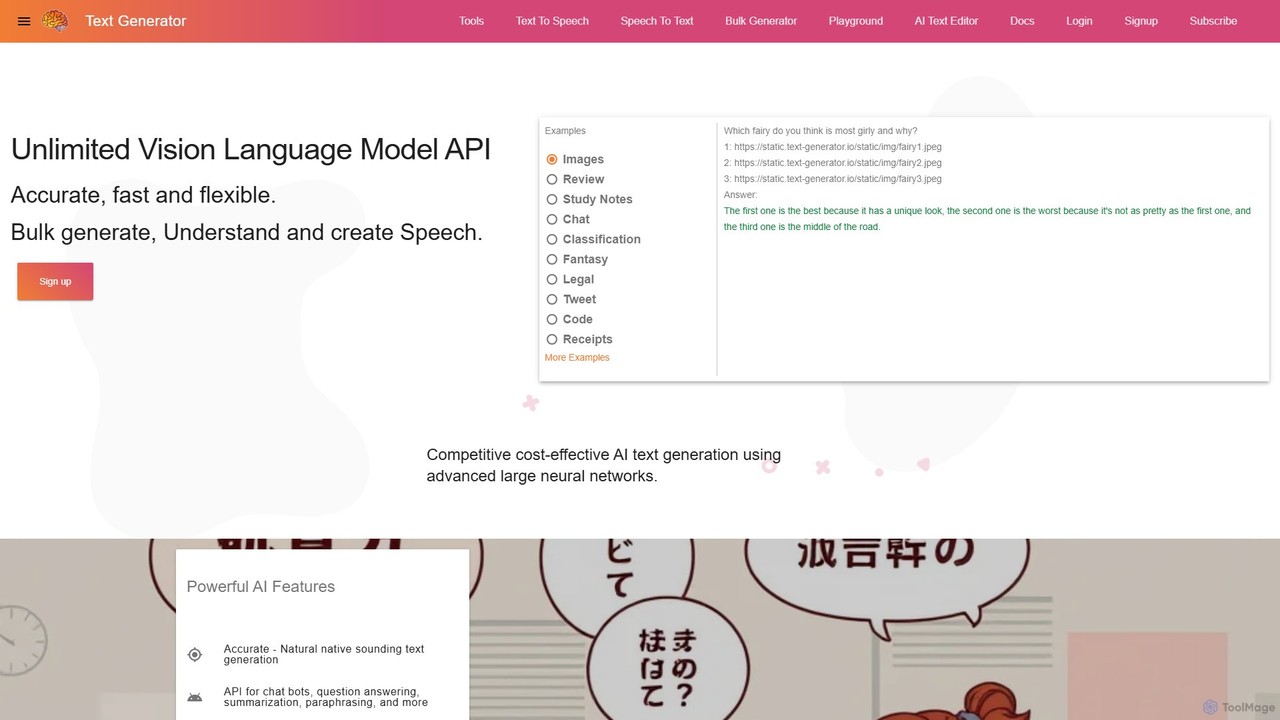
Text Generator is a comprehensive and powerful AI platform designed to provide fast, flexible, and remarkably affordable text generation services. It positions itself as a strong alternative to more expensive solutions like OpenAI, offering a suite of tools that cater to developers, content creators, researchers, and businesses. The platform's core is a versatile Vision Language Model API that not only generates human-like text but also understands and processes content from images and web links. With features spanning from code generation to speech synthesis and recognition, Text Generator aims to be a one-stop-shop for a wide range of AI-powered tasks, all under a simple, unlimited-access subscription model.
Text Generator offers a straightforward user experience, accessible through its web interface and a powerful API.
1. Web Interface: Users can sign up on the website to access the AI Text Editor and a playground. This allows for direct interaction with the AI, testing prompts, generating content, and utilizing advanced editing tools without any coding.
2. API Integration: The platform's main strength lies in its API. It is designed for seamless integration into existing applications and workflows. Notably, it offers an OpenAI-compatible endpoint, allowing developers to switch from OpenAI with minimal effort—often just by changing the API base URL and the API key in their code. The platform provides clear examples for Python and Node.js. For more advanced control, developers can use Text Generator's native HTTP JSON API, which includes unique parameters like repetition_penalty, min_probability, and max_sentence for fine-tuning outputs.
The platform's versatility supports a broad spectrum of applications:
Text Generator's primary advantage is its exceptional cost-effectiveness, claiming to be up to 10 times cheaper than OpenAI for comparable tasks. This is achieved through a simple, flat-rate monthly subscription for unlimited use, which removes the financial uncertainty of pay-per-token models. The ease of migration via its OpenAI-compatible API is a major draw for developers looking to cut costs without a complete overhaul of their codebase. Furthermore, its multi-modal nature—combining text, code, vision, and voice in one platform—offers significant value and simplifies the development stack for complex applications.
Text Generator operates on a subscription-based model. The primary plan is priced at $19.00 per month. This subscription provides comprehensive access to the platform's features, including:
The homepage has also mentioned a price of $13.99/month for unlimited API access, suggesting potential variations in plans or promotional pricing. Users are encouraged to visit the official website for the most current and detailed pricing information.
TextSynth is a comprehensive AI platform that provides access to a diverse range of cutting-edge generative AI models through a simple and efficient REST API. Founded in 2020, it has established itself as a reliable and cost-effective solution for developers, researchers, and businesses looking to integrate advanced AI capabilities into their applications. The platform's core offering revolves around providing access to large language models (LLMs), text-to-image generators, speech-to-text transcription, and text-to-speech synthesis. Key models available include Mistral, Llama, Gemma, Stable Diffusion, and Whisper. A standout feature of TextSynth is its custom inference code, which optimizes performance on standard GPUs and CPUs, resulting in faster inference speeds and significantly lower costs for users.
Using TextSynth is straightforward for developers. The primary method of interaction is through its REST API. To get started, you need to create an account on the TextSynth website to obtain an API key. This key must be included in the header of every API request for authentication (Authorization: Bearer YOUR_API_KEY). The platform offers various endpoints tailored to specific tasks:
For non-programmatic use or quick testing, TextSynth also provides a user-friendly playground where you can directly interact with the models for text completion, chat, image generation, and more.
TextSynth's versatile models can be applied to a wide array of applications:
TextSynth stands out for several key reasons. Its primary advantage is cost-effectiveness, achieved through its optimized inference engine, which makes powerful AI accessible at a lower price point. The platform's pay-as-you-go credit system provides transparent and predictable pricing, eliminating the risk of unexpected expenses. Furthermore, it offers a broad selection of state-of-the-art models, giving developers the flexibility to choose the best tool for their specific needs. The combination of a robust API, detailed documentation, and a free tier for testing makes it an exceptionally developer-friendly platform.
TextSynth offers a simple and transparent pricing structure with two main plans:
Pricing is based on usage:
Their taxonomy shows where the products overlap and where each one has a more distinct focus. Unknown fields are shown explicitly and are never filled with assumptions.
Traffic is shown on the same scale so differences in market visibility are not visually understated.
Both charts share the same months and vertical scale. Each tool identifies its latest reporting month; missing months are left blank, not counted as zero. Regional and source visit counts are estimates calculated from the reported shares.
| Country/region | Percentage | Estimated visits |
|---|---|---|
| 🇺🇸United States | 89.26% | 876 |
| 🇧🇷Brazil | 10.74% | 105 |
| Country/region | Percentage | Estimated visits |
|---|---|---|
| 🇺🇸United States | 80.54% | 2.7K |
| 🇵🇱Poland | 11.07% | 369 |
| 🇮🇹Italy | 7.35% | 245 |
| 🇪🇸Spain | 1.04% | 35 |
Ratings, comments, favorites, and likes are community signals—not a substitute for product fit.
This page is assembled from ToolMage product listings, taxonomy, traffic statistics and on-site user feedback. It is not a hands-on test or an independent review.