
OpenFuture
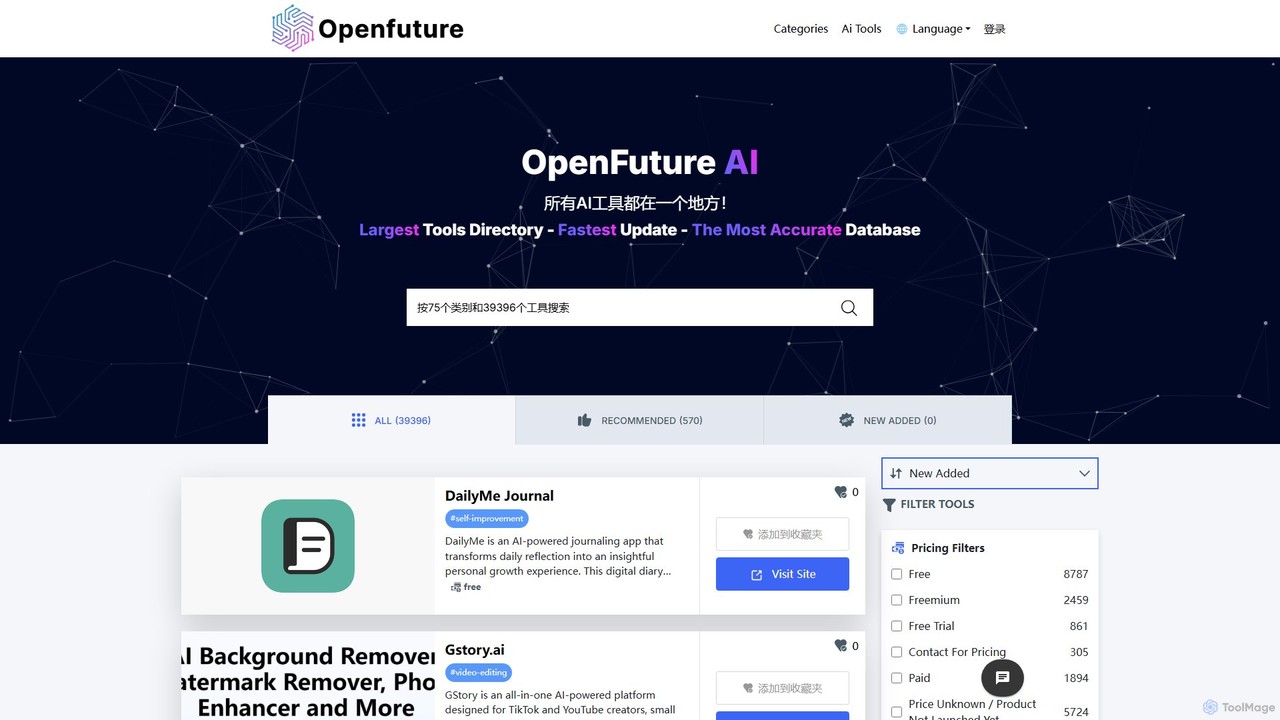
OpenFuture is the world's largest and most comprehensive AI tools directory. It provides a centralized platform for users …
OpenFuture is the world's largest and most comprehensive AI tools directory. It provides a centralized platform for users to discover, compare, and select from thousands of AI-powered solutions. With daily updates, accurate information, and powerful filtering options, OpenFuture helps professionals, creators, and enthusiasts find the perfect AI tools to enhance productivity, streamline workflows, and drive innovation.
About Tools
The category "Tools" within AI aggregators refers to integrated platforms or suites that centralize and orchestrate diverse AI functionalities and services. These AI-powered environments allow users to combine multiple AI models, APIs, or specialized tools into cohesive workflows, streamlining complex tasks. They serve as a unified hub for managing and deploying various AI capabilities, enhancing efficiency and enabling advanced AI applications. This category focuses on platforms that go beyond simple listing, providing active integration and management features.
Core Features
- Workflow Orchestration: Enables chaining multiple AI models or services to automate complex, multi-step processes.
- API Integration: Seamlessly connects with various third-party AI APIs and services, expanding available capabilities.
- Unified Interface: Provides a single dashboard or environment to manage, configure, and monitor different AI components.
- Customization & Automation: Allows users to define custom rules, parameters, and triggers for automated AI operations.
- Resource Management: Centralizes the management of AI models, data, and computational resources for optimal performance.
Use Cases
These tools are invaluable for developers, data scientists, and businesses looking to build sophisticated AI applications or automate intricate processes. They are used in scenarios requiring the coordinated effort of multiple AI systems, such as combining natural language processing with image generation, or integrating predictive analytics with automated content creation.
How to Choose
When selecting an AI tool aggregator, consider its integration ecosystem (which APIs/models it supports), workflow building capabilities (ease of chaining and customization), scalability for your operational needs, and the clarity of its pricing model. Evaluate the user interface for intuitiveness and the availability of community support or documentation.
ToolsUse Cases
Automating Content Generation Workflows
Content marketing teams can use these tools to orchestrate a sequence of AI models: first, an AI for topic research, then a text generator for drafting articles, followed by an image generator for visuals, and finally, an AI editor for proofreading and optimization. This streamlines the entire content creation pipeline, from ideation to publication, significantly reducing manual effort and time.
Developing Custom AI Applications
Developers leverage these platforms to rapidly prototype and deploy bespoke AI solutions without deep expertise in every underlying AI model. They can integrate a speech-to-text AI, a sentiment analysis AI, and a response generation AI to build a custom voice assistant, managing all components from a single environment and accelerating development cycles.
Enhancing Customer Service Automation
Businesses can aggregate various AI services to create advanced customer support systems. This might involve a chatbot for initial queries, an intent recognition AI to route complex issues, and a knowledge base AI to fetch relevant information, all working in concert. The aggregated tool ensures a seamless and intelligent customer interaction experience, improving resolution rates.
Streamlining Data Analysis and Reporting
Data analysts can utilize these tools to connect data ingestion AI, data cleaning AI, and predictive analytics AI, followed by a report generation AI. This creates an automated pipeline for processing raw data, identifying trends, forecasting outcomes, and generating comprehensive reports, enabling faster insights and data-driven decision-making.
Personalizing E-commerce Experiences
E-commerce platforms can aggregate recommendation engines, dynamic pricing AI, and personalized marketing message generators. By combining these, they can offer highly tailored product suggestions, adjust prices in real-time based on demand, and craft unique promotional content for individual customers, leading to increased conversion rates and customer satisfaction.
Accelerating Research and Development
Researchers in fields like drug discovery or material science can aggregate AI models for molecular simulation, data pattern recognition, and hypothesis generation. This allows them to run complex experiments, analyze vast datasets, and identify potential breakthroughs much faster than traditional methods, significantly speeding up the R&D process.