OpenFuture
OpenFuture is the world's largest and most comprehensive AI tools directory. It provides a centralized platform for users …
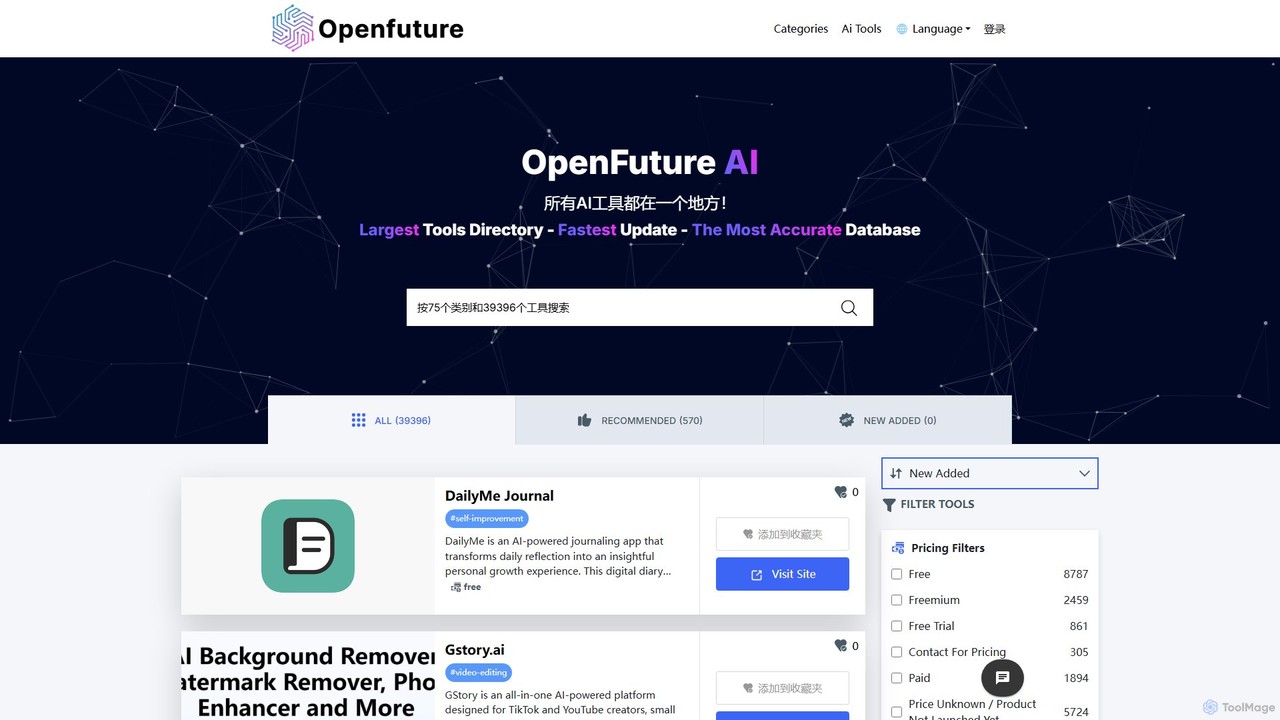
OpenFuture is the world's largest and most comprehensive AI tools directory. It provides a centralized platform for users to discover, compare, and select from thousands of AI-powered solutions. With daily updates, accurate information, and powerful filtering options, OpenFuture helps professionals, creators, and enthusiasts find the perfect AI tools to enhance productivity, streamline workflows, and drive innovation.
About Aggregators
AI Aggregators are platforms that centralize access to multiple AI models, tools, or data sources through a single, unified interface. They function as an intelligent routing layer, directing user requests to the most suitable underlying service based on criteria like cost, performance, or specific capabilities. This approach simplifies development, reduces vendor lock-in, and allows users to leverage the best features from various providers without managing numerous separate integrations. Consequently, aggregators are highly valuable for building resilient and cost-effective AI applications.
Core Features
- Unified API Access: Connect to diverse AI models from providers like OpenAI, Google, and Anthropic using a single API key and standardized format.
- Intelligent Model Routing: Automatically selects the most cost-effective or best-performing model for a given task based on predefined rules.
- Centralized Management: Monitor usage, manage costs, and handle billing for multiple AI services from a single dashboard.
- Failover and Redundancy: Ensures application reliability by automatically rerouting requests to a backup model if a primary provider fails.
- Workflow Orchestration: Enables chaining of different AI models or tools to create complex, multi-step automated processes.
Use Cases
AI Aggregators are primarily used by developers building AI-powered applications, enterprises seeking to optimize AI spending and governance, and product teams needing to experiment with different models. Common applications include creating versatile chatbots that switch models based on query complexity, developing content platforms that test outputs from various LLMs, and building resilient data analysis pipelines that are not dependent on a single provider.
How to Choose
When selecting an AI Aggregator, evaluate the range of supported models and services to ensure they meet your needs. Assess the sophistication of its routing logic, its integration capabilities with your existing tech stack, and the latency overhead it introduces. It is also crucial to analyze the platform's pricing model, security features, and the quality of its monitoring and analytics tools to ensure it aligns with your budget and operational requirements.
AggregatorsUse Cases
Building a Cost-Optimized Chatbot
A startup developer is tasked with creating a customer service chatbot. The goal is to handle simple FAQs cheaply while effectively managing complex user queries. By using an AI aggregator, the developer can implement intelligent routing. Simple, repetitive questions are sent to a fast, low-cost model. More complex, nuanced conversations are automatically escalated to a powerful, premium model. This dynamic allocation strategy significantly reduces operational costs, often by over 50%, compared to exclusively using a high-end model, while ensuring a high-quality user experience across all types of interactions.
A/B Testing AI Models for Marketing Copy
A marketing manager needs to find the best AI model for generating ad copy that aligns with the company's brand voice. Instead of setting up multiple separate API integrations, they use an AI aggregator. With a single request, they can send the same prompt to several models (e.g., GPT-4o, Claude 3, Llama 3) simultaneously. The aggregator platform collects and presents the outputs side-by-side, facilitating easy comparison. This enables the team to make a data-driven decision on which model to adopt for their campaigns, improving content quality and performance without the technical overhead of managing multiple services.
Ensuring High Availability for AI Applications
A DevOps engineer is responsible for an application that heavily relies on a single AI provider. To mitigate the risk of service disruption from a provider outage, they integrate an AI aggregator. The aggregator is configured with automatic failover rules. If the primary AI model becomes unresponsive or returns errors, the platform instantly reroutes traffic to a pre-configured backup model from a different provider. This ensures business continuity and maintains a seamless user experience. The application's uptime and reliability are significantly increased, protecting revenue and user trust during provider-specific incidents.
Centralizing AI Governance and Billing
An IT administrator in a large enterprise notices that various departments are using different AI tools, leading to uncontrolled spending and security risks from decentralized API key management. They implement an AI aggregator as a central gateway for all AI service access. Now, employees access approved tools through this single platform. The aggregator handles authentication, logs all usage for auditing, and consolidates billing into one invoice. This move streamlines AI governance, enhances security by centralizing key management, and provides the finance department with clear, actionable insights into company-wide AI expenditure.
Simplifying Multi-Modal AI Workflows
An AI developer is building an application that needs to perform a sequence of tasks: analyze an image, generate a text description, translate that description, and then create a voiceover. This traditionally requires stitching together multiple APIs. Using an AI aggregator with workflow orchestration, the developer defines this multi-step process within the platform. A single API call to the aggregator triggers the entire chain. The platform automatically passes the output of one model (e.g., image recognition) as the input to the next (text generation), streamlining the entire process. This reduces integration code by up to 80% and significantly accelerates the time-to-market for complex, multi-modal applications.
Standardizing AI Development Across Teams
A Head of AI observes that different development teams within the company are using various AI models and SDKs, leading to inconsistent codebases and duplicated integration efforts. To solve this, the company adopts an AI aggregator and mandates its use. All teams now interact with any AI model through the aggregator's standardized, universal API. This promotes code reusability and simplifies developer onboarding. More importantly, it allows the company to swap underlying AI models (e.g., switching from one provider to another for cost or performance reasons) without requiring any team to refactor their application code, providing ultimate flexibility and future-proofing their tech stack.