
Daytona
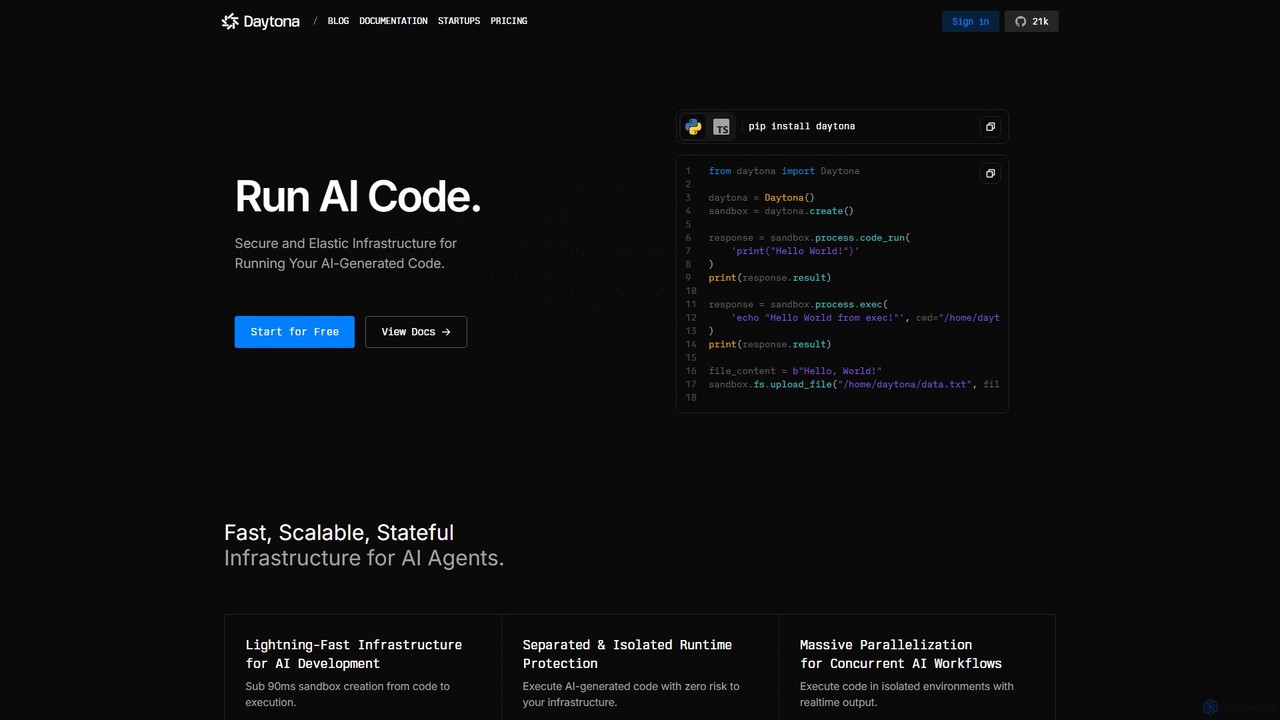
Daytona is a secure, elastic, and high-performance runtime environment designed for executing AI-generated code. It provides isolated sandboxes …
Daytona is a secure, elastic, and high-performance runtime environment designed for executing AI-generated code. It provides isolated sandboxes for AI agents, data analysis, and scalable evaluations, enabling developers to run untrusted code with zero risk to their infrastructure. It's built for speed, scalability, and stateful, long-running tasks.
About Runtime Environment
"Runtime Environment" refers to the dedicated operational infrastructure where AI agents execute their tasks and interact with the digital world. These environments provide the essential services and resources, enabling AI agents to perceive, reason, act, and learn autonomously. They are crucial for managing the agent's lifecycle, ensuring stable and secure operation, and facilitating seamless integration with external systems and data sources. Without a robust runtime environment, AI agents would lack the necessary foundation to perform complex, multi-step operations and maintain persistent states.
Core Features
- Task Orchestration: Manages the execution flow of agent tasks, including scheduling, prioritization, and dependency resolution.
- External Tool Integration: Provides interfaces and APIs for agents to connect with databases, web services, and other applications.
- State Management: Maintains the agent's internal state, memory, and context across different interactions and sessions.
- Resource Allocation: Dynamically assigns computational resources (CPU, memory) to agents based on their needs.
- Monitoring & Logging: Tracks agent performance, logs activities, and provides insights for debugging and optimization.
Use Cases
Runtime environments are essential in scenarios requiring autonomous task execution, such as automated customer service bots managing complex queries or intelligent assistants coordinating workflows across multiple enterprise applications. They provide the stable foundation for agents to operate reliably.
How to Choose
Key selection criteria include scalability to handle varying agent loads, robust security features for data protection, ease of integration with existing infrastructure, and comprehensive monitoring capabilities for operational oversight. Consider also support for specific agent frameworks and programming languages.
Runtime EnvironmentUse Cases
Orchestrating Complex Business Workflows
For enterprises needing to automate multi-step business processes, a runtime environment allows AI agents to execute tasks sequentially or in parallel. For instance, an agent can receive a customer inquiry, query a CRM, generate a personalized response using a language model, and then update the customer record, all within a managed and monitored environment, ensuring consistency and reducing manual intervention.
Enabling Real-time Data Ingestion and Analysis
Data scientists and analysts leverage runtime environments for AI agents that continuously monitor data streams from various sources. These agents can ingest, clean, and analyze data in real-time, identifying anomalies or trends. The environment provides the necessary computational resources and connectivity to databases or data lakes, allowing for immediate insights and automated responses to critical data events.
Powering Autonomous Customer Support Agents
Customer service departments deploy AI agents within runtime environments to handle a wide range of customer interactions. These agents can understand natural language, access knowledge bases, resolve common issues, and escalate complex cases to human agents. The environment ensures agents maintain context across conversations, integrate with ticketing systems, and operate 24/7 without interruption.
Optimizing Cloud Resource Allocation
Cloud architects and DevOps teams utilize runtime environments for AI agents that dynamically manage cloud infrastructure. Agents can monitor resource utilization, predict demand spikes, and automatically scale services up or down. The environment provides the hooks into cloud APIs, allowing agents to make real-time decisions on resource provisioning, cost optimization, and performance tuning.
Providing a Sandbox for Agent Development and Testing
Developers building AI agents require a controlled runtime environment to test agent behaviors, debug interactions, and simulate real-world scenarios. This environment offers isolated execution spaces, tools for logging and introspection, and the ability to reset states, accelerating the iterative development cycle and ensuring agent robustness before deployment to production.
Deploying and Managing Secure Multi-Agent Systems
For applications involving multiple AI agents collaborating on complex tasks, a runtime environment provides the necessary security, communication protocols, and coordination mechanisms. For example, in a supply chain, agents for inventory, logistics, and procurement can interact securely within the environment, sharing information and making collective decisions while maintaining data integrity and access control.