Daytona
Daytona is a secure, elastic, and high-performance runtime environment designed for executing AI-generated code. It provides isolated sandboxes …
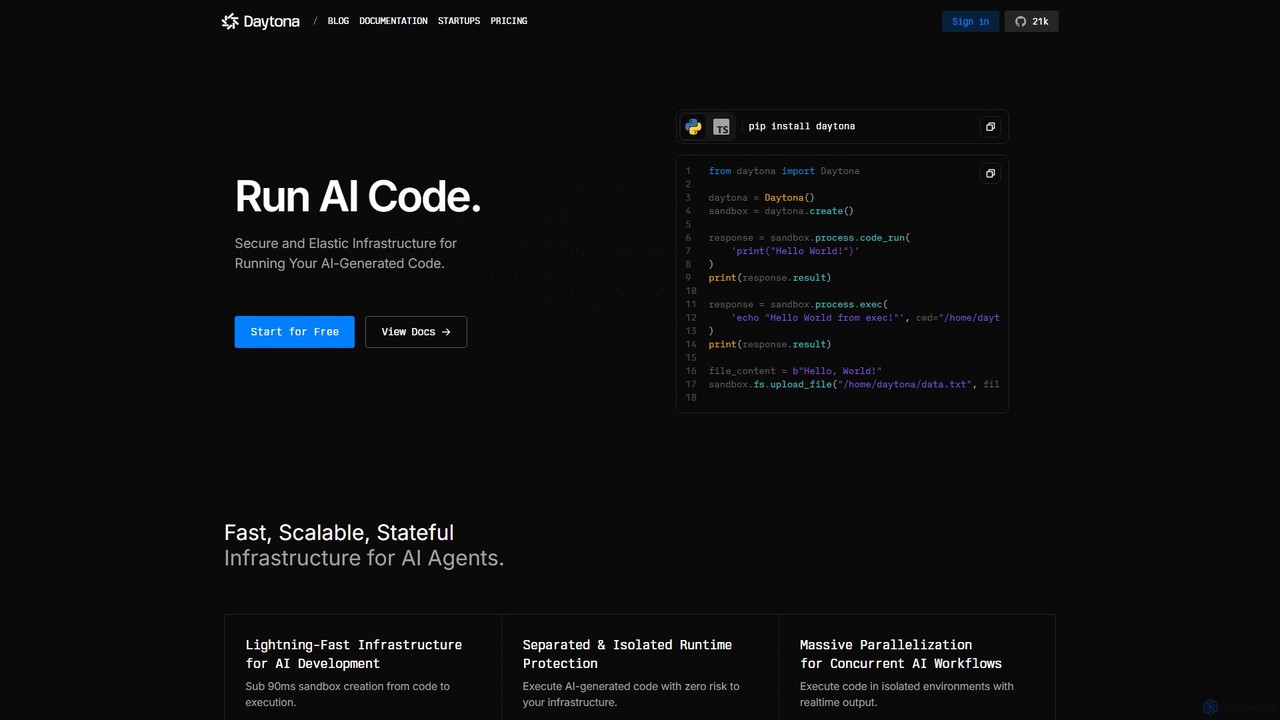
Daytona is a secure, elastic, and high-performance runtime environment designed for executing AI-generated code. It provides isolated sandboxes for AI agents, data analysis, and scalable evaluations, enabling developers to run untrusted code with zero risk to their infrastructure. It's built for speed, scalability, and stateful, long-running tasks.
About Ai Agent Tools
AI Agent Tools are a class of software designed to create, manage, and deploy autonomous AI agents. These agents can perceive their digital environment, make decisions, and execute multi-step tasks independently to achieve specific goals. They are widely used to automate complex workflows that require reasoning, planning, and interaction with various web services, APIs, and local files. Unlike simple automation scripts, AI agents can adapt their actions based on real-time information and outcomes, enabling them to handle dynamic and unpredictable scenarios.
Core Features
- Autonomous Task Execution: Agents can independently perform complex sequences of actions, such as browsing websites, filling forms, and analyzing data, without direct human supervision.
- Goal-Oriented Planning: They can break down a high-level objective into a series of smaller, executable steps and devise a strategy to complete it.
- Environment Interaction: Agents are capable of interacting with digital environments, including accessing websites, using APIs, reading/writing files, and executing code.
- Adaptive Learning: Many advanced agents can learn from their experiences, refining their strategies and improving performance on future tasks.
Use Cases
AI Agent Tools are utilized by developers, researchers, data analysts, and business strategists. In finance, they are used for autonomous market analysis and algorithmic trading. E-commerce businesses deploy them for competitor price monitoring and supply chain optimization. In software development, they assist with automated code generation, debugging, and testing, significantly accelerating development cycles.
How to Choose
When selecting an AI Agent Tool, consider the complexity of the tasks you need to automate. Evaluate its integration capabilities with essential platforms and APIs. Assess the level of autonomy and control it provides, ensuring it aligns with your operational needs. Finally, consider the technical expertise required for setup and maintenance, choosing a tool that matches your team's skill set.

Ai Agent ToolsUse Cases
Automated Market and Competitor Research
A marketing strategist tasks an AI agent with monitoring the digital presence of five key competitors. The agent is instructed to scan their websites, blogs, and social media channels daily for new product announcements, pricing changes, and major marketing campaigns. It autonomously navigates these sites, extracts relevant text and images, and compiles the findings into a structured daily report. This process saves the marketing team hours of manual research each day, providing timely and comprehensive competitive intelligence to inform strategic decisions.
Autonomous Software Development and Testing
A software developer uses an AI agent to accelerate a coding project. The developer provides a high-level requirement, such as "Create a Python script to parse CSV files from a specific folder and upload them to a database." The agent plans the steps: identify file paths, write code to read CSVs, establish a database connection, and create an upload function. It then generates the code, writes unit tests to verify its functionality, and even attempts to debug any errors it encounters. This allows the developer to focus on high-level architecture rather than routine coding tasks.
Complex Data Collection and Analysis
A data analyst needs to gather sentiment data about a new product from social media, news articles, and forums. They deploy an AI agent with the goal of "collecting and analyzing public sentiment for Product X." The agent autonomously searches the web, identifies relevant posts and articles using natural language processing, extracts the content, and performs sentiment analysis. Finally, it aggregates the data, visualizes the trends in a dashboard, and generates a summary report, transforming a multi-day manual task into an automated overnight process.
Personalized Travel Itinerary Planning
A user wants to plan a 7-day trip to Japan. They provide an AI agent with their budget, travel dates, and interests, such as "history, nature, and authentic food." The agent accesses flight and hotel booking websites to find the best deals, researches popular attractions and local restaurants based on reviews, and checks public transport schedules. It then pieces all this information together to create a detailed, day-by-day itinerary, complete with booking links, travel times, and a budget breakdown. The user receives a fully customized travel plan in minutes, a task that would typically take hours of research.
Automating E-commerce Operations
An e-commerce store manager uses an AI agent to optimize daily operations. The agent is tasked to monitor inventory levels across multiple sales channels (website, Amazon, eBay). When stock for a popular item drops below a set threshold, the agent automatically generates a purchase order and sends it to the supplier. Additionally, it scans competitor pricing for the top 20 products every hour and suggests price adjustments to maintain a competitive edge, while ensuring profit margins are met. This automates critical but time-consuming tasks, freeing up the manager for strategic growth activities.
Assisting Scientific Literature Reviews
A medical researcher is investigating a new treatment method. They use an AI agent to conduct a comprehensive literature review. The agent is given keywords and research parameters, and it proceeds to search academic databases like PubMed and Google Scholar. It identifies thousands of relevant papers, filters them based on criteria like publication date and study type, and then summarizes the abstracts of the most relevant articles. It can even identify conflicting findings or gaps in the current research, presenting a synthesized overview that helps the researcher quickly grasp the state of the field and formulate new hypotheses.