Felicis
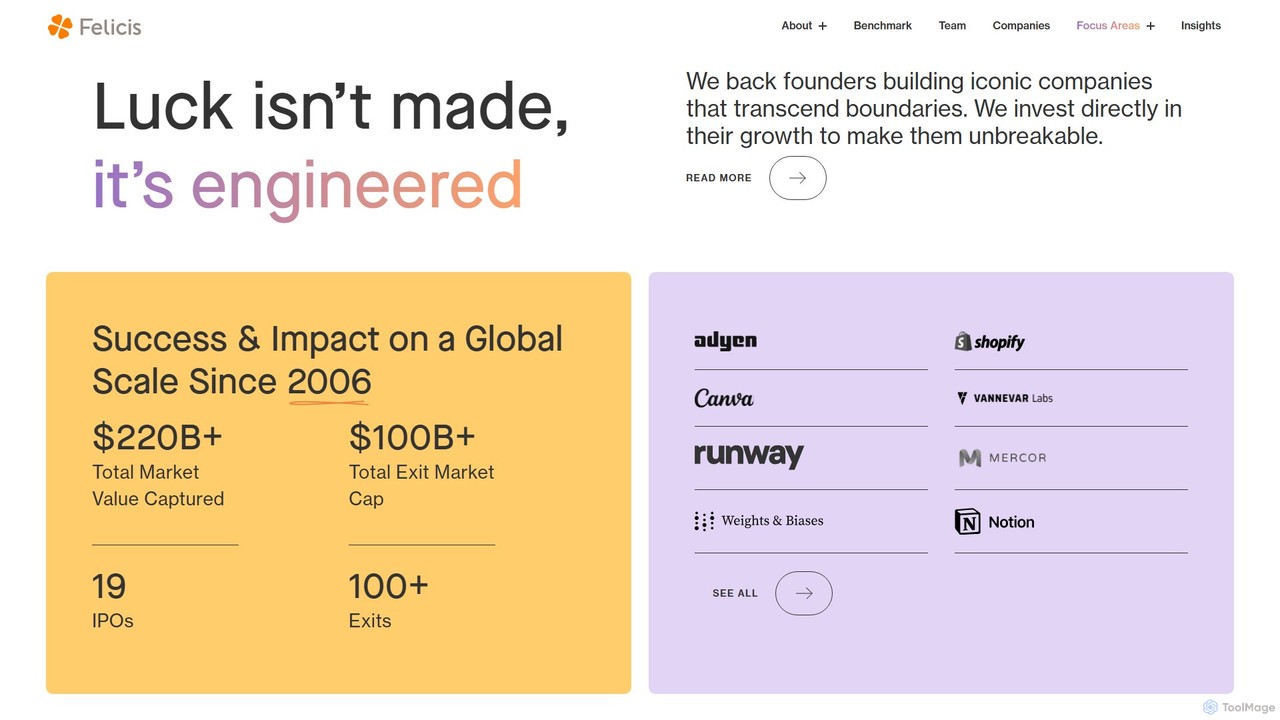
Felicis is a founder-focused venture capital firm that invests in and partners with visionary founders to build iconic …
Felicis is a founder-focused venture capital firm that invests in and partners with visionary founders to build iconic companies. Specializing in sectors like AI, Health & Bio, Infrastructure, and Security, Felicis provides capital, strategic guidance, and deep operational support to help startups achieve breakthrough growth and long-term success.
About Ai Investment
AI Investment tools are a class of software that leverages artificial intelligence to analyze financial markets, identify trading opportunities, and manage investment portfolios. These tools utilize machine learning models, quantitative analysis, and big data processing to interpret complex market signals that are often invisible to human analysts. Their primary value lies in providing data-driven insights, automating complex trading strategies, and optimizing asset allocation based on predefined risk profiles and goals. This represents a specialized application of AI focused on enhancing investment decision-making and execution.
Core Features
- Predictive Market Analysis: Employs machine learning algorithms to forecast stock prices, market trends, and volatility based on historical data and real-time indicators.
- Algorithmic Trading Automation: Automatically executes buy or sell orders based on AI-driven signals and pre-configured strategies, operating 24/7.
- Portfolio Optimization: Uses AI to construct and rebalance portfolios, aiming to maximize returns for a given level of risk tolerance.
- Sentiment Analysis: Scans news articles, social media, and financial reports to gauge market sentiment towards specific assets.
- Risk Assessment: Models potential downside risks and simulates portfolio performance under various market stress scenarios.
Use Cases
These tools are utilized by a wide range of users, from individual retail investors seeking automated guidance to sophisticated hedge funds deploying complex quantitative strategies. Financial advisors use them to enhance client portfolio management, while day traders leverage them for high-frequency trading signal generation. Common applications include automated stock screening, robo-advisory services, and backtesting trading algorithms against historical data.
How to Choose
When selecting an AI Investment tool, consider your investment style and technical expertise. Key factors include the range of supported assets (stocks, crypto, forex), the quality and source of data (real-time vs. delayed), the level of automation (advisory vs. fully autonomous), backtesting capabilities, and the pricing model (subscription vs. performance fees). It is also crucial to assess the transparency of the AI's decision-making process.

Ai InvestmentUse Cases
Automated Stock Screening for Growth Opportunities
A retail investor aims to find undervalued growth stocks but lacks the time to manually research thousands of companies. Using an AI investment tool, they set complex criteria combining financial metrics (like P/E ratio, revenue growth) with non-traditional data (like positive news sentiment). The AI scans the entire market in minutes, presenting a shortlist of high-potential stocks that meet the specific profile. This process transforms a week's worth of manual analysis into a task that can be completed in under an hour, enabling the investor to focus on deeper due diligence of pre-qualified opportunities.
AI-Powered Portfolio Rebalancing
A financial advisor manages dozens of client portfolios, each with a unique risk tolerance and investment goal. Manually monitoring and rebalancing each one is time-consuming and prone to error. The advisor uses an AI investment platform that continuously analyzes each portfolio's asset allocation against market movements and the client's target strategy. When a portfolio drifts from its target, the AI sends an alert with specific, optimized trade recommendations to rebalance it. This automates a critical but repetitive task, ensuring all client portfolios remain aligned with their goals while freeing up the advisor's time for strategic client communication.
Cryptocurrency Arbitrage Opportunity Detection
An advanced crypto trader wants to capitalize on price discrepancies for the same asset across different exchanges. Manually tracking these fleeting opportunities is nearly impossible. They deploy an AI-powered trading bot that monitors real-time price feeds from dozens of exchanges simultaneously. The AI algorithm is programmed to detect profitable arbitrage opportunities, calculate potential transaction fees and slippage, and automatically execute buy and sell orders across the exchanges to lock in a profit. This high-frequency strategy is only feasible through the speed and automation provided by an AI investment tool.
Market Sentiment Analysis for Trading Decisions
A day trader specializing in tech stocks needs to react quickly to market news and social media trends. Instead of manually scrolling through news sites and Twitter, they use an AI tool that performs real-time sentiment analysis. The tool aggregates data from millions of sources, identifying shifts in public opinion about a specific stock—from positive to negative, or neutral to trending. It provides a sentiment score and alerts the trader to unusual spikes in chatter or sudden changes in tone, giving them an informational edge to make faster, more informed entry or exit decisions before the sentiment change is fully reflected in the stock price.
Backtesting Algorithmic Trading Strategies
A quantitative analyst develops a new trading strategy based on a combination of technical indicators. Before risking real capital, they need to validate its effectiveness. They use an AI investment platform with advanced backtesting capabilities. The analyst inputs their strategy's rules, and the platform simulates its performance against years of historical market data, including stocks, forex, and commodities. The AI provides a detailed report on profitability, maximum drawdown, and risk-adjusted returns. This allows the analyst to refine parameters and optimize the strategy in a risk-free environment, significantly increasing the probability of success when deployed live.
Robo-Advisory for Passive Long-Term Investing
A young professional wants to start investing for retirement but feels overwhelmed by the complexity of the stock market. They sign up for a robo-advisor service, a type of AI investment tool designed for beginners. After answering a few questions about their age, income, and risk tolerance, the AI automatically creates and manages a diversified portfolio of low-cost ETFs. The system handles all aspects of the investment process, including initial investment, automatic rebalancing, and tax-loss harvesting. This provides a hands-off, low-cost, and disciplined approach to long-term wealth building, making sophisticated investment strategies accessible to everyone.