Serendpt AI
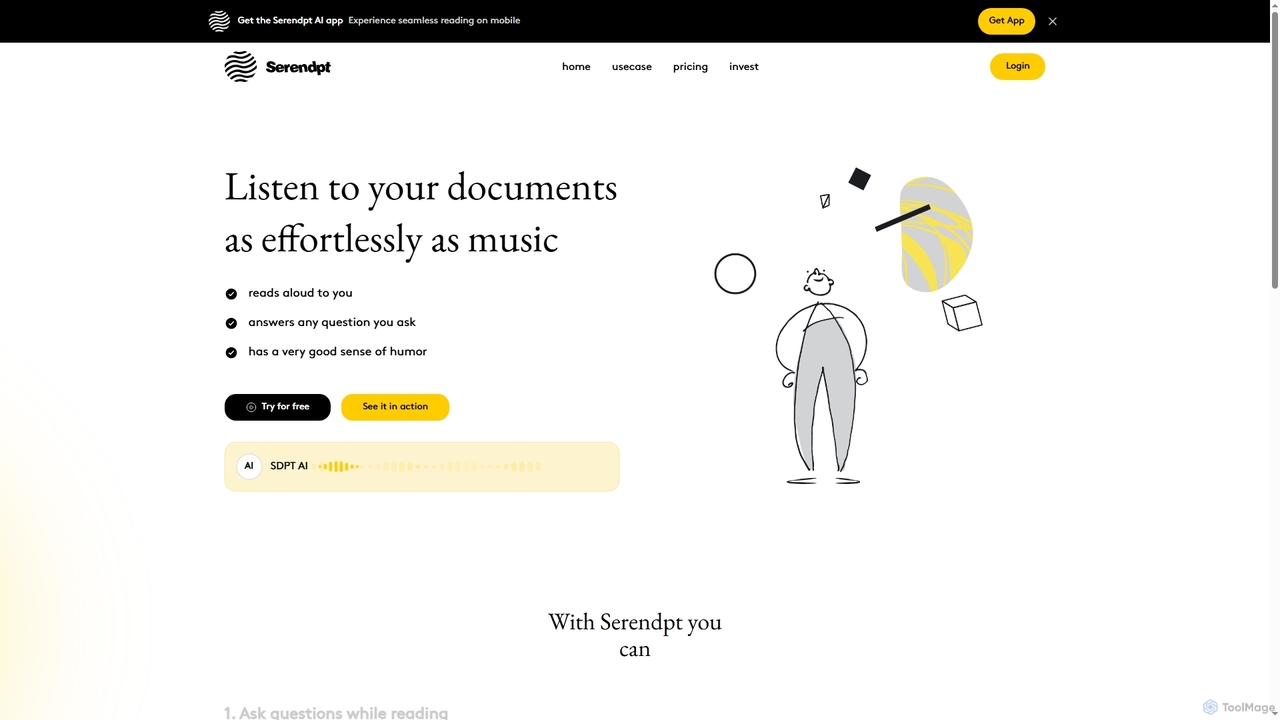
Serendpt AI is an intelligent reading companion that transforms documents and books into interactive experiences. It reads content …
Serendpt AI is an intelligent reading companion that transforms documents and books into interactive experiences. It reads content aloud, answers questions instantly, and offers a personalized tutor mode, all accessible via a mobile app.
About Conversational Ai
Conversational AI refers to advanced AI-powered tools designed to simulate human-like conversations through text or voice. These systems leverage Natural Language Processing (NLP), Natural Language Understanding (NLU), and Natural Language Generation (NLG) to comprehend user intent, maintain context, and generate coherent, relevant responses. They enable highly interactive and personalized user experiences across various digital touchpoints, extending beyond basic query-response to facilitate complex dialogues and task completion.
Core Features
- Contextual Understanding: Interprets the full conversation history and user intent, not just isolated keywords.
- Natural Language Generation: Creates human-like, grammatically correct, and contextually appropriate responses.
- Multi-turn Dialogue Management: Handles complex conversations spanning multiple exchanges, remembering previous interactions.
- Personalization: Adapts responses and recommendations based on user profiles, preferences, and past interactions.
- Sentiment Analysis: Detects and responds appropriately to the emotional tone of user input.
Applicable Scenarios
Conversational AI tools are widely adopted in customer service for automated support and inquiry resolution, enhancing user engagement in marketing, and streamlining internal operations through intelligent virtual assistants. They are crucial for businesses aiming to provide scalable, 24/7 support and personalized digital interactions without human intervention.
How to Choose
When selecting a Conversational AI solution, evaluate its NLP accuracy, ability to integrate with existing systems (CRM, ERP), scalability to handle varying user loads, and customization options for specific industry needs. Consider the ease of training the AI model, supported languages, and the vendor's commitment to ongoing model improvement and security.
Conversational AiUse Cases
Automated Customer Service Agent
For e-commerce businesses or service providers, a Conversational AI system can act as a 24/7 virtual customer service agent. It processes common inquiries about order status, returns, product information, or service details, providing instant, accurate responses without human intervention. This significantly reduces call center volume, improves response times, and enhances customer satisfaction by offering immediate support at any time.
Automating Customer Support Inquiries
Customer service departments utilize conversational AI to handle a high volume of routine inquiries, such as order status checks, FAQ answers, and basic troubleshooting. The AI understands natural language questions, provides instant, accurate responses, and can escalate complex issues to human agents, significantly reducing response times and improving customer satisfaction.
Personalized Sales Assistant
Retail companies can deploy Conversational AI to guide potential customers through product recommendations and purchasing decisions. By understanding user preferences, browsing history, and stated needs, the AI suggests relevant items, answers product-specific questions, compares features, and even assists with the checkout process. This personalized interaction boosts conversion rates, increases average order value, and enhances the overall shopping experience.
Personalized Shopping Assistance
E-commerce platforms deploy conversational AI to guide shoppers through product discovery and purchase decisions. The AI engages users in dialogue about their preferences, recommends suitable products, answers detailed questions about features, and assists with checkout processes, creating a highly personalized and efficient shopping experience.
Internal HR Support Bot
Large enterprises utilize Conversational AI to automate responses to common HR queries from employees. Questions about leave policies, benefits, payroll, or company procedures can be answered instantly and accurately, freeing up HR staff for more complex, strategic tasks. This improves employee experience by providing immediate access to information and significantly reduces administrative overhead for the HR department.
Internal IT Helpdesk Automation
Organizations use conversational AI to power virtual IT helpdesks, allowing employees to get immediate assistance with common technical issues like password resets, software installation guides, or network connectivity problems. This reduces the burden on IT staff and provides employees with instant, self-service support, improving productivity.
Voice-Activated Virtual Assistant
Healthcare providers, banks, or smart home device manufacturers can integrate Conversational AI into voice assistants to offer hands-free interaction. Patients can schedule appointments or get medication reminders, bank customers can check balances, and users can control smart devices. This provides accessible, convenient interaction, enhancing user engagement and operational efficiency, especially for users with accessibility needs.
Interactive Lead Qualification and Nurturing
Marketing and sales teams leverage conversational AI on websites and landing pages to engage visitors, answer initial questions, qualify leads based on predefined criteria, and even schedule follow-up calls. This automates the early stages of the sales funnel, ensuring only high-potential leads are passed to human sales representatives.
Educational Tutoring & Support
Educational platforms and e-learning providers leverage Conversational AI to offer personalized learning support and answer student questions on course material. The AI can explain complex concepts, provide practice questions, offer hints, and guide students through problem-solving steps. This acts as an always-available, patient tutor, enhancing student engagement, comprehension, and academic performance, especially in self-paced learning environments.
Healthcare Patient Engagement
Healthcare providers use conversational AI for tasks like appointment scheduling, medication reminders, answering common health-related questions, and providing pre-visit instructions. These tools offer accessible, confidential, and timely information, improving patient adherence and reducing administrative workload for staff.
Lead Qualification & Nurturing
Marketing and sales teams use Conversational AI on websites, landing pages, or social media to engage visitors, ask qualifying questions, and gather essential lead information. It can then nurture leads by providing relevant content, answering initial queries, or scheduling demos with human sales representatives. This ensures only high-quality, pre-qualified leads reach the sales pipeline, optimizing sales efforts and improving conversion rates.
Educational Tutoring and Language Learning
Educational platforms integrate conversational AI as virtual tutors or language partners. The AI can engage students in practice conversations, provide instant feedback on grammar and pronunciation, answer subject-specific questions, and adapt learning paths based on student performance, offering personalized and scalable learning support.