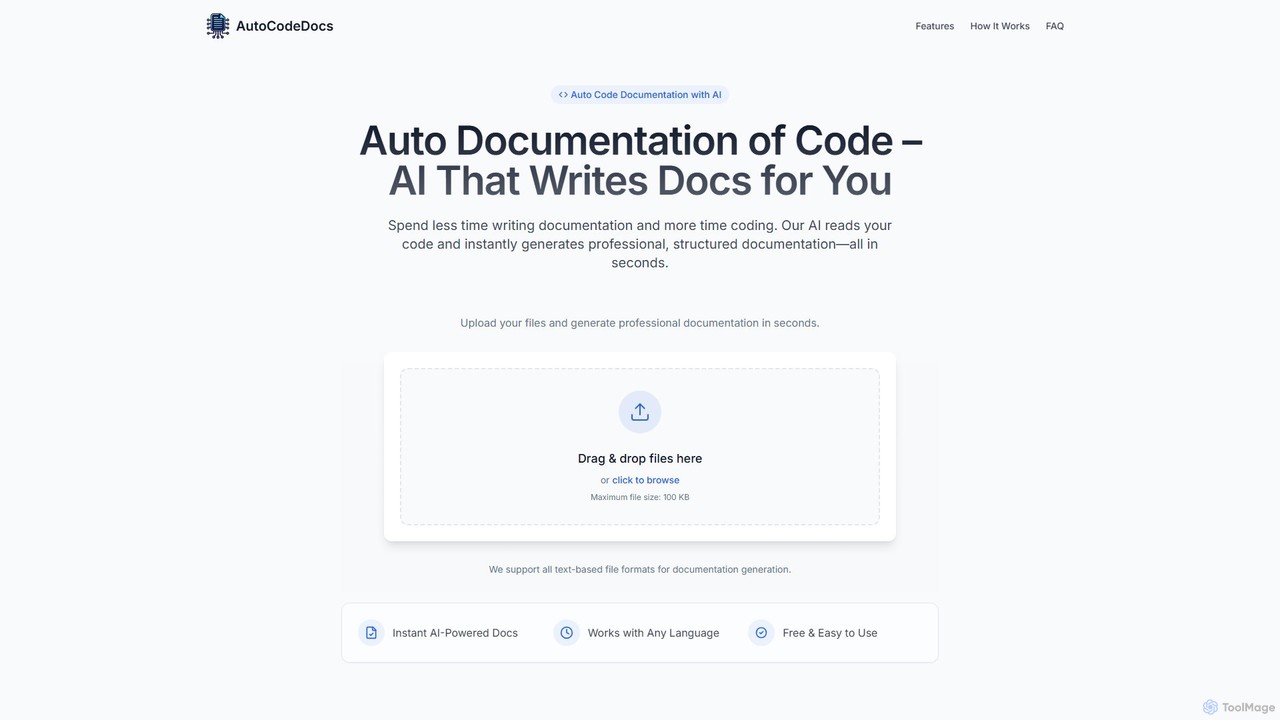
AutoCodeDocs.ai
AutoCodeDocs.ai is an AI-powered tool that automatically generates professional, structured documentation for your code. It supports over 20 …
AutoCodeDocs.ai is an AI-powered tool that automatically generates professional, structured documentation for your code. It supports over 20 programming languages, creating README files, API references, and inline comments in seconds. Simply upload your code files, and the AI will analyze them to produce clear, accurate, and ready-to-use documentation in Markdown format, helping developers save time and improve collaboration.
About Code
AI Code Detection tools are specialized AI-powered solutions designed to identify code snippets or entire programs that have been generated by artificial intelligence models, such as large language models (LLMs). These tools leverage advanced machine learning algorithms and linguistic analysis to distinguish between human-written and AI-generated code patterns. Their primary value lies in ensuring code originality, maintaining security standards, and upholding academic or professional integrity in software development and educational contexts. They help users verify authorship and prevent the unintended introduction of AI-generated vulnerabilities.
Core Features
- AI Authorship Verification: Determines the likelihood of a code segment being generated by an AI model versus a human developer.
- Code Plagiarism Detection: Identifies similarities between submitted code and known AI-generated examples or common patterns.
- Vulnerability Pattern Recognition: Scans AI-generated code for common security flaws or suboptimal practices often associated with automated generation.
- Code Quality Assessment: Evaluates AI-generated code against established coding standards and best practices for maintainability and efficiency.
- Multi-Language Support: Capable of analyzing code across various popular programming languages like Python, Java, C++, and JavaScript.
Applicable Scenarios
These tools are crucial for educational institutions to uphold academic integrity by detecting AI-generated student assignments. Software development teams utilize them to ensure code quality, security, and human oversight in collaborative projects. Additionally, recruitment processes benefit from verifying the authenticity of code submitted during technical assessments.
How to Choose
When selecting an AI Code Detection tool, consider its accuracy in distinguishing human from AI code, its support for the programming languages you use, and its integration capabilities with existing development workflows or learning management systems. Evaluate the tool's reporting features, false positive rates, and its ability to adapt to new AI code generation models.
CodeUse Cases
Academic Integrity Verification in Programming Courses
An educator in a computer science department uses an AI Code Detection tool to scan student programming assignments. By submitting code through the tool, they can identify instances where students might have used AI models to generate solutions, ensuring that submitted work reflects the student's own understanding and effort, thereby upholding academic honesty and fair assessment.
Enhancing Software Supply Chain Security
A software development team integrates AI Code Detection into their CI/CD pipeline. Before merging new code from external contributors or open-source libraries, the tool automatically scans for AI-generated patterns. This helps identify potentially malicious code or vulnerabilities inadvertently introduced by AI, strengthening the overall security posture of their software supply chain and reducing risks.
Maintaining Code Quality and Consistency
During code reviews, a senior developer uses an AI Code Detection tool to flag sections of code that appear to be AI-generated. This helps them identify areas where human oversight might have been minimal, ensuring that all code adheres to established coding standards, maintainability guidelines, and architectural principles, preventing the introduction of inconsistent styles or suboptimal solutions.
Authenticating Code in Technical Hiring Assessments
A hiring manager for a software company uses an AI Code Detection tool to verify the originality of code submitted by candidates during take-home coding challenges or online assessments. This practice helps prevent candidates from using AI assistance to complete tasks, ensuring that the evaluation accurately reflects their individual coding skills and problem-solving abilities, leading to more reliable hiring decisions.
Protecting Intellectual Property in Collaborative Projects
A company working on a proprietary software project uses AI Code Detection to monitor contributions from various team members and external contractors. This helps ensure that no AI-generated code with ambiguous licensing or potential intellectual property conflicts is inadvertently introduced into the codebase. By proactively identifying such instances, the company can maintain clear ownership and avoid future legal complications related to their software assets.
Auditing AI-Assisted Code Refactoring
A development lead uses an AI Code Detection tool to audit code sections that have undergone refactoring with the assistance of AI coding assistants. This helps verify that the AI-generated refactorings align with the project's architectural goals and coding standards, rather than introducing new complexities or deviating from the intended design. It provides an additional layer of quality control for AI-assisted development workflows.