ToolMage
Sign in

Best 2 Tool Directory AI tools for Ai Discovery

Popular Tool Directory AI tools in Ai Discovery include Aiblogfirst and AIDiscoveryBoards, helping you work more efficiently.

Aiblogfirst

Aiblogfirst

Aiblogfirst is a comprehensive platform offering expert insights, unbiased reviews, and practical guides on a wide array of AI tools. It helps individuals and businesses discover, compare, and effectively integrate AI solutions for enhanced productivity, content creation, marketing, and business growth across various domains.

Tool Directory
Visits 19KFavorites 157Likes 167
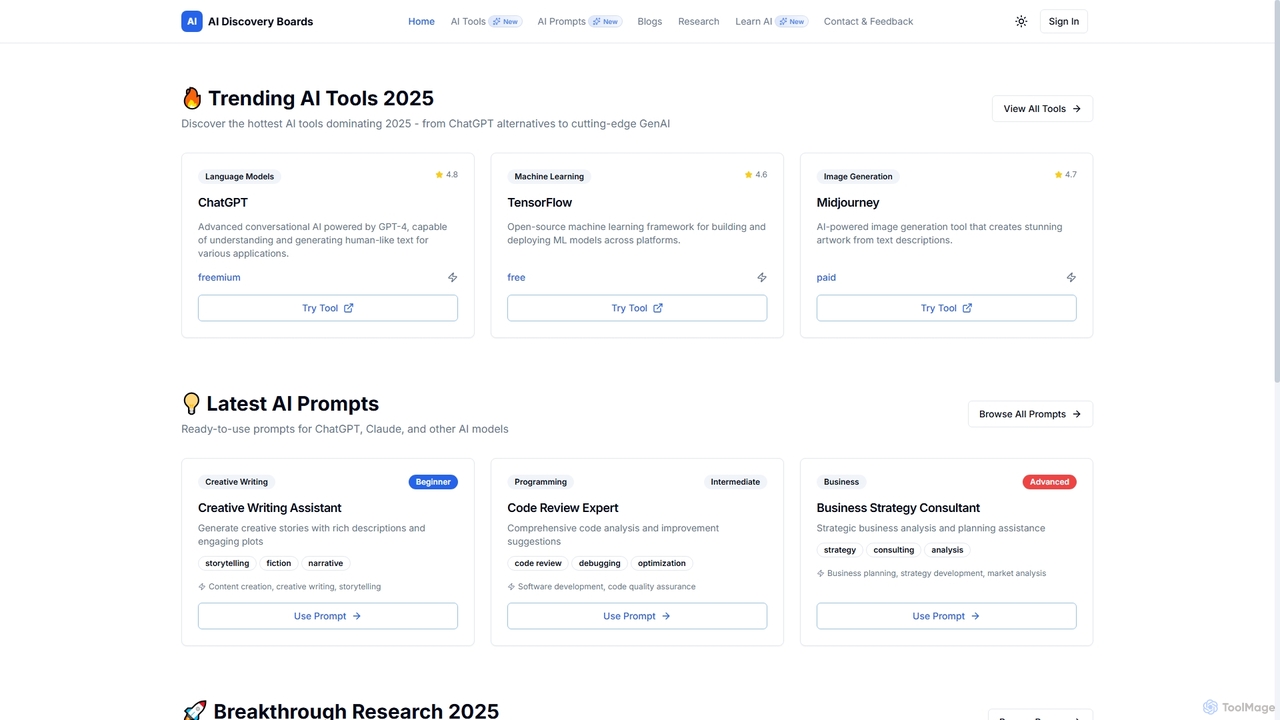
AIDiscoveryBoards

AIDiscoveryBoards

AIDiscoveryBoards is a comprehensive online platform designed to help users discover trending AI tools, explore the latest AI prompts, delve into groundbreaking AI research papers, and access curated AI learning resources. It serves as a central hub for staying updated on the rapidly evolving artificial intelligence landscape.

Tool Directory
Visits 5.6KFavorites 143Likes 140

About Tool Directory

An AI Tool Directory is a specialized online platform that catalogs, categorizes, and reviews a vast array of artificial intelligence tools. As a key component of AI Discovery, these directories function as curated, searchable databases, simplifying the process of finding specific AI solutions. They provide structured information, including features, pricing, and user ratings, to help users compare options efficiently. This centralized approach saves significant time compared to general web searches and offers a reliable way to navigate the rapidly growing AI tool landscape.

Core Features

  • Advanced Search & Filtering: Quickly narrow down options by category, pricing model, key features, and platform compatibility.
  • User Reviews and Ratings: Access community-driven feedback and scores to gauge a tool's real-world performance and reliability.
  • Detailed Tool Profiles: View comprehensive pages for each tool, including in-depth descriptions, screenshots, and official links.
  • Curated Collections: Discover hand-picked lists of top tools for specific tasks, industries, or emerging trends.
  • Side-by-Side Comparison: Evaluate multiple tools simultaneously based on standardized attributes to make informed decisions.

Applicable Scenarios

AI Tool Directories are valuable for a wide range of users. Developers use them to find specific APIs for their projects, marketers search for automation tools for campaigns, and entrepreneurs research competitors. Content creators, researchers, and students also rely on these platforms to stay updated on the latest AI technologies and find the right software for their work.

Selection Criteria

When choosing an AI Tool Directory, consider its comprehensiveness and how frequently it's updated with new tools. Evaluate the quality of its search and filtering capabilities for relevance and accuracy. The depth of information in tool profiles and the authenticity of user reviews are also crucial. Finally, assess the overall user experience, including site navigation and the quality of curated content.


Tool Directory use cases

1

Find the Right AI Tool for a Specific Task

A marketing manager needs an AI-powered copywriting tool to generate social media posts. Instead of using a general search engine, they turn to an AI Tool Directory. They filter by 'Copywriting', 'Social Media', and 'Free Trial'. The directory returns a focused list of 10 relevant tools. By reading user reviews and comparing features side-by-side, the manager quickly identifies the top three candidates to test, saving hours of research and ensuring they find a tool that fits their exact workflow and budget.

2

Research Competitors and Market Gaps

An entrepreneur is planning to build a new AI-powered project management tool. They use an AI Tool Directory to conduct market research. By searching for 'Project Management' and analyzing the top-rated tools, they can identify common features, popular pricing models, and read user reviews to understand customer pain points with existing solutions. This process helps them spot a gap in the market for a tool with a unique feature, such as AI-driven task prioritization, giving their startup a competitive edge from the start.

3

Discover New APIs for Software Development

A software developer is building an application that requires natural language processing (NLP) capabilities. They access an AI Tool Directory and navigate to the 'API' section, then filter by 'NLP'. The directory provides a list of available APIs, complete with links to documentation, pricing tiers, and developer reviews. This allows the developer to quickly compare options like OpenAI's GPT, Google's Gemini, and smaller, specialized NLP APIs, ultimately selecting the one with the best performance and cost-effectiveness for their specific use case.

4

Stay Updated on the Latest AI Trends

A technology journalist and content creator focuses on the AI industry. To find fresh topics for their articles and videos, they regularly browse the 'Newly Added' and 'Trending' sections of a major AI Tool Directory. This allows them to discover emerging tools before they become mainstream. They can identify new trends, such as the rise of AI agents or real-time voice translation tools, providing their audience with cutting-edge content and solidifying their reputation as an industry expert.

5

Build a Technology Stack for a New Business

A small business owner is setting up their operations and wants to leverage AI to maximize efficiency. They use an AI Tool Directory to build their technology stack. They search for categories like 'CRM', 'Email Marketing', and 'Customer Support'. For each category, they find AI-enhanced tools, compare their integration capabilities (e.g., does the CRM integrate with the email tool?), and check pricing. This structured approach allows them to select a cohesive set of tools that work well together, creating an efficient, automated workflow from day one.

6

Curate Resources for Educational Purposes

A university professor teaching a course on 'AI in Business' uses an AI Tool Directory to create a resource list for students. They compile a curated collection of tools for different business functions like marketing, finance, and HR. By sharing this list, students can explore real-world applications of AI, understand the current market landscape, and even use some of the free tools for their projects. The directory acts as a dynamic, up-to-date textbook, providing practical examples that go beyond theoretical concepts.

Tool Directory FAQ

What is an AI Tool Directory?

An AI Tool Directory is a curated online database that lists, categorizes, and provides detailed information about various artificial intelligence tools. Unlike a general search engine, it offers a structured environment specifically for discovering and comparing AI software. Key features typically include advanced search filters, user reviews, side-by-side comparisons, and collections organized by task or industry. They serve as a central hub for professionals, developers, and enthusiasts to navigate the complex AI landscape efficiently.

How does an AI Tool Directory differ from a standard search engine?

An AI Tool Directory offers several advantages over a standard search engine like Google for finding AI tools. The key differences are:

  • Curation and Structure: Directories are curated by experts, ensuring listed tools are relevant and categorized correctly. Search engines provide raw, algorithm-based results that can be overwhelming.
  • Rich, Standardized Data: Directories present information like pricing, features, and integrations in a consistent format, making comparison easy.
  • Advanced Filtering: You can filter results by specific criteria (e.g., 'free trial', 'API access') that are not available in general search.
  • Community Context: They often include user ratings and reviews, providing real-world insights that search engines lack.

In short, a directory is a specialized discovery tool, while a search engine is a general information retrieval tool.

What key features should I look for in an AI Tool Directory?

When evaluating an AI Tool Directory, focus on features that enhance discovery and decision-making. Look for:

  • Comprehensive Coverage: A large and constantly updated database of tools across many categories.
  • Powerful Search and Filtering: The ability to quickly narrow down choices based on specific needs like features, pricing, and integrations.
  • Authentic User Reviews: A system for genuine user feedback and ratings to gauge real-world performance.
  • Detailed Information: Clear, concise, and accurate profiles for each tool.
  • Intuitive User Interface: A clean, easy-to-navigate design that makes finding and comparing tools straightforward.
  • High-Quality Curation: Helpful collections, articles, or guides that highlight top tools for specific use cases.
Who benefits most from using an AI Tool Directory?

A wide range of individuals and organizations can benefit from using an AI Tool Directory. Key user groups include:

  • Business Professionals & Marketers: To find tools for automation, data analysis, and content creation that improve efficiency and campaign results.
  • Developers & Engineers: To discover APIs and platforms that can be integrated into their own software and projects.
  • Entrepreneurs & Startups: For conducting market research, analyzing competitors, and building a cost-effective technology stack.
  • Content Creators & Creatives: To find AI-powered tools for writing, image generation, video editing, and more.
  • Students & Researchers: To explore the practical applications of AI and stay current with the latest technologies in the field.
How can I trust the reviews and ratings in a Tool Directory?

Trustworthiness is crucial for a tool directory. Reputable directories employ several methods to ensure the authenticity of reviews and ratings. Look for platforms that have a verification process for reviewers, such as requiring a login via a professional network like LinkedIn or a company email. They may also use algorithms to detect and flag suspicious or spammy reviews. Additionally, directories that foster an active community often have more reliable feedback, as engaged users are more likely to provide thoughtful and balanced critiques. Always consider the volume and recency of reviews, as a tool with hundreds of recent, detailed reviews is generally more trustworthy than one with only a few old, generic comments.