Aihairtransplant
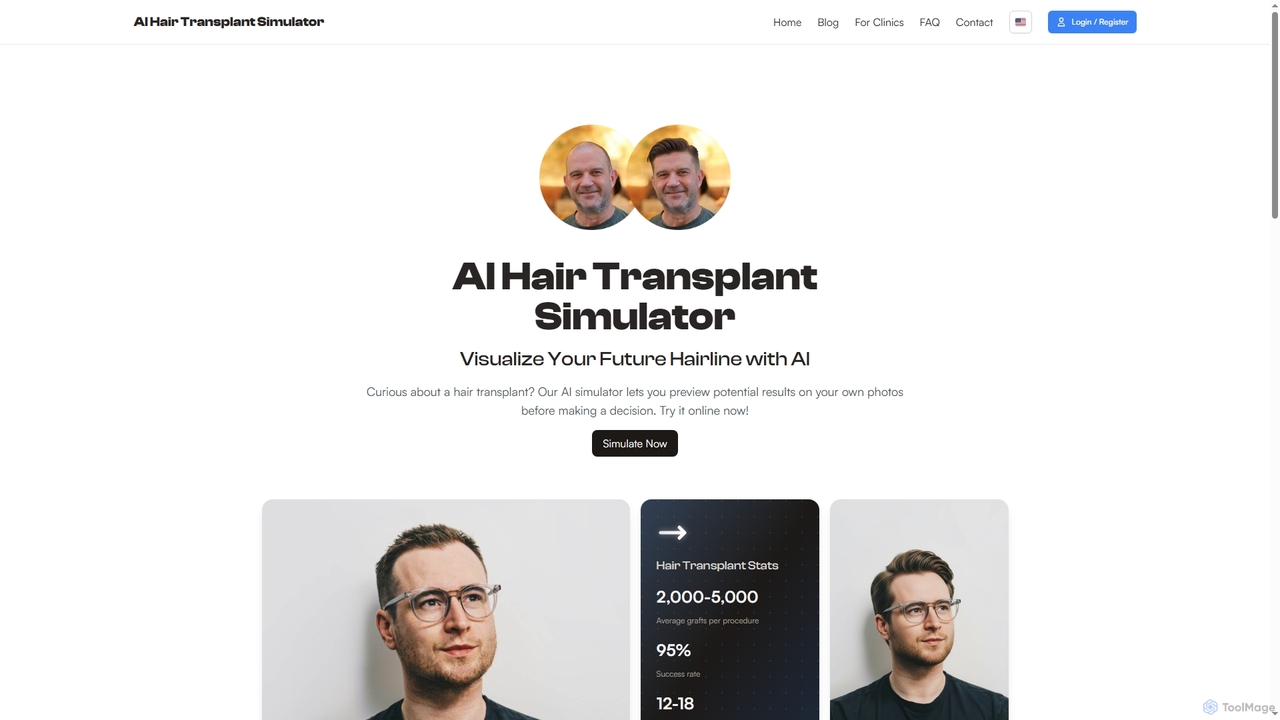
Aihairtransplant is an AI-powered simulator that allows individuals to visualize potential hair transplant results on their own photos. …
Aihairtransplant is an AI-powered simulator that allows individuals to visualize potential hair transplant results on their own photos. It also offers a robust solution for hair transplant clinics to engage website visitors, capture qualified leads, and convert them into consultation bookings by integrating the simulator directly onto their sites.
About Simulation
AI Simulation tools are a specialized category within AI Imaging, designed to create, run, and analyze virtual models of real-world systems or processes. Leveraging advanced AI algorithms, these tools can predict outcomes, optimize designs, and test scenarios without physical constraints. They provide invaluable insights for research, development, and strategic planning across various industries, enabling faster iteration and risk reduction.
Core Features
- Predictive Modeling: Develops and runs models to forecast system behavior and outcomes under different conditions.
- Virtual Prototyping: Creates digital twins or virtual versions of products and systems for testing and validation.
- Scenario Analysis: Explores a multitude of 'what-if' scenarios to understand potential impacts and optimize decisions.
- Data-Driven Optimization: Uses AI to analyze simulation results and suggest improvements for efficiency, performance, or cost.
- Interactive Visualization: Renders complex simulation data into intuitive visual formats for easier interpretation and collaboration.
Use Cases
AI Simulation tools are crucial for engineers validating new designs, urban planners optimizing traffic flow, and financial analysts forecasting market trends. They allow for the safe and cost-effective exploration of complex systems, from molecular interactions to global supply chains, before real-world implementation.
How to Choose
When selecting an AI Simulation tool, consider the accuracy and fidelity of its modeling capabilities, its integration with existing design and data platforms, and the scalability to handle complex datasets. Evaluate the user interface for ease of model creation and analysis, and assess the level of customization and support available for your specific industry needs.

SimulationUse Cases
Simulating Product Performance for Engineering Design
Engineers in manufacturing use AI simulation to test new product designs under various stress conditions, such as extreme temperatures, pressure, or fatigue. By creating a digital twin, they can predict material behavior, structural integrity, and potential failure points before physical prototyping, significantly reducing development costs and accelerating time-to-market for complex machinery or consumer electronics.
Optimizing Urban Planning and Traffic Flow
City planners and urban developers utilize AI simulation to model complex urban environments, including traffic patterns, pedestrian movement, and public transport networks. They can test the impact of new infrastructure projects, road closures, or public event layouts on congestion and accessibility, enabling data-driven decisions to improve urban mobility and reduce environmental impact.
Forecasting Financial Market Behavior
Financial analysts and traders employ AI simulation to model market dynamics, predict stock price movements, and test investment strategies under various economic conditions. By simulating thousands of market scenarios, they can assess risk, optimize portfolio allocations, and identify profitable trading opportunities with greater accuracy than traditional methods, enhancing decision-making in volatile markets.
Training Autonomous Systems in Virtual Environments
Developers of autonomous vehicles, robotics, and drones use AI simulation to train and test their systems in safe, controlled virtual environments. This allows for the rapid iteration of algorithms, sensor configurations, and decision-making processes under diverse and challenging conditions (e.g., extreme weather, complex obstacles) without the risks and costs associated with real-world testing, accelerating development cycles.
Optimizing Supply Chain Logistics and Operations
Logistics managers and supply chain analysts leverage AI simulation to model complex global supply networks, warehouse operations, and transportation routes. They can test the impact of disruptions (e.g., port closures, material shortages), evaluate new distribution strategies, and optimize inventory levels to improve efficiency, reduce costs, and enhance resilience against unforeseen events.
Designing and Testing Pharmaceutical Drugs
Researchers in the pharmaceutical industry use AI simulation to model molecular interactions, predict drug efficacy, and simulate clinical trials. This allows them to screen potential drug candidates more efficiently, understand their mechanisms of action, and optimize dosages in a virtual environment, significantly accelerating the drug discovery and development process while reducing the need for costly and time-consuming physical experiments.