Oso
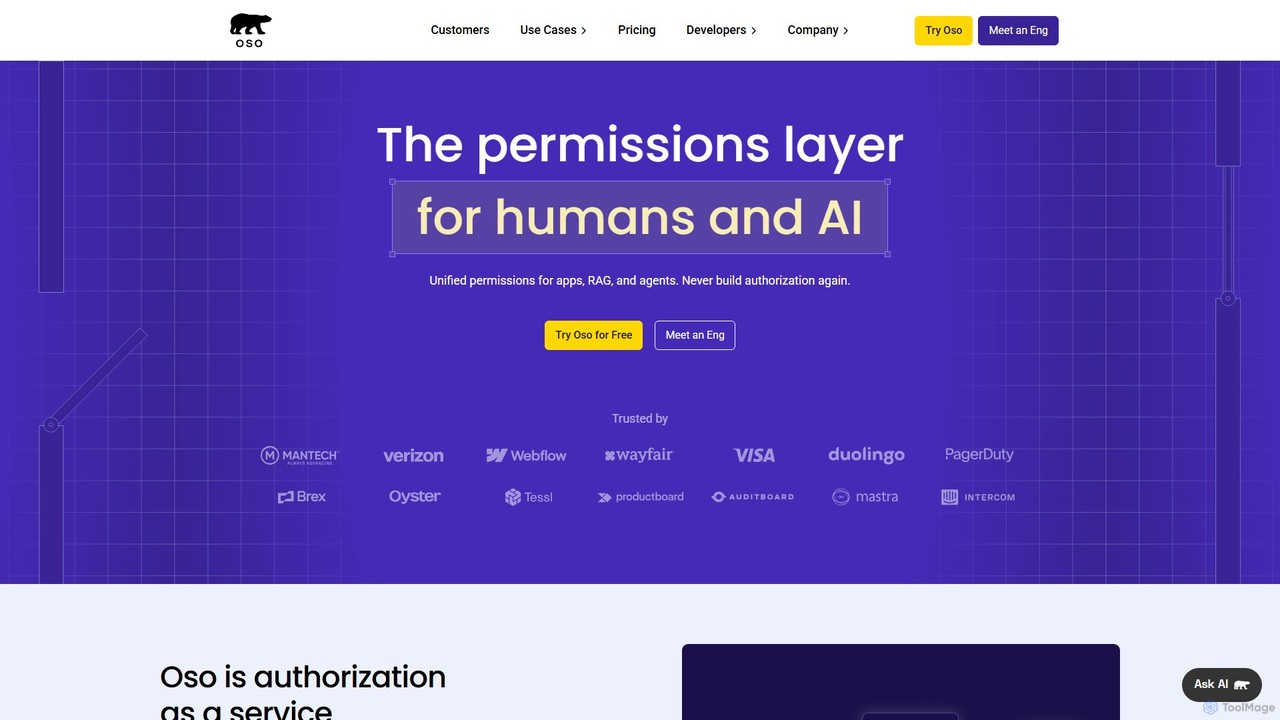
Oso is an Authorization as a Service platform for developers. It simplifies the implementation of complex access control …
Oso is an Authorization as a Service platform for developers. It simplifies the implementation of complex access control logic like RBAC, ReBAC, and ABAC. Using its declarative policy language, Polar, engineering teams can quickly build and enforce fine-grained permissions for any application, including modern AI-native apps with agentic workflows and RAG systems, accelerating development and enhancing security.
Pangea
Pangea is a developer-first platform offering a suite of API-based security services. It provides essential security guardrails for …
Pangea is a developer-first platform offering a suite of API-based security services. It provides essential security guardrails for web and AI applications, enabling developers to easily embed features like secure audit logging, data redaction, threat intelligence, and authentication. Pangea is designed to accelerate development while ensuring applications are secure and compliant from the start.
About Security
AI Security tools are AI-powered solutions designed to protect artificial intelligence systems, data, and infrastructure from evolving cyber threats and AI-specific vulnerabilities. Leveraging advanced machine learning, behavioral analytics, and natural language processing, these tools proactively identify anomalies, predict potential attacks, and automate response mechanisms. They are crucial for safeguarding sensitive data, maintaining model integrity against adversarial manipulation, and ensuring the trustworthiness, resilience, and compliance of AI deployments across various industries, from finance to autonomous systems.
Core Features
- Adversarial Attack Defense: Protects AI models from sophisticated malicious inputs (e.g., data poisoning, evasion attacks) designed to manipulate or degrade their performance and decision-making.
- Threat Detection & Prediction: Utilizes AI to identify and predict sophisticated cyber threats, including zero-day exploits, advanced phishing campaigns, and insider threats, with enhanced accuracy and speed.
- Data Privacy & Compliance: Ensures sensitive data used by AI systems, both in training and inference, adheres to stringent privacy regulations (like GDPR, HIPAA) and internal organizational policies.
- Vulnerability Management: Automatically scans, identifies, and helps remediate security weaknesses and misconfigurations within AI models, their training pipelines, and underlying infrastructure components.
- Automated Incident Response: Triggers rapid, AI-driven actions to contain, mitigate, and recover from security incidents in real-time, minimizing potential damage and operational downtime.
Applicable Scenarios
AI Security tools are indispensable across diverse sectors. In financial services, they detect fraudulent transactions and secure AI-driven trading algorithms. Healthcare providers use them to protect patient data processed by diagnostic AI and ensure compliance with privacy laws. For technology companies, these tools are vital for securing AI-powered applications, cloud-based AI infrastructure, and protecting proprietary machine learning models from intellectual property theft and adversarial attacks. They enable organizations to confidently deploy AI, knowing their systems are resilient against a wide array of threats.
How to Choose
When selecting AI Security tools, prioritize solutions that offer comprehensive protection against both traditional cyber threats and AI-specific adversarial attacks, such as model poisoning and data evasion. Evaluate their integration capabilities with your existing AI development and security operations (SecOps) ecosystems, ensuring seamless workflow automation. Consider the tool's performance in terms of detection accuracy and false positive rates, its support for relevant data privacy regulations, and its scalability to effectively manage growing data volumes and complex AI infrastructure. Robust reporting and analytics features are also key for continuous improvement.

SecurityUse Cases
Protecting AI Models from Adversarial Attacks
AI researchers and machine learning engineers utilize AI Security tools to fortify their models against adversarial examples. By integrating these tools into the model development lifecycle, they can automatically detect and neutralize malicious inputs designed to trick or degrade AI performance, ensuring the reliability of critical systems like autonomous driving or facial recognition. This proactive defense prevents costly errors and maintains public trust in AI applications.
Automated Detection of Advanced Cyber Threats
Security operations centers (SOCs) leverage AI Security tools to enhance their threat detection capabilities. These tools analyze vast amounts of network traffic, system logs, and user behavior data to identify subtle anomalies indicative of sophisticated cyberattacks, including zero-day exploits, ransomware, and advanced persistent threats. This automation significantly reduces the time to detect and respond to breaches, minimizing potential damage and operational disruption.
Ensuring Data Privacy in AI Training Pipelines
Data scientists and compliance officers employ AI Security solutions to ensure the privacy and regulatory compliance of sensitive data used in AI model training. These tools can identify and redact personally identifiable information (PII), enforce access controls, and monitor data usage to prevent unauthorized exposure. This is critical for industries like healthcare and finance, where strict adherence to regulations like GDPR and HIPAA is mandatory.
Securing Cloud-Native AI Infrastructure
DevOps and cloud security teams use AI Security tools to protect their dynamic, cloud-native AI infrastructure. These tools provide continuous monitoring of cloud configurations, container security, and API endpoints, identifying vulnerabilities and misconfigurations that could expose AI services. They automate security policy enforcement and provide real-time alerts, ensuring a secure foundation for scalable AI deployments.
Real-time Fraud Detection in Financial Transactions
Financial institutions deploy AI Security tools to combat sophisticated financial fraud. By analyzing transaction patterns, user behavior, and historical data in real-time, these AI-powered systems can detect highly complex and rapidly evolving fraud schemes that traditional rule-based systems might miss. This leads to a significant reduction in financial losses and enhances customer trust by preventing unauthorized activities.
Vulnerability Scanning and Remediation for AI Applications
Application security teams integrate AI Security tools into their CI/CD pipelines to continuously scan AI-powered applications for vulnerabilities. These tools can identify weaknesses in code, dependencies, and model configurations, providing actionable insights for remediation. This proactive approach ensures that AI applications are developed and deployed with security built-in, reducing the attack surface and improving overall software integrity.